
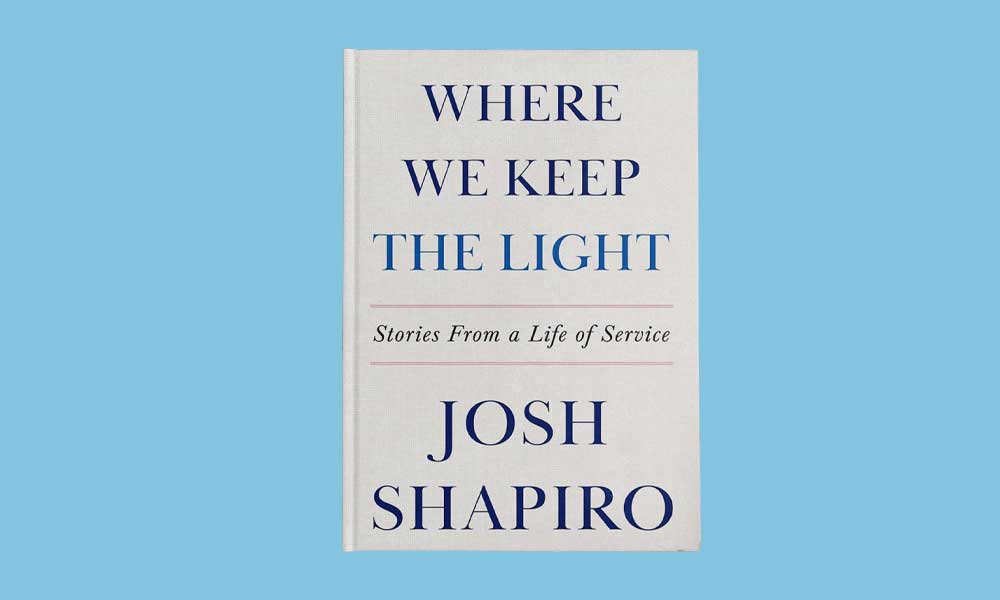
Where We Keep the Light: Stories From a Life of Service
By Josh Shapiro
Harper, 260 pp.
I sometimes imagine owning a set of floor-to-ceiling bookshelves filled with books by presidents, past presidents and would-be presidents. I picture it whenever, as now, a new wave of campaign biographies starts to roll in.
At the center of its eye-level shelf, impossible to miss, I would place The Personal Memoirs of U.S. Grant, a 19th-century blockbuster written after Ulysses S. Grant’s presidency, his bankruptcy and the onset of his terminal illness. Grant wrote it with the explicit aim of making enough money to support his wife Julia once he succumbed to cancer.
It did, and deservedly so. Grant’s book is a great read, if only for his regretful recollections of the Mexican War; he is a battlefield hero who regards the war as an unjust land grab by slave states out to bolster their numbers. That war set the stage for the Civil War and Grant’s command of the Union Army, which made him famous and, more important, president.
Somewhere close to Grant’s magnum opus, I would place Barack Obama’s Dreams from My Father, published when the author was an Illinois state senator. It is a young man’s story of trying to make sense of the legacy his long-absent and then deceased Kenyan father had left him: the color of his skin and, if such things are heritable, an intellect and curiosity that matched his mother’s. Obama’s search for his roots underscored his youth and sense of purpose: He was not ready to make history until he understood his own. Being the son of a divorced mother also linked him with his times: In the second half of the 20th century the share of American children with single, separated or divorced parents multiplied from less than 2 percent to nearly a quarter. A remote absentee father was a common figure.
With an open race for the White House awaiting us in 2028, how will the new wave of campaign autobiographies fit into this mixed stack of self-examiners and self-promoters?
While we’re on the subject of fragmented families, JD Vance—although not yet a presidential candidate—probably deserves some shelf space for struggling, in Hillbilly Elegy, to disentangle his own identity from the Appalachian white working-class culture into which he was born, one that he grew up to blame for many social maladies.
Other volumes, shelved nearby, are less willing to lay bare their authors’ human failings. John F. Kennedy’s Profiles in Courage was a series of stories about senators who had demonstrated the courage of their convictions in politics, often crossing their party’s leadership. By celebrating Senate votes as acts of courage, the book reminded readers, many of them WWII veterans, of Kennedy’s own act of physical courage at sea. The book won a Pulitzer Prize, although today his ghostwriter, Ted Sorensen, is credited with doing much of the work. By contrast, Al Gore was proud to say that Earth in the Balance, his study of climate change, was written by him, not a ghostwriter. It established Gore’s identity as the leading Green Democrat of his day, a fact that resonated with the baby boom generation.


I would probably set aside an entire shelf for the works of Theodore Roosevelt, who, in his twenties, when the country was debating the advisability of America becoming an imperial power, wrote a history of the Naval War of 1812. TR kept on writing and publishing till his death. He even returned to the naval history later to add a chapter on the Battle of New Orleans, contending that Andrew Jackson was the only impressive commander of American ground troops in the entire conflict.
Jimmy Carter produced a standard campaign autobiography, introducing himself to voters beyond his native Georgia. The clever title Why Not the Best? actually referred to a question in his job interview with Admiral Hyman Rickover, father of the nuclear navy. When asked if he always did his best, Carter conceded that he did not. To which Rickover asked, “Why not?” For candidate Carter, the ambiguity proved useful.
Post-presidency, Carter went on to publish several more books, including a volume of poetry. His candor about the depth of his Christian faith and his belief in good works (which he pursued for decades after leaving office) was a moral tonic for a country still reeling from the Watergate scandals of Richard Nixon. Nixon, for his part, wrote books before his presidency and several after his forced resignation, in what proved a successful campaign to regain respectability in policymaking circles.
So, with an open race for the White House awaiting us in 2028, how will the new wave of campaign autobiographies fit into this mixed stack of self-examiners and self-promoters? Among the first to pitch himself to us in print is Pennsylvania’s Democratic Governor Josh Shapiro, an interesting potential candidate for three reasons. First, he is from a swing state, vital to the Democratic Party’s chances. Second, he is a centrist who stresses throughout the book the virtues of listening to people who might not vote for you and seeking practical solutions to political problems with Republicans. This is a potential approach for his party: Attract independents and disaffected Republicans with a pragmatic centrism while the Republicans proceed to make America their version of “even greater.” And third, Josh Shapiro is Jewish, at a time when American antisemitism is reported to be at its highest in decades.
His book, Where We Keep the Light, underscores that fact. It starts when an arsonist firebombed the governor’s residence in Harrisburg, late at night, after the first Passover seder of 2025. The arsonist, who is now serving 25 to 50 years, was by his mother’s account suffering from schizophrenia and bipolar disease and had gone off his meds. The DA said the man expressed some connection between his potentially murderous attack and the war in Gaza.
Shapiro gets to his Judaism very quickly. Throughout his career as a state legislator, county commissioner, attorney general and governor, he has attached great importance to Shabbat dinner every week with his family. They are Conservative Jews who keep kosher. His children attend the same Jewish day school just outside Philadelphia that he and his wife Lori attended. They met in ninth grade and, but for a period of a few years, have been together ever since. In high school he spent five months in Israel, including some time on an Israeli Army base. Of being in Israel, he writes, “It really connected me to my faith. In Israel, it was just everywhere. It was the first time I could feel faith. I could see it and touch it and it wasn’t abstract.” On a later trip to Israel, with Lori, he proposed.
The newsworthy bit in the book that leaked before publication involved his vetting by the Kamala Harris campaign while being considered for the spot of running mate. During the process, he recalls in the book, his interviewers asked, “Have you ever been an agent of the Israeli government…or communicated with an undercover agent of Israel?” He recalls replying that he found the question about being an Israeli agent “offensive” and, as for contact with Israeli undercover agents, he says he responded, “If they were undercover…how the hell would I know?”
Shortly after that exchange (he would say not because of it) Shapiro withdrew from consideration, having realized, he says, the politically servile role the Harris campaign had in mind for its vice president.
The media attention that was lavished on these exchanges about Israel makes for a misleading guide to this campaign autobiography.
Shapiro’s views on foreign policy don’t figure all that much.
Nor, for that matter, do his views on domestic policy. This is probably wise, as policy positions and issues tend to be fickle forecasters of what presidents actually confront in office. I remember being in the car with my father listening to the Kennedy-Nixon debate and acquiring the dubious wisdom that the 1960 presidential race was really about the fate of Quemoy and Matsu. (I leave the elaboration to Wikipedia.)
Shapiro’s book is really about his sense of his own character. He emerges as a middle-class suburban Everyman, a pediatrician’s son, a husband who’s in love with his wife who is also his confidante. He adores his children, and after practicing the nitty-gritty of politics—ringing doorbells, making deals—loves no activity quite so much as shooting hoops or coaching his kids’ basketball teams (he was cut from his own college team). Of his motive for entering politics, he writes, “My calling was to serve in a way where I could still be a great father and husband, to serve in a way where I could be impactful and actually get shit done.”
He relates some things he got done: releasing a massive document detailing the Catholic Church’s failure to act on allegations of clerical sexual abuse; dissuading a Pittsburgh health care and insurance company from blocking hospital access for patients insured by a rival; joining Barack Obama’s working group on health care reform, which toiled away at what would become the Affordable Care Act.
He is a great admirer of Obama and was one of those Jewish Democrats who came to Obama’s defense when his support for Israel was questioned. He does not mention a college newspaper story he wrote questioning the possibility of peace in the Middle East (the stuff of opposition research) but has evolved into a pro-Israel, anti-Netanyahu supporter of a two-state solution. As if to counter suspicions that his religiosity might conceal a moral insularity, he writes of his close friend, and still closer adviser, the person with whom he talks through political and moral dilemmas: Pastor Marshall Mitchell, a Black Baptist minister with a Jewish grandfather.
Shapiro’s book, and the run for the White House that is implicit in its appearance, raise interesting questions about the state of the electorate. His success at dealing with Republicans in a deeply divided state will no doubt cause him to be rejected in some progressive circles as Biden redux, a leader who supports a centrist legislative agenda when the country is burning. Is this what Democratic primary voters will want in 2028? His family life (one marriage, four kids, decades of services on Saturday morning) seems almost too serene for the 21st century. Does his religion resonate with an America where Gallup has documented “steep declines in U.S. religiosity in recent decades”? Would today’s electorate, with its many conservative nationalists, be as welcoming to him as voters in 2000 were to Joe Lieberman?
In his story of himself, Shapiro does not experience a great, illuminating or testing moment. As a schoolboy he was moved by the plight of Soviet Jews denied the freedom to leave their country. He campaigned for the freedom of one in particular who ended up in New York City and is now a professor of mathematics at CUNY and an Orthodox rabbi.
His own college years at the University of Rochester are a familiar clash of adolescent ambitions (medical school, varsity basketball) with the reality of rigorous science courses and athletic recruitment at even strong academic Division III colleges. The most memorable passage in the book is Shapiro’s meditation on the importance of light as “the central, definitive metaphor” of the Jewish faith, from the first order of creation to yahrzeit candles and all the lights that burn in between: Shabbat and holiday candles, the Burning Bush, the Eternal Flame. The occasion for this meditation is the arsonist’s devastation in Harrisburg last Pesach and the hate-fueled damage that fire had visited on the Governor’s residence:
“With the realities of what had happened and what it meant for the state of the American political climate, it could have been so easy to descend into darkness. That tensions are so high, divides so great, norms so shattered, and communities so disconnected, that this is how we act. But this wasn’t how we’d look at this. We don’t look toward the darkness. I knew that we would find meaning from the fire. I knew that we would lean on our faith and our community even more as our way through. I knew that after everything, that’s where we keep the light.”
Not bad. Not destined for Grant’s shelf perhaps, but a reasonable, readable work of self-introduction.
Robert Siegel is Moment’s special literary contributor.
Moment Magazine participates in the Amazon Associates program and earns money from qualifying purchases.