
Ask anyone to name one word in Hebrew. The response, most likely, will be “shalom.” Jews will almost certainly know that shalom means “peace” and will therefore equate it with the idea of hope.
Not so in today’s Israel, where shalom once expressed a top political objective and a cherished cultural value—and was marketed internationally as a core of the national ethos. For the past two decades, with the devaluation of political peace in Israeli society, the word shalom has all but vanished from political discourse. For many Israelis, if not most, the notion of an accord with a sovereign Palestinian entity in the West Bank means mortal risk, not peace.
During the first 50 years of Israel’s existence, shalom became such a cherished, almost sacred super-value of Jewish culture and Israeli political and popular culture that it verged on becoming a cliché. Popular songs, like Naomi Shemer’s “Machar” (“Tomorrow”), put forward a utopian vision of peace between Israel and its neighbors, while in the 1960s and 1970s, when Israelis landed back at Lod Airport after traveling abroad, they used to sing “Heveinu shalom aleichem” (“we are bringing peace upon you”). Meanwhile, governments often used shalom as a propaganda tool to distract from Israel’s belligerent image, particularly overseas. (Just about any speech to the UN by an Israeli leader will include “Our hand is extended in peace toward our neighbors,” or something similar.)


In 1972, on my first visit to the United States, an AIPAC lay leader gave me two buttons. One said Israel Is Real and the other said Shalom Means Peace. As a 12-year-old, I understood the second button’s message as a shorthand for Israelis’ deep yearning for safety and harmony.
A year later, the shock of the Yom Kippur War gave birth to a movement that excoriated the political and military establishment for failing to pursue peace.
I became a staunch supporter of the so-called peace camp. Our hymn was “Shir LaShalom” (“Song for Peace”), originally sung by one of Israel’s military musical troupes in 1969 and influenced by 1960s American antiwar songs.
Shalom shares a Hebrew root with “shalem,” which means “whole” and denotes completeness or perfection, both physical and spiritual, as well as total peacefulness in relationships between individuals and collectives. Shalom appears in the Bible more than 200 times in various positive meanings, ranging from calm to well-being, security and, of course, the opposite of war. Shalom is also one of the biblical names of God.
Modern Hebrew, inspired by a biblical formulation, adopted shalom as a greeting—both for hello and farewell. At a Knesset celebration of the Hebrew language 20 years ago, then-prime minister Ariel Sharon lamented the use of foreign words like “bye” instead of “the beautiful word shalom.”
Sharon’s lamentation was somewhat ironic. Because ditching shalom as a greeting in favor of non-Hebrew terms was a matter of stylish slang, whereas abandoning shalom as a term for a viable political scenario was an expression of the shift in the national zeitgeist that had been gaining momentum for over 25 years. And at the time, Sharon himself, more than any Israeli politician, was responsible for that shift.
He and his aides made a point of avoiding the term “peace” and certainly a path that would lead to peace, and opted instead for unilateral terms such as “disengagement,” “realignment,” “convergence” or “departure.”
“Israelis have always been skeptical of the possibility of a full ‘warm’ peace with their neighbors,” says Yossi Alpher, a longtime Israeli strategic analyst and the author of No End of Conflict: Rethinking Israel-Palestine. Skepticism notwithstanding, they insisted on striving for it. When Israel negotiated its first and most important peace treaty with Egypt, Israeli leaders demanded that the Arabic term for peace used in the treaty would be sulh, which implies not only cessation of war but also social and cultural reconciliation. The Egyptians, however, insisted on using the Arabic term salam, which implies a formal state of peace (end of war, diplomatic relations but no comprehensive people-to-people normalization).
What has changed, says Hagit Ofran of Shalom Achshav (Peace Now), is “the notion that yearning for peace—any kind of peace—is unrealistic, naïve, pie in the sky.” This devaluation of the term and concept of shalom was an unintended consequence of the Oslo Agreements of 1993, which were envisioned as a path toward Israeli-Palestinian peace. When radical Palestinian organizations opposed to that vision launched a series of deadly terrorist attacks in the mid-1990s, opponents of Oslo on the Israeli right referred to casualties of these attacks as “korbanot Hashalom” (“victims of peace”), further tarnishing the word shalom in the eyes of the public.
Then, according to Alpher, came a major blow to the already devalued shalom: The second intifada erupted in October of 2000 as Israeli-Palestinian peace talks collapsed and put Israelis and Palestinians on a long and bloody course of conflict. While several rounds of negotiations brought Israelis and Palestinians close to a final-status political settlement formula under then-Prime Minister Ehud Olmert, they did not open a path for shalom to return back into the national discourse.
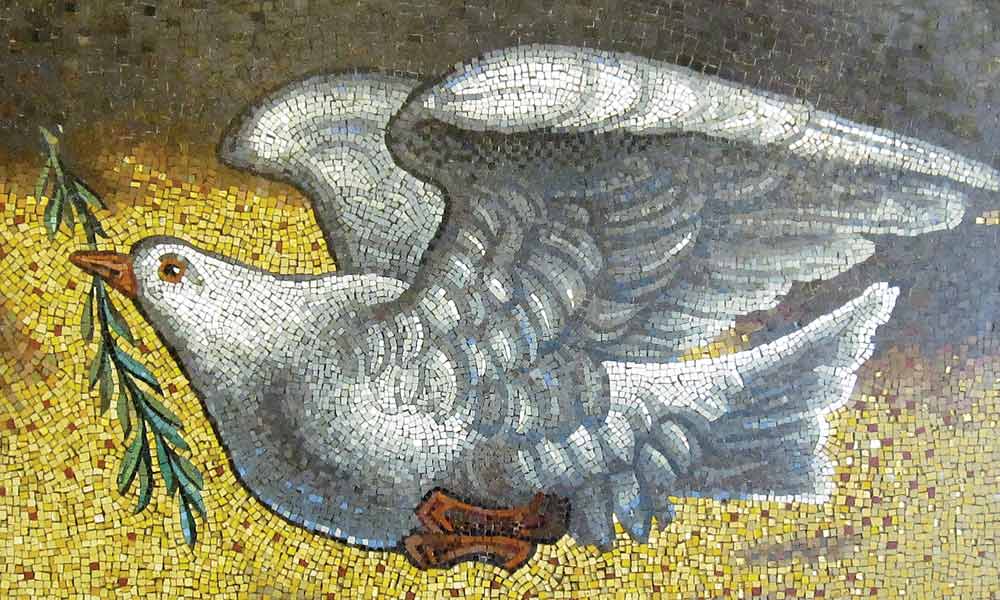
In 2009, then-Deputy Prime Minister Moshe Yaalon referred to Peace Now as a “virus” and colorfully said, “Whenever politicians bring in the dove of peace, the army has to clean up” the droppings. A right-wing organization commissioned a competition for bumper stickers that would graphically depict the sentiment. One of the winning stickers showed the logo of Peace Now with the word shalom crossed out and the word hayim (life) superimposed on it. Shalom, in other words, was equated with death.
In later years, as a spokesperson for the American sister organization of Peace Now, I witnessed my Israeli colleagues’ efforts to seek alternatives to the s-word. They talked about a “diplomatic solution,” about a “political arrangement” and other alternatives to a word that had turned toxic. Luckily, among American Jews, you could still credibly talk about peace. But even here, “It’s a sad moment to realize that there is a dissonance between the shalom we mention in our prayers and what we see in political advocacy,” says Rabbi Josh Weinberg, vice president for Israel at the Union for Reform Judaism and the executive director of the Association of Reform Zionists of America. “We pray for shalom and we sing and say shalom,” he says, “but there is a deep sense of disillusionment.”
If the first moment of shalom devaluation was the Palestinian uprising of 2000, then the second devastating blow was Hamas’s attack on October 7, 2023.Israelis refer to the impact of the violence on prospects for future reconciliation with the Palestinians as hitpakhut (a collective “sobering up”).
Can shalom make a comeback? “Today, it’s hard to imagine Israeli-Palestinian peace,” says Michael Koplow, chief policy officer of the Israel Policy Forum. “But it was hard to imagine Israeli peace with Egypt and Jordan before these treaties were signed. And yet, it happened.” And so perhaps the best that can be said for shalom right now is: “One can always hope.”
Moment Magazine participates in the Amazon Associates program and earns money from qualifying purchases.