


Jewish Politics & Power is published every other week. Sign up for our newsletter for updates.
1. Why Graham Platner is the face of the Democratic dilemma
He may not be a household name, but Graham Platner is now poised to become the Democratic nominee in a tight race in Maine, which could be crucial in deciding future control of the U.S. Senate.
Last week, Platner’s rival, Maine Governor Janet Mills, dropped out of the primary, making him the sure candidate to face incumbent Susan Collins, a moderate Republican struggling to keep her seat.
Platner, an oyster farmer and military vet with little political experience, is a left-wing populist. But Platner’s claim to fame, or to infamy, comes from the Nazi-associated skull and crossbones tattoo, known as a “Totenkopf” (death’s head), that, until recently, occupied a good quarter of his chest. When the issue came up during the campaign, Platner explained that he got the tattoo as a young Marine during a night of drinking when on leave in Croatia. Platner stressed that he had no idea of the symbol’s Nazi origins.
And then there are his views on Israel.
Even in the current-day Democratic climate that embraces criticism of Israel, Platner stands out with his harsh comments and positions. He has advocated for ending military aid to Israel, has questioned the future of the U.S.-Israel relationship and uses the term “genocide” to describe Israel’s massive killing of civilians in Gaza. “What has happened in Gaza is the moral question of our time,” he said. “And we failed miserably.”
In an interview with the Jewish Telegraphic Agency, Platner sought to explain his Totenkopf tattoo, revealing that the now-famous photo of him shirtless was taken during the wedding of his Jewish half-brother. “I took my shirt off at the wedding and performed a rather ridiculous dance for them as their wedding present,” he said in the interview. “If I thought that I had something that had clear white supremacist or antisemitic connotations, I would not have taken my shirt off in front of my extended Jewish family, because that would have been ridiculous.” Platner has since covered the tattoo with a Celtic knot design.
He did not, however, take back his criticism of Israel. If elected, Platner will join the progressive wing of Senate Democrats (Bernie Sanders and Elizabeth Warren have been among his early endorsers) who have been working to defund aid to Israel, limit arms sales and demand accountability for Israeli actions.
2. To endorse or to denounce, that is the question
Platner’s ascendancy may sound familiar. The story of an outsider far-left anti-Israel populist taking on the establishment is not dissimilar to that of New York’s Zohran Mamdani.
To be clear, Platner is no Mamdani. He lacks the charisma, the following and the national attention. But his race does echo, at least to the ears of Jewish Democrats, that of Mamdani’s and raises a similar dilemma for Jewish activists and donors: Do they back a Democrat in a critical Senate race, or criticize him for being anti-Israel? (With one important caveat: Mamdani ran for mayor of the city with the largest Jewish population in the world, Platner wishes to represent a state with fewer than 20,000 Jewish residents.)
The Mamdani experience seems to have changed how the Jewish community reacts to such candidates.
Take a look at Minority Leader Chuck Schumer. “After years of allowing Trump’s abuses of power, Senator Collins has never been more vulnerable, and we will work with the presumptive Democratic nominee Graham Platner to defeat her,” Schumer, who had initially endorsed Mills, said in a joint statement with fellow New York Senator Kirsten Gillibrand.
Schumer refrained from endorsing Mamdani during the mayoral race, but this time is different, not only because Platner’s history of anti-Israel messaging doesn’t go as far or deep as Mamdani’s but also because the Democratic establishment has learned a lesson: Progressives are the rising power within the party and hold the key to enthusing supporters. Faced with a real chance to flip a much-needed Republican seat, Dems are more willing now to show their support for candidates who do not necessarily adhere to the mainstream party line on Israel.
Jewish groups aren’t necessarily there. Haile Soifer, head of the Jewish Democratic Council of America, said her group “won’t support a Democrat who doesn’t represent the values of the vast majority of American Jews.” The organization, she said, is “not ready” to endorse Platner, perhaps leaving the door open for future support if he revises his views on Israel.
The Jewish vote won’t matter much for the Maine senate race. But the Jewish establishment’s approach toward Platner’s candidacy can serve as a preview of the decision Jewish Democratic voters will have to struggle with as the midterm elections approach and going forward: How to reconcile their support for Israel with their wish to get Democrats elected? The Maine election hints that ensuring Democratic victories may well be the overriding consideration.
3. The politics of buffer zones
A May 5 demonstration outside a Manhattan synagogue was the first test of New York City’s new “buffer zone” rules, which call on police to ensure that protests outside houses of worship do not prevent safe access for worshipers. Some 100 pro-Palestinian activists staged the protest outside the Park East Synagogue, which was hosting an event sponsored by a real estate company selling homes in Israel and in West Bank settlements.
Police kept the protestors a block away, and even though counter-protesters and some local politicians complained that they still felt unsafe, there were no major incidents.
NYPD is still in the process of compiling regulations regarding protests under the new law. Meanwhile in Congress, members are trying to advance a federal buffer zone law that would limit protests outside synagogues and other houses of worship across the country. New York Democrat Tom Suozzi and Ohio Republican Max Miller co-sponsored the bill, which was rolled out with the support of the Anti-Defamation League, the American Jewish Committee and other Jewish organizations. According to the proposed legislation, protesters will be kept 100 feet away from houses of worship, although the rule will not apply to demonstrations deemed peaceful and non-disruptive.
The bill has yet to gain co-sponsors, and its chances of passing are still unclear.
4. Jewish heritage week, Trump style
May is Jewish American Heritage Month. Started in 2006, it has served as an opportunity to highlight the history and achievements of Jewish Americans, to celebrate the role of the Jewish community in shaping the nation and to fight hate and antisemitism.
Some previous presidents have hosted White House celebrations to mark the event, but Trump presented a new idea: A national Shabbat.
In his proclamation announcing Jewish American Heritage Month, the president called on members of the Jewish community “to observe a national Sabbath. From sundown on May 15 to nightfall on May 16, friends, families, and communities of all backgrounds may come together in gratitude for our great Nation. This day will recognize the sacred Jewish tradition of setting aside time for rest, reflection, and gratitude to the Almighty.”
A website promoting “Shabbat250” listed ways in which it can be observed: “You can participate by setting aside time for rest, introspection, and community connection. This might include a festive family meal, attending religious services, or simply ‘unplugging’ from technology to reflect on the blessings of freedom.”
Two quick takes on the initiative:
First, it is thoughtful and, for the first time, tries to add real Jewish content to Jewish Heritage Month.
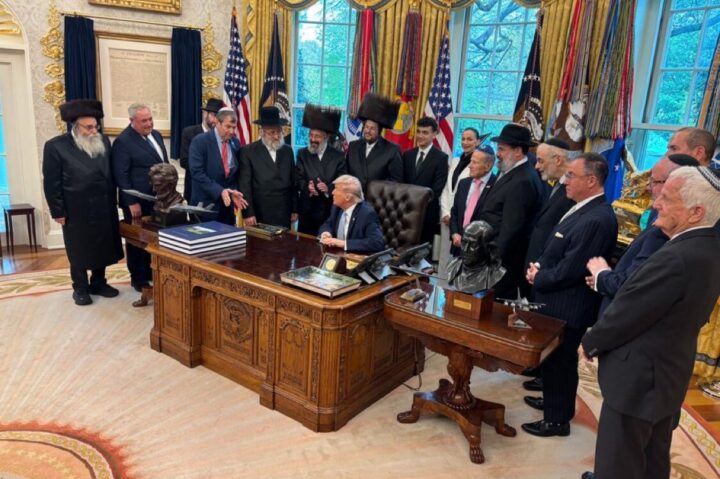
Second, the idea also reflects Trump’s Jewish circle—more observant, more Orthodox, more likely to take Shabbat seriously. (For example, take a look at this photo of Trump’s recent Passover meeting with Jewish leaders.)
5. Blessed is the nation whose God is the Lord
Done with observing the national Shabbat? Here’s something to do the following day.
On May 17, Americans are invited to the National Mall to “Rededicate America” on its 250th anniversary. “Prepare for the nation’s 250th birthday with Scripture, testimony, prayer, and rededication of our country as One Nation to God,” the online invitation states. Just like the national Shabbat, this too is a never-before-seen presidentially sponsored event.
Will Jews feel welcome? It is titled as a non-denominational event, but expect heavy presence of Christian evangelicals, who dominate Trump’s faith ecosystem. There should be no shortage of kippot in the crowd.
Top image credit: JJonahJackalope (CC BY-SA 4.0)