
 This column originally appeared in the April 1984 issue.
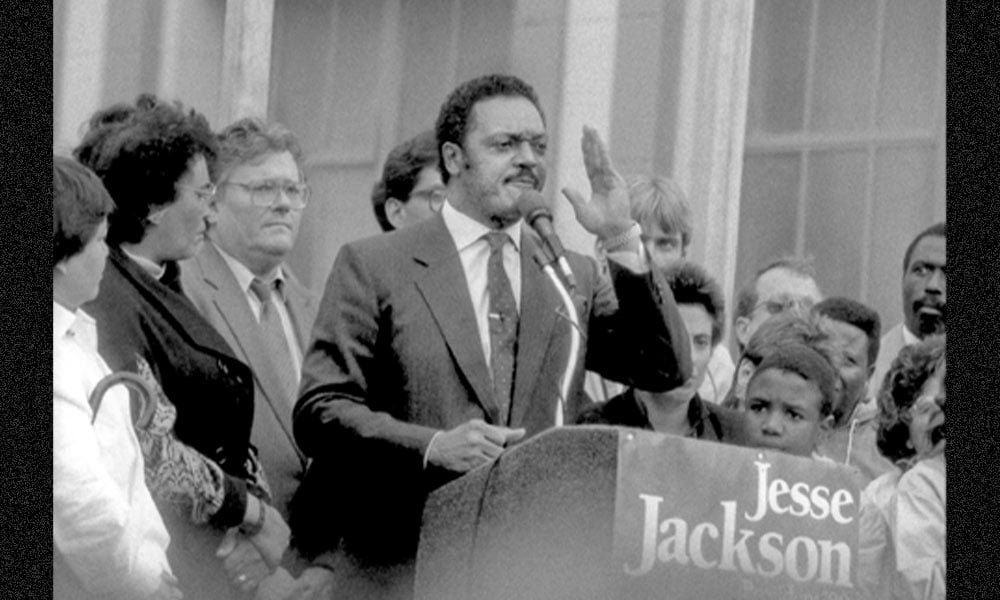
The first time around, the rainbow sign came after the flood. Now Jesse Jackson, who claims to be a man of God, has reversed the order: first the rainbow sign, then the flood.
Let there be no mistake: Jackson’s actions, his evasions and his statements, have done grave damage to this nation. The man seems incapable of clearing up yesterday’s ill-spoken offense without adding some new insult that will have to be explained tomorrow. For all his enthusiasm, for all his telling critique of American society, for all the merit in his notion of “empowerment,” Jesse Jackson has recklessly smeared the rainbow coalition he claimed to want to paint. His infectious energy turns out to be blighted by the bacillus of bigotry.
Most likely, Jackson himself does not see it that way. He continues to believe, we are told, that “the Jews” have confused the anti-Zionism to which he freely admits with anti-Semitism, which he stoutly denies. But some of us, at least, know the difference between the two—and think Jackson suffers from both.
Back in 1973 Jackson was reported to have blamed the “German Jews” around Richard Nixon, including John D. Ehrlichman and R.H. Haldeman, for the administration’s insensitivity to the poor. In 1979, referring to the scheduled heavyweight boxing match between John Tate, a black American, and Gerri Coetze, a white South African, Jackson observed that the fight “represents humiliation to blacks and concerned whites around the world. It is sponsored by two Jews.” Again in 1979—this time on CBS’s Sixty Minutes—Jackson said, “With all the talk of the black-Jewish alliance, we don’t own radio stations together, we don’t own banks together, we do not share in the ownership of the industries they have begun to get some hold on together….””
These and sundry other sordid facts are reported in a 19-page review of Jackson’s statements on Israel and the Jews prepared by the Anti-Defamation League. In the meantime, of course, the Jewish Defense League, with its characteristic boorish stupidity, has organized “Jews Against Jackson.” (One wishes the ADL would do 19 and more pages on the JDL, which makes an ongoing contribution to anti-Semitism.) Perhaps it is this convergence that has led Jackson to believe, as we are told he does, that he is the victim of a Jewish conspiracy to do his candidacy in. But in this, he is also mistaken. Until he raised the Jewish issue, there was no reason for such a conspiracy; once he raised it, there was no need.
Indeed, indications are that the initial Jewish response to the Jackson candidacy was a mixture of opposition and curiosity, with pockets of support here and there—much as the reaction of other Americans. Very many Jews, we may suppose, opposed the Jackson candidacy because they disagreed with Jackson’s view that the United States should recognize the PLO. (Many other Americans opposed his candidacy for reasons considerably less substantial, less respectable than that.) Very few Jews were aware, even dimly, of Jackson’s history of anti-Semitic statements.
By now, however, liberal and radical Jews who had regarded the Jackson candidacy as a contribution to the debate, who may even have contemplated voting for him, have moved—quickly, and angrily. They did not move because they were told to move. Indeed, the measured reaction of Jewish organizational leaders was remarkably temperate; it was the media, and not Jewish leadership, that focused attention on the issue. (It is possible, of course, that Jackson believes the Jews control the media—but that is another matter.)
Regrettably, we are not dealing here with a Butz or a Watt—that is, with a leader who has so misspoken that he is consigned to oblivion. No black leader has so captured the black imagination since Martin Luther King Jr.; hence both Jews and others have been far more constrained in their response to Jackson’s slurs than they would otherwise have been. But Jackson seems obsessed with the Jews; hence the consequences of this dismal episode are likely to stay with us for years to come. For his failing candidacy has now found its scapegoat. Unless Jesse Jackson himself moves vigorously to defuse the situation, black mythology may well recall this period as the second time Jews crucified the messiah.
And that would be a tragedy, indeed—less for the Jews, who have lived with calumny before, more for the blacks themselves and for America.


The last time of explicit falling out between blacks and Jews was in the late 1960s. In ghetto after ghetto in this country, stores were torched. Many of these were owned by Jews. More painfully still, the debate over community control of the public schools in New York City led to ugly and explicit confrontations between the two groups. Though Jews justifiably felt that they deserved some credit for having been in the vanguard of the battle for racial justice in America, blacks justifiably felt that the Jews were abandoning the fight once their own interests were directly threatened.
Since that time, a combination of fatigue and resentment has kept the groups apart. Though the condition of black America has worsened, white America has not had the wisdom or the energy—or, for that matter, the decency—to engage with the problem. We gave it one burst of dramatic energy back in the ’60s—and that, we have implied by our inaction, has drained us for a while. And, for Jews, the fatigue has been supplemented by specific resentment regarding the matter of quotas.
As well as by our growing awareness that anti-Semitism finds a congenial home within the black community.
We, who like to depict ourselves as champions of decency, and would like so to be seen by others, have preferred not to call attention to this depressing fact—but it shows up over and over again in polls on the subject. It turns out, apparently, that many black Americans resent our continuing self-description as a victim people. After all, we surely do not apear to be victims—not in this time, in this place. It is hard for most blacks to understand just what the suburbs and the slums have in common, just why these extravagantly successful people called Jews continue to insist that they, too, are among the persecuted.
And it is easy for some blacks, searching for an explanation of the vast difference in economic condition between these two maligned peoples, the blacks and the Jews, to imagine that the Jews have made it by stepping on the blacks. That way, one weird distortion explains away both Jewish success and black non-success.
Blacks deserve better analysis, more honest explanation. And that means they deserve better leadership than Jesse Jackson offers.
But Jesse Jackson is hardly the issue here. At stake is not his failing candidacy or even his future stature. At stake is any possibility of resurrecting the coalition of decency on which serious movement towards justice in this country depends. It is not possible to conceive of that coalition without the enthusiastic participation of both blacks and Jews, and it is for that reason that the Jackson episode is not merely a disappointment, but—potentially—a genuine tragedy, for all America.
The blame cannot, however, be laid exclusively at Jackson’s door. It is unseemly for those who have for the last decade and more practiced a politics of resentment now to preach a politics of reconciliation. It is inappropriate for those who regularly refer to “shvartzes” sanctimoniously to condemn those who use “Hymie.” The exemplary public declarations of Jewish organizations on the matter of civil rights ring hollow when contrasted to the sanction we have come to give bigotry in our private attitude and behavior. It is time, and then some, for us to stop behaving as if we have not yet recuperated from the traumas of the 1960s. It is time, and then some, for us to stop pretending that our history of persecution has immunized us against prejudice.
And it is time for us to stop expecting to be rewarded with gratitude for having once upon a time been there when it counted. When it comes to the battle for justice, credentials must be daily renewed. In any case, we did what we did and do what we do, such as it is, not in order to earn the thanks of others, but to preserve our own self-respect. And that is why, above all, it is necessary that we remind ourselves in the wake of Jesse Jackson’s offenses that the bigotry of others does not offer us a hechsher, a license, for hate.—L.F.
Top image credit: Brian McMillen (CC BY-SA 4.0)