
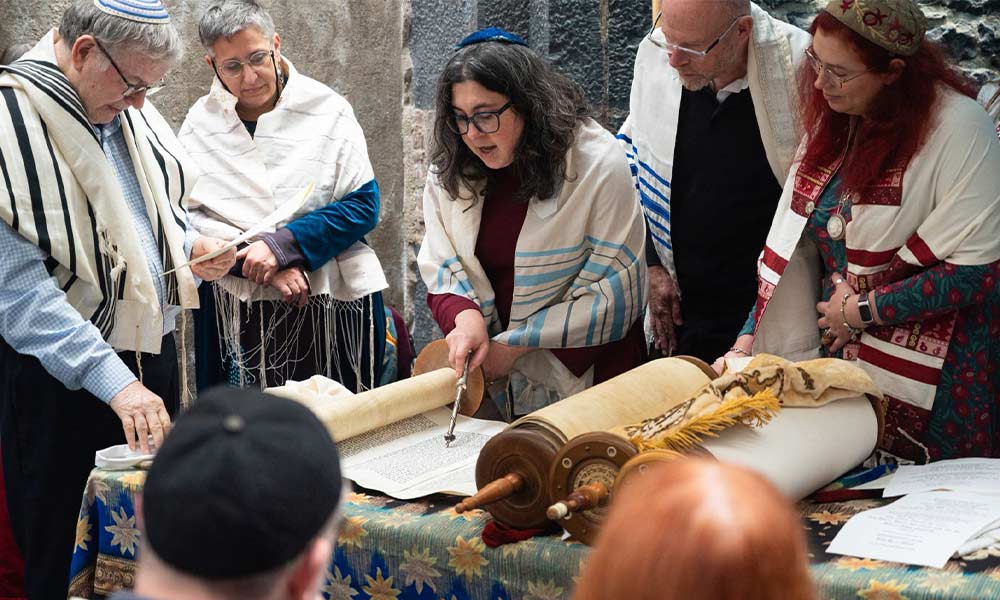
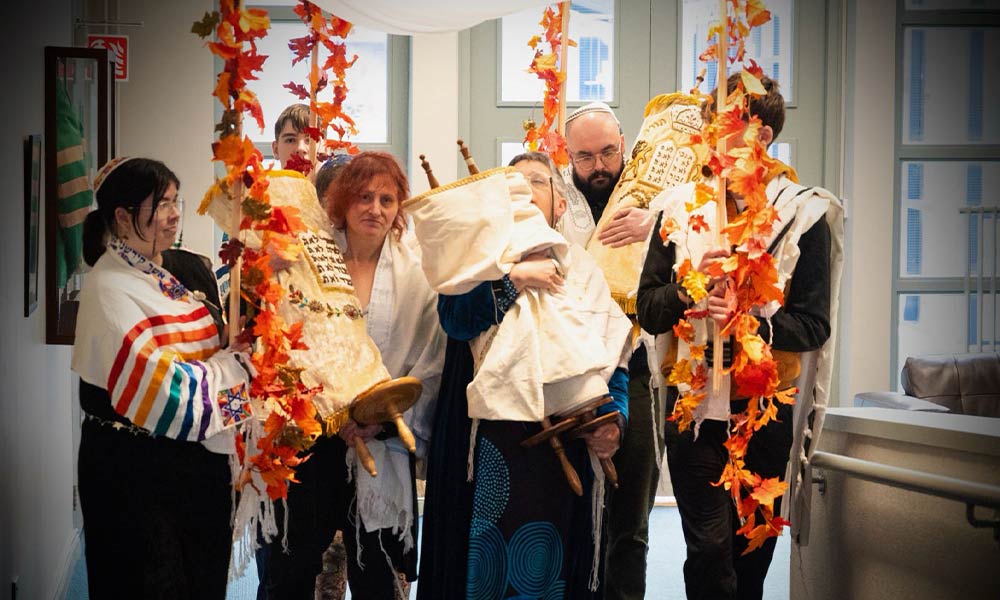
The corridors of Limerick’s Istabraq City Hall rang out with the sounds of Hebrew prayer on a Shabbat of this past fall to celebrate a historic occasion for Western Ireland’s burgeoning Jewish communities.
Jewish leaders from Limerick, Cork, Galway and Belfast, along with local representatives from Catholic and Anglican communities and municipal representatives, gathered together to celebrate the gift of four Torah scrolls, which will serve expanding liberal Irish Jewish communities outside of Dublin.
“It was very, very special, from start to finish,” says Yonit Kosovske, a professor of music at Limerick University and a leader of Limerick’s small Jewish community. “There were lots of tears, tears of joy really.”
For decades, the narrative around Jewish life in Ireland has been one of decline. Today it is estimated that there are fewer than 3,000 Jews living on the island of Ireland, which includes both Northern Ireland and the Republic of Ireland, down from a historical high of 5,500 in the mid-20th century.
Despite a few prominent Jews in Irish history, from former Irish Chief Rabbi Isaac Herzog to Dublin’s former Lord Mayor Robert Briscoe—and fictional ones such as Leopold Bloom, the main character of James Joyce’s Ulysses—most of Ireland’s 7.1 million people have never met a Jew.
For us, getting a Torah scroll was a bit scary. We are not so practicing…what would we do with it?
“In Ireland, you’ve still got a strong belief in the Aes Sidhe, the fairy people,” says Sophia Spiegel, a leader of the Cork Jewish Community. “That’s what we’re like, these mythological people who lived very far away and a long time ago, but not something real.”
For her, the ceremony was an opportunity to prominently celebrate the reality of the Jewish community within Ireland’s religious and cultural tapestry.
The timing of the ceremony was also auspicious. Around 120 years—the lifetime of Moses—before the Jewish community leaders danced through Limerick’s city hall with their new Torah scrolls, Limerick’s Jews had been run out of the city at the urging of an antisemitic preacher.
In 1904, the Redemptorist priest Father John Creagh called for assaults and a boycott against businesses run by immigrant Jews in Limerick. The period is remembered as the Limerick Boycotts, or by some, as the Limerick Pogrom, and by 1906 most of Limerick’s Jews had relocated to Cork and Dublin or moved abroad.
Contrary to a common narrative, however, that was not the end of Jewish life in the region.
Kosovske notes that the so-called Celtic Tiger—a term referring to Ireland’s economic resurgence beginning in the 1990s and stretching through 2008—had brought many Jews back to the country. The UK’s exit from the EU left Ireland the last English-speaking country in the EU, making it an easy transition for American and Israeli Jews with EU citizenship. Ireland’s strong university system was also an attraction for many Jews to cities such as Limerick and Galway, which had long been devoid of formal Jewish communities.
The new arrivals also brought with them diverse backgrounds and approaches to Judaism, from the U.S. Reform movement to Israeli secularism, that fell outside of the Orthodox infrastructure that already existed in Ireland.
“They’re all small, they are all very different, but they are all growing,” Kosovske says, describing the Jewish communities in Limerick, Cork, Galway and Belfast, whose leaders gathered in Limerick to accept the Torah scrolls.
For many of the community leaders, the event was also a symbol of a brighter Jewish future in Ireland—especially at a time when too often the international view of Jewish life on the island is defined by international politics more than by the reality on the ground.
“Not everyone can make the distinctions between Israel and Jews, and between the Israeli government and Israelis,” laments Michal Molcho, a community leader and professor at the University of Galway. “We live in a world where people are looking for simplicity and they don’t have the bandwidth for the complexity that the conflict has.”
Since the outbreak of the Israel-Gaza war in the wake of October 7, 2023, Ireland has been one of Israel’s strongest critics in Europe, and Israel closed its embassy in Dublin in 2024 in response to Ireland’s recognition of a Palestinian state.
“In Ireland, which is perceived as a very sort of Jew-negative environment, it felt really empowering for four communities to be there together, showing how we’re growing and thriving and we’re still here,” says Sophia Spiegel, a leader of the Cork Jewish Community.
“I think the community is growing, in part, because of the experience of antisemitism.” Spiegel says. “There’s an increased need for people to feel safe in an environment where they’re not going to be pressured on their views in relation to the Middle East, where they can be unapologetically Jewish without having to worry about anything.”
Molcho, noted that in Galway, much of the Jewish community are Israelis who had come due to its prominent university.
Despite the tense political environment surrounding Israel on Irish campuses, including calls for boycotts of Israeli academia, she said, the Galway Jewish Community’s formation and activities have received the full support of the university.
“I believe we are the youngest Jewish community in Ireland,” says Molcho. “It’s a community which is more secular, but has a larger portion of Israelis than the other communities.”
She notes the importance of having the University of Galway’s president at an inauguration event of her own community in the city in late November. “I think that for the president of the university, it was possibly a bit surprising to see that there were more Jewish people at the inauguration of the Torah scrolls than there ever [were people at] any of the [Gaza] demonstrations.”
“The events of October 7 and the fallout made a lot of people who weren’t so attached realize that they are Jewish and that that does matter,” she adds.
But the leaders were also adamant that Ireland’s Jewish community is much more than international politics.
“One of my biggest concerns when moving to Ireland, especially when my children were younger, was, how are we going to create Jewish community and give them a Jewish education here?” says Kosovske. Dublin’s Jewish infrastructure was hours away, and—for someone who grew up in an American Reform Jewish milieu—not the right denominational match.
“In Dublin, there are around 1,500 Jews. There are two synagogues to choose from. There’s quite a lot of social stuff going on. But outside of that, especially if you have children, you have to work hard to make sure that they are connected to their Jewish heritage,” Spiegel, who grew up between the UK and the Netherlands, added.
One of Dublin’s two synagogues is liberal while the other is Orthodox, Cork had an Orthodox synagogue that closed down in 2016, and Belfast in Northern Ireland still has one Orthodox synagogue.
In Belfast, community leader Paula Tabakin explained that her community is excited to be able to use the scrolls in upcoming bar and especially bat mitzvahs, as girls wouldn’t be able to read from the Torah in the city’s Orthodox synagogue.

In Galway, Molcho says, the scroll will provide an opportunity to engage in Jewish ritual for some who have never experienced it.
“Secular Jews can spend their whole life barely ever going into a synagogue, so it’s a community that has no nusach [liturgy] that they know from home, that doesn’t know many of the tefilot [prayers], nothing,” Molcho says. “So For us, getting a Torah scroll was a bit scary. We are not so practicing…what would we do with it?”
But she quickly realized that they would enable new opportunities for community life, from Bnei Mitzvot to high holiday services.
The scrolls, which were gifted by the congregation Temple Emanu-El in Haverhill, MA, have their own extensive history. Three were scribed in Eastern Europe before the Holocaust and the fourth in Israel in the 1950s. Temple Emanu-El, like many other synagogues in the United States, is downsizing as it merges with another community and is passing along its scrolls to others.
Spiegel had heard that the Temple Emanu-El was looking for a home for their scrolls thanks to Rabbi David Kudan, an American rabbi and a longtime friend of the Cork Jewish community.
Upon hearing that they were available, the four communities raised money together to send Spiegel to the U.S. to ferry the scrolls back to Ireland.
“The Torah is called the Etz Chayim—the Tree of Life,” Spiegel notes. “And these seeds of those trees—communities which have passed—are being replanted back in Europe to bring new life.”
“It’s a real sign of hope, these Torahs coming over,” added Spiegel. “It’s a symbol that we’re here, that we’re still growing, that we’re vibrant and that—in spite of things sometimes being difficult politically—people feel safe enough and proud enough to be Jewish in Ireland.”