
Ilan Berman is senior vice president of the American Foreign Policy Council and a frequent contributor to Moment.
Right now, based on what we know, do the signs point to a long or a short war?
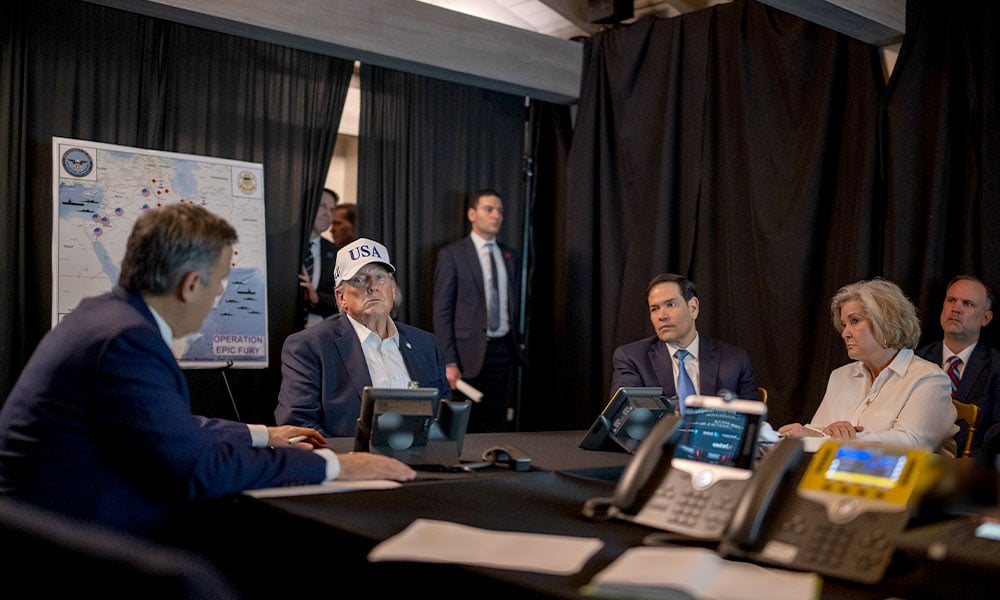
It’s still difficult to tell, since the objectives of the Trump administration are fluid. If what we’re talking about is a campaign to further erode Iran’s ballistic missile and nuclear capabilities, we are likely looking at a shorter conflict. If we move more squarely into “regime change” territory, however, we are looking at a longer timeline, as both the United States and Israel seek to steer events by targeting key leaders and military officials.
Domestic politics also plays a big part here, as you would expect. The current debate in Congress over war powers is overwhelmingly political in nature, because the legal authorities the president has are sound. But the latitude he has isn’t unlimited, both because a protracted conflict will start exerting an effect over domestic polling in an election year and because an open-ended engagement will naturally require congressional oversight. All of which is to say that I think we are looking at a shorter timeline—precisely how much shorter remains to be seen.
Who is running Iran now? Do we have any idea?
The answer to that question is changing in real time, as both Israel and the United States strike high-value targets in Iran. Just yesterday, Israel bombed the building where the entire clerical conclave was supposed to be in the process of selecting the next supreme leader—though casualties have not yet been confirmed! And The Jerusalem Post is reporting that something like 1,000 top-level religious and military leaders have already been killed. That sort of operational tempo makes it very, very hard for the Iranian regime to maintain cohesion—which is precisely the point, as far as Jerusalem and Washington are concerned.
In this context, one of the key things I am watching is whether there comes a point that so many senior clerics and religious authorities are taken off the board that the IRGC abandons its subservient posture and makes a bid for political leadership. So far, the IRGC has remained faithful to the clerical establishment and buttressed the country’s religious authorities. I’m not certain, though, that that is an indefinite condition.
If something like regime change actually took place, what might it look like? Are there any civil society structures into which more moderate forces could step?
Regime change, let’s remember, isn’t just one thing. It can take many forms. It’s already clear that Team Trump isn’t interested in George W. Bush-era regime change, of the sort we saw in Afghanistan and Iraq. There’s no appetite for nation building among the electorate writ large, and certainly not in the president’s MAGA base. Additionally, the administration really had difficulties interacting with various elements of the Iranian opposition during its first term in office, and that has left a bad taste in their collective mouths. All of which is to say that Trump seems to be looking at a scenario similar to what we saw in Venezuela earlier this year.
Now, the president has told the Iranians that it’s up to them to seize the moment, and that’s an important signal. The White House is willing to open up a window of opportunity, but it believes that it’s up to the Iranians themselves to take the next step. And if they don’t, Trump will inevitably do a deal with whatever reconstituted entity remains from the current regime—because the national security priorities here are to impose limits on Iran’s nuclear and ballistic missile programs (and hopefully also its terror support).
How reliable are our sources of information about reaction in Iran? Do we know whether there is widespread rejoicing, or a rally-round-the-flag backlash effect, or anything in between?
This is a crucial question, because the information front in the current war is essential. The regime’s predictable reaction, as we’ve seen in previous episodes (like last summer’s war), is to black out the internet and make it as hard as possible for the Iranians to communicate with the outside world. This is both because the regime wants to prevent the internal situation from getting out to the international community—where, presumably, it might generate some reaction—and because the internet has become a critical medium by which the Iranian opposition coordinates.
This blackout isn’t hermetic, though, and we are seeing at least some news leak out of Iran via social media platforms and the like. For now, at least, the Iranian people seem overwhelmingly supportive of the U.S. campaign, because they see it as the most promising way to remove (or at least alter) the regime that has brutalized them for almost half a century. If the conflict drags on for a long time, these attitudes may change. But for the moment, it’s pretty clear that the Iranians are supportive.

There’s also a third angle: The regime is afraid of free Western information as a means by which the people can be both informed and mobilized. That is significant now, because the Iranian people need to understand precisely what the United States is doing, and what it won’t do, as a way of allowing them to appreciate and hopefully seize the moment. Unfortunately, though, what we’ve seen over the last year has been a pretty dramatic scaling down of the U.S. informational enterprise, and tools like the Voice of America have been neutered to the point that they’re only marginally effective. Organizations like Radio Free Europe, on whose board I sit, are still continuing to function—and RFE’s Radio Farda is still broadcasting into Iran. But a great deal more is needed here to meet the moment.
Where do you see the greatest risks of the conflict widening or becoming regional? Of the various third parties already being affected or being drawn into the conflict—missile strikes in the Emirates and Bahrain, Israel-Lebanon conflict, riots in Pakistan, etc.—which are the most dangerous?
Iran’s response to the initial Israeli and American strikes was to target a number of its regional neighbors, including Saudi Arabia, Oman, Qatar, the United Arab Emirates and Kuwait. The thinking in Tehran seems to have been to try and ratchet up the costs of the conflict to partners of Israel and the United States and get them to lean on Washington and Jerusalem. If that was the case, the regime miscalculated catastrophically—because it managed to convince its entire neighborhood that it represents an existential threat to their security. Put another way, the Islamic Republic has managed to build its own regime change coalition. This is significant, because it injects additional variables into the equation. Clearly, the Trump administration is the principal driver here. But other countries have the potential to weigh in and shape events as well, as they seek to respond to Iran’s aggression—as the Saudis and others have already pledged to do.
(Top image credit: The White House)