
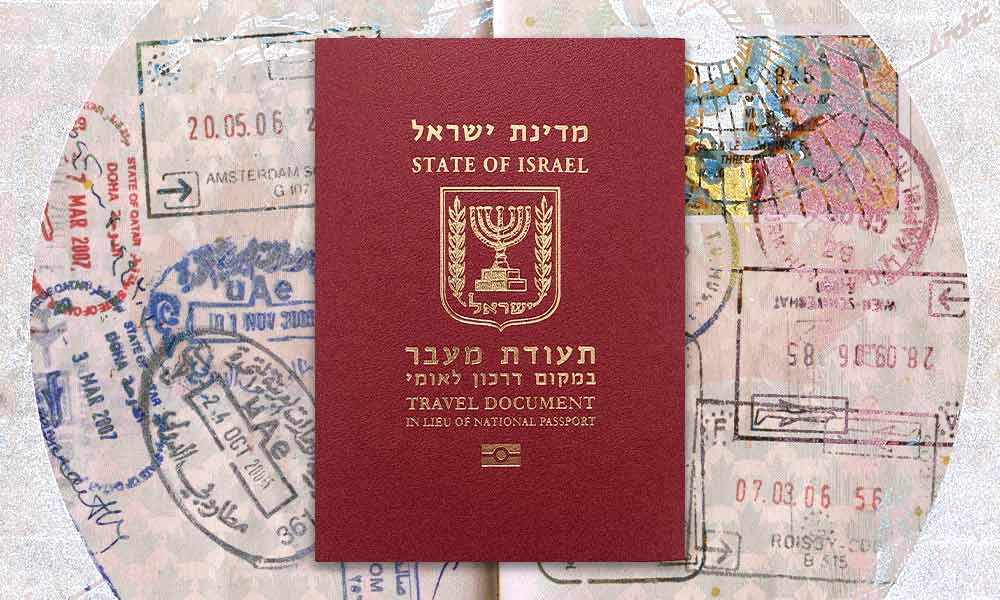
Yousef was in Washington, DC, performing with the Jerusalem Youth Chorus in late February when the United States and Israel attacked Iran and war, once again, broke out in Israel. When it was time to fly home, his friend passed through airport security and boarded their Royal Jordanian flight (a replacement for the previously canceled United one) back to Tel Aviv. But 20-year-old Yousef (who asked that his last name not be used) was stopped due to complications with his travel document, the laissez-passer carried by many East Jerusalem Palestinians in lieu of a passport, which identifies him as a Jordanian citizen—although he has never been to Jordan—and Jerusalem permanent resident.
East Jerusalem Palestinians face this problem often—the laissez-passer (“let pass” in French) is internationally recognized but much more restrictive than a passport. Yousef’s friend was easily able to board with an Israeli passport, but since the new flight made a stop in Amman, Yousef would have needed a tourist visa to leave the airport there—which the country of Jordan denied him.
Although Yousef’s laissez-passer lists Jordanian citizenship, it comes without a Jordanian passport (and as Yousef points out, “I’m not Jordanian. It’s hard for me to feel Jordanian”).
Yousef’s story is one experienced by many East Jerusalem Palestinians, an undefined identity as a result of a history of wars and annexations.
As Yousef remained stranded in the United States, his family back in Jerusalem tried to help, going to the Ministry of Interior home office in an attempt to get an Israeli passport for him. But due to the war, offices were largely closed, and his family went home empty-handed.
Two weeks later, it was the Jerusalem Youth Chorus (JYC) U.S. tour manager, Lindsey Gore, who finally got Yousef back to Israel. The JYC is a music and dialogue program for Palestinian and Israeli youth in Jerusalem, and Gore handles travel documents like Yousef’s frequently.
Nicknamed the “flight queen,” Gore spent days checking and refreshing flight announcements from United, El Al and any other international airlines—even looking into rush visas for Switzerland to make a possible connection there—any avenue to get Yousef home. Gore finally found an El Al flight direct from New York to Tel Aviv. “At this point, I don’t even bat an eye, because it’s an unfortunate reality of travel in and out of that region, depending on where you’re from.”
Yousef’s story is one experienced by many East Jerusalem Palestinians, an undefined identity as a result of a history of wars and annexations.
The laissez-passer’s Jordanian classification is a remnant from when East Jerusalem was part of Jordan—only 59 years ago. Following the 1948 War and the establishment of the State of Israel, Jordan occupied, and two years later annexed, the West Bank and East Jerusalem, despite objections from other Arab states who favored the vision of an independent Palestinian state.
Israel later took control of the territory in the Six-Day War. Different from the West Bank, which went under Israeli occupation, Israel de-facto annexed East Jerusalem in an act to reunify the city (and later made it official in 1980 with the Jerusalem Law). The unification of the East and West cities brought around 70,000 East Jerusalemites into Israel, but as permanent residents rather than citizens. Today, East Jerusalem’s population is around 400,000 people.
Permanent residency status can be revoked if someone is unable to demonstrate that their “center of life” is Jerusalem.
This history puts East Jerusalem Palestinians in a different situation than other Arabs living in Israel: Unlike the Palestinian Arabs who were granted Israeli citizenship following the 1948 War (and currently make up about 20 percent of Israel’s population), due to a previous law change, Palestinians of 1967 were not granted automatic citizenship.
Living in East Jerusalem is a unique experience for the people caught in the middle of the decades-long conflict.
Yousef’s grandfather, now 85-years-old, was born in Hebron when it was a city in the British Mandate of Palestine. In 1948, the city went to Jordan, and then in 1967 to Israel. Yousef’s grandfather worked and lived in East Jerusalem, and when Israel gained both territories in the war, he was given a blue ID (Israel) while his brothers still in Hebron were issued green IDs (West Bank). Thus, just by chance, Yousef’s grandfather was granted more freedom than his brothers. Today, with their blue IDs, Yousef and his grandfather are able to travel to the West Bank to visit their family, but with their green IDs, his brothers cannot freely travel into Jerusalem to visit in return.
“East Jerusalem is a special case between what we call the Arabs of 1948—Arabs inside Israel in the green line—and the West Bank,” Amnon Ramon, a senior researcher at the Jerusalem Institute for Policy Research, says. Similarly, Yael Berda, an associate professor of sociology at Hebrew University, refers to the group as “a bridge between Jewish Israelis and Palestinians.”
While having a blue ID card grants permanent residents greater freedoms within Israel than Palestinians in the West Bank and Gaza, it does not necessarily grant them the same rights allowed to Israeli citizens. As permanent residents, East Jerusalemites can’t vote in Israeli general elections and, without passports, are subject to international travel restrictions—as Yousef experienced.
In addition, permanent residency status can be revoked. The main reason for this would be if someone was unable to demonstrate that their merkaz hayim or “center of life” is in Jerusalem—spending an extended period of time (currently seven years) away, or having a green card or citizenship in another country, are risks to the residency status. Paying rent, electricity bills, and sending children to local schools are just some of the ways residents can prove their center of life is in Jerusalem.
Other bureaucratic systems make life more complicated for those living in East Jerusalem: House demolitions due to lack of permitting, run-ins with border police, lack of access to bomb shelters are all issues that Palestinian permanent residents deal with disproportionately more than citizens.
“For a while there was a campaign to make them citizens, and Israel offered Jerusalemite Palestinians citizenship, which they didn’t take because they considered it to be occupied territory. And later, when people did want to actually become citizens, then Israel made it impossible,” Berda says. “It’s very contextualized. It’s all about the political moment, the historical moment, and the political interests at that moment.”
Some residents apply for Israeli citizenship, but it is a long process, often taking up to five or six years, and even then a “yes” isn’t guaranteed. A 2022 Haaretz analysis found that since 1967, only 5 percent of East Jerusalem Palestinians who have applied for Israeli citizenship were granted it. “The process is very long and very difficult, and the chances are not good,” Ramon says, explaining that today, there are an average of 700 applications per year, and around 300 of those are approved. This means that out of 400,000 total Palestinian residents of East Jerusalem, only about 20,000 are citizens.
“They have to bring a lot of documents, some of which they can’t achieve,” Ramon says, connecting the issue to the difficulty of obtaining housing permits inside Jerusalem. Not having a permitted house makes payment of municipal taxes, water and electric bills difficult to prove. “And of course, for some East Jerusalem Palestinians, it’s also very difficult, because in the end they have to declare loyalty to the State of Israel.”
And while the color of an ID card might allow Palestinian permanent residents to freely live and work in Israel, it can’t stop the assumptions and prejudices made simply about being Arab. “It’s hard, because if you walk in the street, it’s not safe for you because you are Arab, and the soldiers just check you because you are Arab,” Yousef says. “If anyone sees your name is an Arab name, he will be bad with you.”
“There is always a question mark around the question of Israeli sovereignty in Jerusalem, because the Arabs, the Palestinians, are residents and not citizens,” Ramon says. Although East Jerusalem is formally a part of Israel, there is still a strong Jordanian and Palestinian Authority presence in the city, one example being that about 85 percent of children in East Jerusalem attend schools with Palestinian curriculum, Ramon says.
The religious complexities of Jerusalem add a layer of tension for the Palestinians living there, with the Temple Mount/al-Aqsa Mosque, Jewish and Muslim holy sites, being physically on top of each other in the Old City. Since the reunification of Jerusalem, Israel has restricted non-Muslim access to the Temple Mount, still in control of security, but giving administrative and religious control to the Jordanian-appointed Islamic Waqf.
As a result of the blue ID status—granting them physical access to the sites within Israel, as well as religious access as majority Muslims—East Jerusalem Palestinians are often seen, according to Ramon, as the “gatekeepers” of the compound. However, tensions have often sparked at the site, most notably during Ramadan, when many Palestinian Muslims worship at the mosque.
Despite tensions, Hebrew University professor Berda sees Jerusalem as a blueprint for how Israelis and Palestinians can live peacefully together. “People don’t understand how much Jerusalem is the key to thinking of this place as a shared homeland. Although very unequally, people do live together. So understanding what works there and what, of course, doesn’t work, Jerusalem can really be like our guide to get out of the mess we’re in.”
However, with the Iran war bringing new tensions, hope for a possible solution seems far away. “Of course, the vision was two states, with East Jerusalem as the capital of the Palestinian state,” says Ramon. “But today that looks like science fiction.”


While a political solution might now be pushed farther into the future, organizations like the JYC hope to use dialogue between Israelis and Palestinians to bring about change. Yousef joined the chorus in the hope of a better future, with Palestinians and Israelis living in understanding of each other, and to raise awareness of the issues they face every day.
“We don’t have that many places to help the people to tell their stories,” Yousef says. “And every Palestinian in Jerusalem has hard stories.”
The choir creates a space for Israelis and Palestinians to come together and share their experiences openly and safely. Yes, they might disagree, but they respect each other and everyone’s experiences.
“We have singers in the group who vastly disagree on almost everything, and yet we need to stand for something that’s worth standing for. We are trying to demonstrate an alternative to violence,” Micah Hendler, JYC founder and artistic director, says. “We are trying to demonstrate what a shared future for Israelis and Palestinians could look, sound, and feel like right on stage.”
Yousef talks about being attacked by settlers just a few months before his trip to the United States. After leaving the chorus for two months when a close friend of his was killed by soldiers, Yousef returned to share his story. “In the beginning, it was so hard to be with everyone and to talk with everyone about this story. But now I just feel so happy because I came back to the choir,” Yousef says, “because in this time the choir supported me and helped me.”
“I hope to change all this life, all these wars,” Yousef says. “Everyone wants to live with peace in his heart and with his family.”