
Soon after Russia’s tanks crossed the border of Ukraine in February of 2022, Kyiv-based Vaad of Ukraine, an organization that before the war focused primarily on Jewish projects, started to provide psychological rehabilitation services to families scarred by war, paying no attention to the beneficiaries’ religion or ethnic self-identification.
“While this war is on, it’s incumbent on the Jews to help everyone in Ukraine, because all of us share the same fate,” says Iosif Zissels, Vaad co-president.
Using funds raised primarily in the United States, Vaad (an acronym that translates to the Association of Jewish Organizations and Communities) has helped about 4,000 people, including women, children and discharged members of Ukraine’s armed forces who are suffering from post-traumatic stress. At the start of the war, the money was plentiful; between June 2022 and July 2023, the organization raised $1.5 million. Funding has been eroding ever since, however, dropping to the current level of about $500,000.
“I understand this,” said Zissels, who is a former member of the Ukrainian Helsinki Group and a former Soviet political prisoner. “The donors got tired. No one can withstand so much pressure for so long.”
After the war ends, Ukraine’s Jewish community will have to be rebuilt on new foundations, Ukraine-based social scientist Vyacheslav Likhachev writes in a detailed report commissioned by the Union of Councils for Jews in the Former Soviet Union (UCSJ), of which I am the president.
According to Likhachev’s report, the war has “changed the very nature of Ukrainian Jewry: from a ‘community onto itself,’ it became a ‘community for others.’”
Jews have been living on the lands that comprise modern Ukraine for about 2,000 years. At the turn of the 20th century, their number stood at about 2 million. Then came waves of migration, pogroms, various phases of Soviet repression, extermination by the Nazis, and more waves of migration.
Today, the number of Ukraine’s Jews depends largely on how you define a Jew. If you go with a low estimate, the population stands at around 32,000.
A higher number—which includes people who acknowledge Jewish roots despite intermarriage and assimilation—is closer to 200,000. (The higher number would make Ukraine home to the third-largest Jewish population in Europe, trailing France and Great Britain and likely on par with Germany and Hungary.)
The war has changed the very nature of Ukrainian Jewry: from a ‘community onto itself,’ it became a ‘community for others.’
Ukraine’s Jewish institutions sprang up after the country declared its independence from the USSR in 1991 and money began to flow: from the West, from Russia’s Jewish oligarchs who had personal ties to Ukraine, and from Ukraine’s own Jewish businessmen, many of whom had built fortunes in the mining and financial services industries.
Using these resources, Ukraine’s Jews created hundreds of organizations, including synagogues, schools, summer camps, research organizations, museums, historical preservation societies and news publications. These include the museum of Jewish Memory and Holocaust in Ukraine, Odessa Jewish University, the master’s degree program in Jewish studies launched by the National University of Kyiv Mohyla Academy and the Association of Jewish Organizations and Communities of Ukraine.
Over the years, Ukraine’s Jewish organizations developed the capacity to serve the elderly and others in need, building a “client” relationship with those they served.
During the ongoing war, this network has been scaled up to receive and distribute aid from the West, responding to a broader range of clients—well beyond the Jewish community.
According to Likhachev’s report, the Jewish community of Ukraine was well positioned to help in the war effort, shifting their priorities from inward- to outward-looking.
In Dnipro, for example, the Menorah Center was turned into a humanitarian hub. Food, medicine, personal hygiene items and other humanitarian supplies were purchased and delivered by representatives of Jewish communities from European countries.
Supplies were then sent on to areas close to the front and, after the successful offensive of the Ukrainian army in the fall of 2022, to the liberated territory. In late 2022, a survey of 350 civilians conducted by the Center for Operational Analysis and Research found that residents of liberated territories and frontline regions in Ukraine received first assistance from Jewish organizations.
For example, residents of a village near Kupiansk reported that one week after liberation, medical supplies were delivered to them by the Kharkiv Chesed. And in Mykolaiv, where the Russians damaged a water cleaning plant, bottled water was trucked in by the Jewish community of Odessa.
In such surveys, Jewish organizations trailed only the International Red Cross and the Office of the United Nations High Commissioner for Refugees for the amount of aid given. Jewish organizations’ combined giving was followed by major European humanitarian organizations, including Caritas and People in Need.
“A significant part of the activities of the organized structures of the Jewish community is now also directed not toward specifically ‘Jewish’ projects, but toward humanitarian work or assistance to the front,” Likhachev writes. “A large number of activists previously involved in community projects now prefer non-Jewish, nationwide initiatives. The same applies to financial participation.”
Likhachev observes that the war has strengthened the pride of Ukrainian Jews. At the outset of the war, the synagogues and community centers in Kyiv were as well attended as they were on High Holidays.
All the effects have not been positive, of course. War damage to Jewish historical sites has been significant.
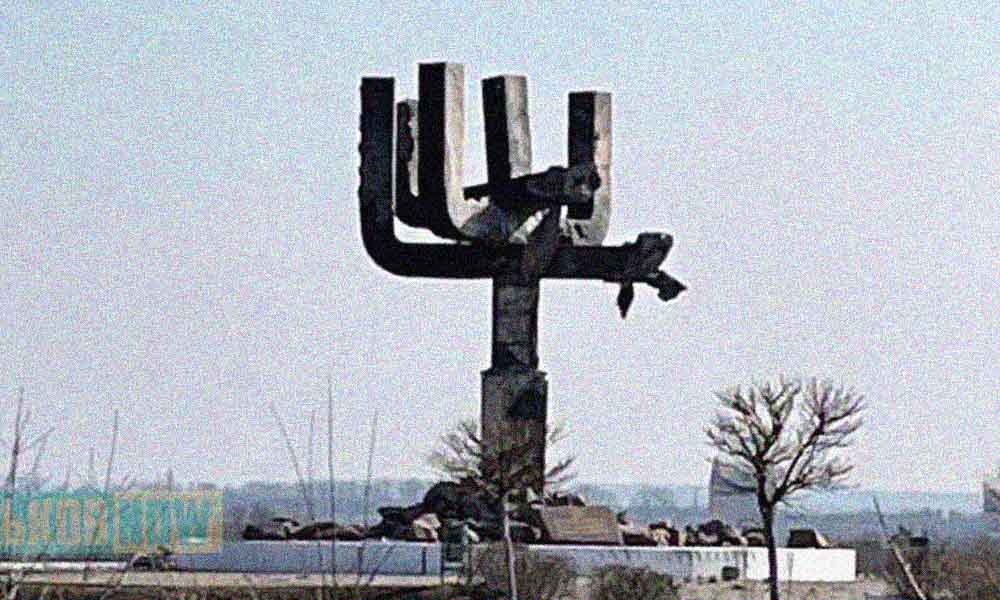
According to the “Religion on Fire” project, 17 Jewish religious sites were damaged in the fighting, including Jewish cemeteries in the Kyiv, Odesa, and Sumy regions. In the city of Mariupol, the old synagogue and a new community center were completely destroyed early in the war. Similarly, damaged sites in Kharkiv include two synagogues and the Karaite house of worship. In the Western Ukraine town of Chortkiv, located hundreds of miles from fighting in the Ternopil region, a synagogue was hit by rocket fire.
About 18,000 people left Ukraine for Israel between 2022 and 2024. No reliable numbers exist on the number of Jews who left for Europe and North America. It’s anyone’s guess how many will return once the fighting ends.
The future of Jewish groups in Ukraine will depend on funding streams for community and religious institutions.

Overall funding for Jewish organizations decreased significantly with Russia’s invasion, which ended the relationships with Russia’s Jewish oligarchs and destroyed the businesses of wealthy Ukrainian Jews.
After the war began, Zissels saw an opportunity for Vaad to make a difference. He began by arranging medical evacuations for residents—including the very ill—who were trapped in the war zones of eastern Ukraine. Some were even hiding in cellars to escape Russian bombardment.
“I was horrified by the psychological condition of these people,” Zissels says. Starting in March 2022, Vaad reprogrammed funds from its existing programs to address psychological rehabilitation of people, whether Jews or non-Jews, scarred by the war.
The criteria for selecting participants reflect the horrors of this war: (1) temporary or irreversible loss of a husband/breadwinner; (2) the family has the status of an internally displaced person; (3) the family has stayed for more than two weeks under occupation or under constant fire; (4) the family has suffered an irreversible loss of a close family member as a result of military operations.
Vaad initially focused on women and children, but after a year it expanded its rehabilitation sessions to include discharged members of the armed forces. Altogether, the group has provided 140 therapy sessions, each enrolling about 30 people and lasting three weeks. Per person, the cost runs at about $750 to $850.
Psychological rehabilitation remains Vaad’s primary mission. It’s a big lift, and financial woes notwithstanding, the sessions are ongoing. Zissels told me that he is delighted that the program is about to enroll its 4,000th participant.
While Zissels takes donor fatigue in stride, the rest of the world should not.
Paul Goldberg is the author of The Dissident, a novel, and president of the Union of Councils for Jews in the Former Soviet Union (UCSJ).
Top image: The menorah memorial at the entrance of the Drobitsky Yar Holocaust memorial outside Kharkiv, Ukraine, was damaged by Russian shelling in March 2022. Courtesy of Defense of Ukraine