
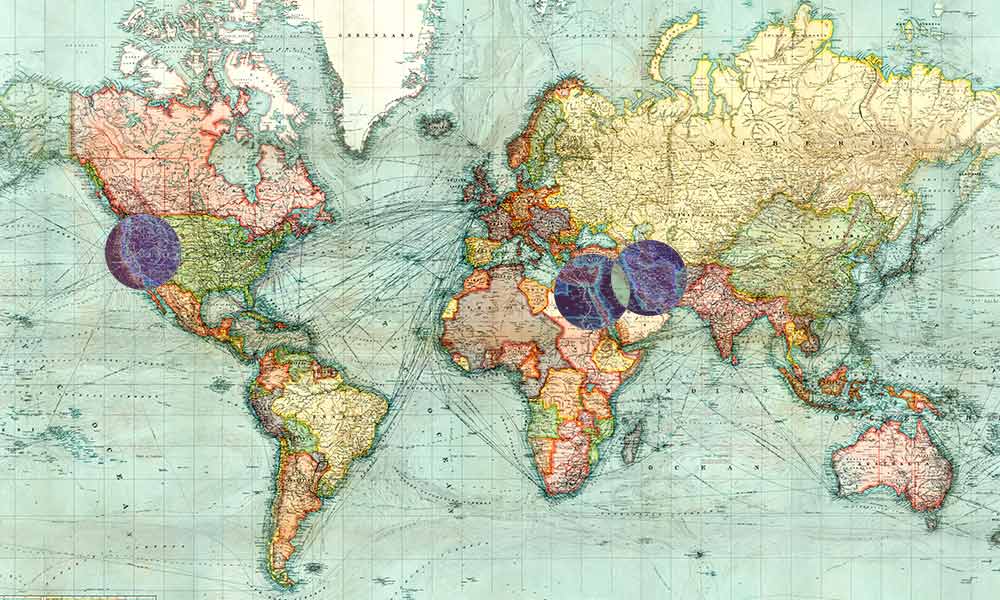
For most Iranian American Jews, the most accurate way to describe the current chaotic state of affairs in the Middle East is to declare that it is a state of homeland versus homeland versus homeland.
More specifically, it is a former homeland versus an eternal homeland that is allied with a gleaming land of refuge.
Though the description “former homeland” cannot capture the ingrained, central space that Iran holds for my community, which called the country home for 2,700 years until the 1979 Iranian Revolution set the repressive foundations of a fanatic Muslim theocracy, one that oppresses over 90 million people today.
For nearly three millennia, the Jews of Iran, who constitute one of the most ancient minority communities in the country, were born, lived and buried in the soil of this once-magnificent land. Between 5,000 and 8,000 Jews remain in Iran, one of the largest Jewish communities in the Middle East outside Israel; our siddurim are written in Persian and Hebrew, and each Nowruz, or Persian New Year, wherever we are, we add those siddurim to a collection of ancient Persian poetry books on our symbolic “haftseen” tables that display seven signs heralding a prosperous year.
Currently, millions of Iranians around the world are celebrating the bombing of their former homeland.
Iran’s deep entrenchment within our very DNA is nothing if not a testament to the immortality of Persian culture, values, history and the resilience of the Persian spirit itself.
But to observe the reactions of many of us in the Iranian diaspora worldwide, regardless of our faith, to this historic war, is to witness the irrational: Currently, millions of Iranians around the world are celebrating the bombing of their former homeland.
To highlight this irrationality, we should consider the responses of those in the Israeli diaspora mere hours after the Hamas attack on October 7, 2023, that ultimately resulted in a seven-front war for the Jewish state: Thousands of Israelis immediately ended vacations and business trips early, flew home, and re-enlisted in the IDF to serve their country. In some cases, Israelis who had been living abroad comfortably for decades also flew home and re-enlisted.
In doing so, they sent an unequivocal message: This geographical entity known as their former home was worthy of existence and defense, and that included its dysfunctional leaders.
Iranians in the diaspora, on the other hand, not only cringe at the thought of re-enlisting in their former country’s armed services but are throwing dance parties at home in which they openly celebrate news of another annihilated Iranian leader, or another Israeli or American bomb that reached its target. Incidentally, most of these celebrants are secular Muslims.
They are also sending an unequivocal message: The people of their former land are not only worthy of existence, but also of basic human freedom and dignity, which is why their repulsive leaders and their physical spaces, whether government buildings or missile factories, must be wiped out.
From my comfortable abode in sunny Los Angeles, I have remained happily uncomfortable.
In the late 1980s, I escaped Iran as a little girl and as a child survivor of the Iran-Iraq War. Overnight, my family and I became protected Jewish refugees and finally resettled in Southern California after spending nearly a year in a refugee resettlement city in Italy, thanks to the life-saving efforts of HIAS, then known as the Hebrew Immigrant Aid Society. We lost everything when we escaped Iran, but the most painful losses were the goodbyes that we believed were only temporary.
It has been over 30 years since we left the country, and the thought of returning as long as the regime was in power was always a laughable (and dangerous) one. That thought is beginning to change.
I screamed with gleeful disbelief after hearing that Iranian Supreme Leader Ali Khamenei—the emblem of evil—had been killed. Family members even forced me to sit down, offering me a glass of water due to my delirious ecstasy. Khamenei had been elected Supreme Leader weeks before we were granted entry to the United States. More than 30 years ago, as I attempted to decipher headlines in Italian newspapers related to news of his selection as the new supreme leader following the death of Ayatollah Ruhollah Khomeini, I grew so angry that I dropped my precious gelato cone onto my small sneakers, the ones I had worn the day we left Iranian soil and the warmth of my grandmother’s final hug still lingered in my anxious heart. I was angry because, despite my young age, I understood that Khamenei’s ascent to power meant I still could not return to my land, and to the arms of my loved ones back home.
Upon hearing the news of his demise, I was ecstatic, but my joy was temporary; the moment I watched the first of many U.S. Central Command-issued cockpit footage of American airstrikes—footage showing how fighter jets had locked in their target—I grew uncomfortable.
Their target was my former homeland. In fact, it was the city of my birth, Tehran.
It was a primal discomfort, one that is hard to describe. After 2,700 years of ingrained history, I felt possessive toward this mountainous and at times miserable territory that included the city where I was born, took my first steps, spoke my first words, learned to tie my mandatory Islamic head covering (hijab), and where the headquarters of the world’s largest state sponsor of terror once stood.
In truth, the Iranian revolution, which occurred before I was born, and its hideous implementation (and exportation) over nearly five decades, has been a cancer in the once healthy, albeit imperfect body of a collective Iran, once one of the most Westernized, modern and secular states in the region. Watching the silent footage from inside the cockpit of an American fighter jet that had identified its target was like watching a doctor make a deep incision in one’s own body.
The regime is a cancerous tumor. And the deeper the tumor, the bigger the cut.

One day later, my primal discomfort soared as my former homeland began shooting indiscriminate ballistic missiles at my eternal homeland. When I read that Jerusalem, the eternal city of my soul, was under fire and that the Kotel (Western Wall) had been evacuated and closed, there was only one thing to do: I immediately sent text messages to dozens of relatives in central Israel, asking about their welfare. From bomb shelters, they wrote back and assured me they had access to food, water and plenty of memes of the former Ayatollah.
I then began writing another series of text messages, this time, to loved ones in Iran, anxiously asking about their welfare, but with full understanding that there was and remains another internet shutdown in the country amid this now-prolonged war.
Those messages were, and remain, unanswered.
Tabby Refael is an award-winning writer, speaker and former weekly columnist for The Jewish Journal of Greater Los Angeles. Her Substack, Tabby’s Overcompensating Newsletter, is devoted to exploring issues surrounding Iranian, Jewish and Mizrahi identity.