
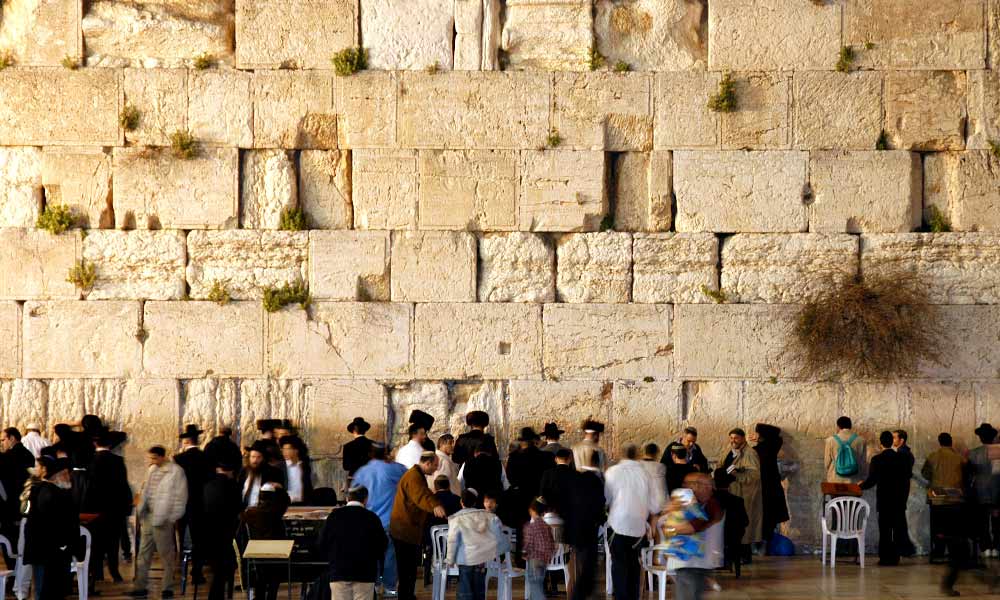
On February 25, the Knesset passed, by a vote of 56-47, the initial presentation of a bill that would effectively criminalize egalitarian prayer at the Western Wall, including in the southern section where today many Reform and Conservative families from Israel and abroad celebrate bar and bat mitzvahs.
The bill still has to go through additional committee oversights and readings. If it is passed as written in this initial stage, control of prayer arrangements at the Wall will be placed under the authority of the chief rabbinate, which is largely Haredi-controlled. Any deviation from the rabbinate’s interpretation of Jewish law as it pertains to permitted behavior at the Wall—including, for example, a woman who wears a tallit (prayer shawl) or prays aloud, even in the women’s section—will be viewed as a “desecration,” which carries criminal penalties of up to seven years in prison.
The bill was proposed by Member of Knesset Avi Maoz, head of the far-right religious Noam party, who, along with Haredi and other Orthodox politicians, cheered it as a “victory for tradition, Jewish law and Judaism.” Unsurprisingly, it was denounced by progressive Jewish leaders and Israeli opposition members as a blow to religious freedom and an insult to diaspora Jewry.
The implications of this proposed law extend far beyond the Western Wall and the attached plaza. The proposal must be seen as part of an increasingly acrimonious and polarizing struggle over who defines Judaism in Israel, the boundaries between state and religion and the source of religious authority. It also creates a rift between Jews in Israel, a majority of whom are not liberal on this, and those abroad, who are being told by the Israeli government that their interpretation of Jewish law and choice of religious expression are criminal offenses in the Jewish state.
The immediate trigger for the legislation was a recent ruling by the High Court of Justice that ordered the government to implement its own decision, passed in 2016, to recognize a pluralistic prayer space in the southern section of the Western Wall, near the archaeological site known as Robinson’s Arch, and to complete the necessary multimillion-dollar construction within ten months. Prime Minister Benjamin Netanyahu and Finance Minister Bezalel Smotrich, who was then tourism minister, supported the decision, along with a majority of the government.
“A state willing to jail women for reading Torah is taking giant strides toward becoming Iran.”
That decision was a compromise on the part of Orthodox feminist groups, since liberal Orthodox women had to give up any claim to the “traditional” Wall and abandon their struggle to be allowed to read from the Torah and wear tallitot and phylacteries in the women’s section. Yet the government stalled for a year on implementing the compromise. In June 2017, under pressure from his ultra-Orthodox coalition members, Netanyahu called the deal off, leading to a crisis with diaspora Jews. Various liberal and women’s groups appealed to the High Court of Justice and, in response, the state notified the Court that it would create the egalitarian space.
But successive governments, almost all of them headed by Netanyahu, have done nothing. Extremist rabbis often hold prayer services in the section that was supposed to be made available to the egalitarian groups in order to prevent them from praying there. In 2018, a boulder fell and damaged the site, and, for safety reasons, access to the ancient stones of the Wall has been restricted. The municipality and the government continue to argue about who is responsible for the lack of repairs—which, given their largely ultra-Orthodox makeup, neither of them actually want made.
The High Court of Justice does not intervene in issues of religion and state, and it did not do so in this most recent ruling, either. The judges did not address the status of the Wall, which is currently being treated as a synagogue rather than as a national holy site, which would by law have to be administered in ways that accommodate all Jews, including secular Jews. Indeed, the court focused solely on the government’s promise to upgrade the site, and it framed its decision as little more than procedural critique of the government that has yet to fix a small platform damaged by the boulder and arrange safe access.
Maoz and the bill’s other supporters know this. Yet they immediately seized the opportunity to present the Court as an adversary of Judaism and the Court’s decision as part of its purported overreach and its attempts to force a liberal agenda on the State of Israel.
“I want to say thank you to the High Court of Justice,” Maoz declared after the vote. “I hadn’t submitted this bill until the High Court gave its ruling…Today, the Knesset set a clear boundary to High Court interference in the sanctity of the Western Wall. It is inconceivable that a court should decide what constitutes desecration in the holiest place for the Jewish people.”
United Torah Judaism MK Moshe Gafni framed the bill as a victory over the Reform movement, which he described as “the destroyers of the Jewish people.”
For the bill to become law, it still must pass committee deliberations and additional votes. It may be amended or even canceled. Meanwhile, Netanyahu called off a meeting of the Ministerial Committee for Legislation. Although he offered no public explanation, it is widely believed that he canceled this meeting in order to prevent his ministers from backing the bill, in an apparent attempt to avoid a showdown with diaspora Jews. Meanwhile, Netanyahu, who also wishes to avoid a showdown that could threaten his coalition, has done nothing to rein in his extremist ministers and has not commented on any of the bill’s provisions.
But the damage has already been done in Israel and abroad. Yizhar Hess, vice chairman of the World Zionist Organization and formerly a long-time head of the Conservative movement in Israel, posted on X: “Today’s approval of moving forward with legislation to imprison Jews who pray at the Egalitarian Kotel will always be remembered as a dark day in the history of Zionism and the nation-state of the Jewish people… How could it be that the only Western democracy without freedom of religion for Jews could be the Jewish state?” The attempt to push the bill through must also be seen as part of a wider movement by the government to turn Israel into a religious-national state and part of a broader legislative pattern intended to expand the authority of religious institutions over Israel’s legal system.


Recently, the Knesset’s Constitution, Justice and Law Committee approved a final draft of a bill that would expand the country’s religious courts’ authority to arbitrate civil disputes in accordance with religious law. According to the bill, the status of religious court arbitration rulings will be comparable to that of a civil court verdict. This means that religious court arbitration could be enforced immediately; furthermore, arbitration rulings cannot be appealed.
Ruth Halperin-Kaddari, founding head of the Rackman Center at Bar-Ilan University, which promotes the status of women in matters of family law, notes that the rabbinic courts already exercise exclusive authority over marriage and divorce for Jewish citizens, as well as certain aspects of personal status.
Now, she says, “For the first time, the state is seeking to grant the state religious court system broad authority to hear cases involving private civil disputes…This will establish a religious legal system that bypasses the civil one.”
Halperin-Kaddari also notes that since the system is based on Orthodox interpretation of Jewish law, women cannot serve as judges. “The rabbinical court system isn’t fully committed to the principles of equality and human rights that are the foundation of the Israeli legal system…and women will now be deprived of the protections offered by civil law.”
Anna Kislanski, the CEO of the Israel Movement for Reform and Progressive Judaism, adds, “A state willing to jail women for reading Torah is taking giant strides toward becoming Iran.”
Regardless of its final fate, the bill has already brought to the fore questions that liberal Jews in Israel and abroad can no longer ignore, including who has the authority to define Judaism in the Jewish state, what the role of the judiciary is in protecting minority religious rights, and whether Israel can balance its Jewish and democratic identities.
And, finally, does this prove that in Israel, when coalition politics collide with Jewish unity, politics win out?
(Top image credit: Wayne McLean (CC BY 2.0))