
Sitting down to the seder table this year, we may feel daunted at the chaos of the times that surround us. War, fear, the loss of stability—can the ritual work its familiar magic in the face of all that? Will we somehow manage, yet again, to reexperience the exodus from Egypt? Will the questions and echoes it raises be more than we can handle?
A moment’s reflection should reassure us that the Haggadah has resonated in worse times than these. What could be more chaotic and disorienting than the experiences it actually commemorates? The exodus from Egypt is a story of wrenching discontinuity. Israelis passing long nights in safe rooms or stairwells may relate all too well to those Hebrew slaves hurriedly eating the Passover offering while listening for the sounds of death and destruction outside. Families threatened with war or famine worldwide share the terrifying weight of the decision as to whether now is the time to pick up and flee from a place that no longer feels safe. (Don’t wait for the bread to rise. Just go!)
At its heart, the seder is very simple. We share a meal; we tell a story. The Haggadah, likewise, has its fixed elements, but it’s also capacious, a thousand-year-old outline waiting to be filled and brought to life with discussion and argument.
It’s that tension between the story and its empty spaces that inspired us to put together this supplement to your own Passover Haggadah this year. We reached out to brilliant and thoughtful observers—poets, artists, rabbis and others—and asked what they would add to the Haggadah today and, just as important, where they would add it. For instance, one contributor shares a Yiddish poem about the Warsaw Ghetto; another reminds us to reflect upon the miracle of Israel. Others reflect on Jewish peoplehood, on strength under pressure or pressure, or on the seder itself. Two poets offered fine new work inspired by Gaza, raising the question: If we’re moved to grieve for Gaza, should it be done as part of the Maggid, the story we tell about our liberation, or after dinner, when we taste the fruits of freedom and weigh its responsibilities?
We hope you’ll take this as a smorgasbord to sample from as you like, or use it as a jumping-off point for your own group’s explorations and celebrations. A happy and meaningful Pesach to all!—Amy E. Schwartz
Click here for a printable PDF version of Moment’s Haggadah Supplement
With contributors from
Aviya Kushner | Shais Rishon | Mijal Bitton | Tamar Biala | Dovid Bashevkin | Miriam Udel | Marge Piercy | David Arnow | Roya Hakakian | Adam Serwer | Joy Ladin | Dara Horn | Tobi Kahn
Aviya Kushner
Maggid
Ha Lachma Anya | This is the Bread of Affliction
A Yiddish Poem from the Warsaw Ghetto
Every year at our family seder my father reads a Yiddish poem which begins “in varsheve geto, iz itst khodesh Nissan,” or “in the Warsaw ghetto, it is the month of Nissan.” The poem by Binem Heller describes a seder under perilous conditions, with empty glasses and cries of hunger from the children. It recounts the pain of not being able to open the door to a needy person in the kol dichfin section. But the part that gets to me every year is the line about how truths and lies are mixed. The word Heller uses for mixed is zumisht, which my father tells me can also be used to describe when a person is confused. I think this is something all of us feel with time—how lies become larger. Our doubts become mixed with the ancient beauty and truth of Jewish tradition. Sometimes we are confused by the enormity of the contrasts we observe. The poem provides room to be furious, to acknowledge horror, and yet to continue. Many of us need this room.
+ Read full poem here
It is the Month of Nissan in the Warsaw Ghetto
In the Warsaw Ghetto is now the month of Nisn
Over goblets of borscht and matzos from bran
The people again sing of the miracles of old
How the Jewish People came out of Egypt
How old is the story? How old is the melody?
But now, behind shrouded windows, the seder takes place
And truth and lies are so interwoven
it’s hard to tell one from the other
“Kol dichfin, let all who are hungry . . . ”
The doors and windows are covered
“Kol dichfin, let all who are hungry . . . ”
Asleep from hunger, the little ones
Kol dichfin, let all who are hungry . . . ”
By empty Pesach dishes
“Kol dichfin, let all who are hungry . . . ”
The old blind men are weeping
In the Warsaw Ghetto is now the month of Nissan
And one could think that the figures here piously swaying
are Marranos hiding from the outside world.
No!
The remnants of the Jewish People
Of the “sixty ten thousands” that Moses
led out of Egypt has been driven into the ghettos.
Where dying’s permitted — but protest is not from Holland. From Belgium.
From France. From Poland.
Here sit the last of them weeping.
Here sit the last of them plundered and naked.
From 50 families remains only one.
In the Warsaw Ghetto is now the month of Nisan.
There’s Volinska Street. The crooked attic roof.
My mama has guests?
For the seder, from Brussels . . .
Her son and grandchildren have come.
From what can she prepare a seder?
Who could have counted on that so unexpectedly?
Accompanied by “angels”
with axes and crosses
They came to be slaughtered!
The table is set and the goblets are standing
Prepared for “selected” souls
But the children are begging for bread, in French.
And not one of them will ask “The four Questions”
In the Warsaw Ghetto is now the month of Nisan.
My mama puts a smile on her face.
Her lips which are bitten from hunger
Are transformed by the holiday.
Milder, softer.
Her eyes begin to shine again
Just as they did long ago in bygone times.
In her eyes the raisin wine is brimming
From long-forgotten distant Seders.
Suddenly her eyes widen in terrified surprise
Astonished, she stretches out her hands,
her pious hands.
Instead of starting the seder with Kiddush
Her son begins intoning:
“Pour out your wrath! . . .”
In the Warsaw Ghetto is now the month of Nissan.
The cup of Elijah stands full
But who has come here to disrupt this seder?
The angel of death has come to drink!
As always, German — the language of giving commands.
As always — the language of barking orders!
As always — they have come to round up
The Jewish People to slaughter
No more will the ghetto stand for the taunts of the Nazis
As they bring a world of destruction.
With blood we will smear the doorposts!
With blood from the Germans!
With blood from the rapists!
In the Warsaw Ghetto is now the month of Nissan
From neighbor to neighbor
the word will be passed
German blood will not stop flowing!
As long as one Jew in the ghetto still lives!
In their eyes will be no submission.
In their eyes there will be no more tears.
Only hatred and determination
And the fierce joy of resistance!
From their transformation!
Listen! How in the night the shots resound!
Listen! How death hunts the Nazis in their tracks!
Listen! We’ve come to the end of the story!
With heroic self-sacrifice on the first night of Leil Ha-Shimurim [the Night of Watching, Pesach]
via the Intermountain Jewish News
Aviya Kushner is the author of The Grammar of God and WOLF LAMB BOMB.
Shais Rishon
Ma Nishtana | Why is this Night Different?
A Fifth Question for the Curious
The seder famously has many “fours” symbolizing the four expressions of freedom G’d uses when speaking to Moses about freeing the Children of Israel from Egypt. However, there is also a fifth expression of freedom that is one of the origins of the Cup of Elijah, a Fifth Cup added to the Four Cups much like the fifth expression among the four expressions. If I were to add to the seder, I suppose I would have no choice, given my nom de guerre (MaNishtana), other than to add another question immediately after the Four Questions of Mah Nishtanah:
“How is this night different for those whose chains have changed but not disappeared?”
The Haggadah centers curiosity as the engine of liberation. Adding a fifth question honors that structure without disrupting it. For Black and Jewish readers, the Exodus is not only ancient memory but interpretive grammar for modern bondage—whether racialized incarceration, antisemitic violence or inherited inequality. This question extends the Haggadah’s logic. If we are commanded to see ourselves as having left Egypt—or, in Hebrew, “Mitzrayim,” meaning “constriction”—we are also commanded to see where Egypt—constriction—persists.
Shais Rishon is the Rabbi of Ohel Eidot Chemdata synagogue and activist who writes on African American Judaism under the pen name MaNishtana.
Mijal Bitton
Avadim Hayinu | We Were Enslaved
Solidarity with Iran
Early in the seder, we recite Avadim Hayinu—“we were slaves to Pharaoh in Egypt.” It is the moment we name what bondage was and acknowledge that without redemption, we and our children would still be enslaved. This year, inspired by the hundreds of thousands of Iranians who have taken to the streets over these past years at tremendous cost, I would read the song “Baraye” in translation at this moment in the seder.
In September 2022, a 22-year-old Kurdish Iranian woman named Mahsa Amini was arrested by Iran’s morality police for not wearing her hijab correctly. She died in custody within days, and her death ignited the Women, Life, Freedom movement—one of the most powerful uprisings against the Islamic Republic since its founding. Out of that moment came a song the regime immediately recognized as dangerous. A 25-year-old musician named Shervin Hajipour collected tweets from ordinary Iranians explaining why they were risking their lives in the streets and set them to music. Each verse starts with the word “baraye” which means simply “for the sake of.” He recorded it alone in his room and uploaded it to Instagram. Within days it had tens of millions of views. The regime arrested him and took the song down. They understood what tyrannies always understand: Naming your dreams out loud is an act of resistance.
That spirit has not been extinguished. As we gather at our seder tables this Pesach, Iranians are still resisting and fighting for freedom. This year, protests erupted across more than 200 cities in what has become the largest uprising since the Islamic Revolution—and the regime has responded with devastating violence.
“Baraye” is poignant and extraordinary and worth bringing to your seder table in full—but here I am only highlighting some of its lines:
For dancing in the streets. For the fear that comes with a kiss. For my sister, your sister, our sisters.
One of the quiet miracles of the Exodus is this: Even under the heaviest tyranny, even when Pharaoh had convinced an entire civilization of his own divinity, the Israelites could still cry out. They could still dream of something different. That cry—that ability to say “we were slaves” and in the same breath dream of a better future—before any plague, before any redemption—was itself an act of radical faith.
“Baraye” is that same cry. It is not a victory song. It is a list of everything a people is still waiting for, everything they are willing to risk their lives to reach. And this year, it is not history. It is happening now.
We are inspired by their courage. We read “Baraye” to stand in solidarity with their struggle. And we pray to God that they—and all people living under tyranny today—taste redemption speedily in our days.
Mijal Bitton is a sociologist and the cofounder and spiritual leader of The Downtown Minyan in New York City.
Tamar Biala
Avadim Hayinu | We Were Enslaved
On Job and Caregivers from Other Lands
For a decade now, my mother has been ill with Alzheimer’s disease. Over the years, she has been looked after by several foreign caregivers, all from Kerala, India, wonderful women who left their homes and families and came here to Israel, to provide for their own children lives better than theirs. I became particularly attached to one woman named Sheeja. Before returning home to India, she was with us for a Passover seder. At one point we asked her please to tell us, what is it like to be a foreign worker in Israel? The answer we received was long and complicated, and utterly transformed the seder for us.
Israel employs foreign workers from Asia and Eastern Europe as caregivers for the elderly, as agricultural workers, in construction, and more. On October 7 many working in agriculture and in caregiving in the communities around Gaza were murdered or even kidnapped. The foreign workers all over Israel were deeply shaken and many returned home as soon as they could (some by special rescue flights organized by their countries). Their absence dramatically showed how dependent we are on them and what kinds of work they are doing for us, as many Israelis and many friends who came from abroad to show their support volunteered to take these workers’ place, especially in agriculture.
When the testimonies of survivors of October 7 began to come to light in the media, I was moved to read those of the foreign workers who had survived, and the eulogies for those who’d been killed. For a long while, it was unclear if the foreign workers who had gone abroad would return to Israel once things calmed down. To our relief, many returned, and even brought friends and family members.
Throughout the last two years, I was kept informed on this subject, thanks to a member of our synagogue (the Hakhel egalitarian community in Baka, Jerusalem) named Josh Lawson, who during this war was the Medical Organization Officer for the IDF. At the beginning, Josh organized the work on the Shura base (identifying all bodies) and then was in charge of few other things, among them, the care for all the foreign workers that were wounded or in captivity, and to the families of all the foreign workers abroad, including those who were murdered, of course. He saw to it that they would receive the exact same treatments and financial compensations as the Israeli victims and their families, for the rest of their lives.
Recently, I reread the book of Job, and right from its opening, describing the blows rained down on Job (and his family!) I noticed that the “lads” working for him are mentioned again and again among those harmed by those blows too. At once, it became clear to me that this was talking about our foreign workers, and I turned to write a midrash about what became of them.
In my midrash, Job knows that the injuries to the “lads” and their families result from God/Satan’s injuring him, and he decides to help those among them who have survived, the families of those who didn’t, and of course, those who were taken captive. I ascribe to Job all the doings of Josh Lawson during the Gaza War. The midrash concludes with the return of the lads who survived to Job, whose situation improves anew, only this time, they are no longer called “lads” because Job sees them as family and calls them “my sons and daughters.”
Job’s Lads
For Major Josh Lawson,
Medical Organization Officer (res.), Israel Defense Forces
One day…and a messenger came to Job, and said: ‘The cattle were plowing, and the jennies grazing beside them. Sabeans fell upon them and took them, and the lads they put to the sword…God’s fire fell from the sky and burned up the sheep and the lads and consumed them…Chaldeans deployed in three columns, swept over the camels, and took them and the lads they put to the sword. (Job, 1, 13-17)
The Satan struck at Job’s lads. And those lads, who were they? They were those workers from faraway lands who would help Job in his fields, and with his sheep and cattle in the cowshed, and some say, they even looked after Job’s aged parents.
Job saw, and said in his heart, the Satan sought to test me, he went and struck at my lads, it was on my account that this storm came over them. And all the while he was sitting in mourning for his children, he knew that the families of those murdered lads were sitting in mourning for their loved ones, too, and that the families of those whose children had been taken into captivity, and the families who had no idea what was the fate of their children, were suffering and anguished.
When his friends came to comfort him, and wanted to talk about his pains, he answered them, saying of those lads, When Shaddai was with me, my lads were around me (Ibid. 19, 5) but now they will die in their youth (Ibid. 36, 14)? How will I help them and their families at this hard time?
He thought, until he said, and now I will be their tune (neginatam) and I will become their word (Ibid. 30, 9)—I will be their defender (meginam) and I will be their speech until they receive everything they need, those who survived, those who were taken captive, and all the families of those who were killed.
He stood up and did something: Each one who was saved from that inferno, he would visit their sickbed, and support them until he healed. And he would go, in the days and the nights, looking for the bodies of the murdered, to bring them to their families. And he would care and look after each and every family whose son was murdered or missing, in body and soul. And he didn’t rest or sit still until he found the bodies of those who were murdered in their captivity, and those who survived in those tunnels, until he returned them to their families.
The Holy Blessed One, and He, too, restored to Job what he had lost, as is written and God gave to Job twice as much…and God blessed Job’s ending more than his beginning, and he had fourteen thousand sheep, six thousand camels and a thousand pair of cattle and a thousand jennies. (Ibid. 42, 10-12).
But it doesn’t say that he restored lads to him. Because the Holy Blessed One had not restored them, but they returned by themselves. And this is what Scripture means by And he had seven sons and three daughters (Ibid. 42, 13) And he had and not as is written at the beginning and were born to him seven sons and three daughters (Ibid. 1, 2), for his children at his end were none other than his lads, whom he strengthened, and strengthened their families, and they were returning from afar to help him, and he would call them “my sons and my daughters.”
Tamar Biala is the editor of Dirshuni: Contemporary Women’s Midrash, a collection of midrash composed by Israeli women.
Dovid Bashevkin
Arba’a Banim | The Four Children
Sharing Your Family Narrative
If given the opportunity to add something to the Haggadah, I would perhaps suggest a blank page—to allow people to gather their thoughts and reflect on all the blessings in their lives. Honestly, I don’t think the Haggadah needs or benefits from additions, because the underlying focus should not be the page, but the people around the Seder table. The Haggadah is a vehicle for a loftier goal: to transmit the significance of our immutable Jewish identity to our family.
Passover is a celebration of the formation of the Jewish people, and the Haggadah serves as a springboard to connect ourselves and our families to the still-unfolding story of that people. That is why, when Passover approaches, I have a personal custom of rereading writer Bruce Feiler’s 2013 New York Times op-ed, “The Stories That Bind Us.” It is a powerful piece that presents research showing how sharing a family narrative with your children promotes long-term resilience. While not quite an “addition,” perhaps the ideas it contains can enhance your Passover as they have enhanced my own.
Here is a an excerpt (but really the entire article is incredibly profound):
Decades of research have shown that most happy families communicate effectively. But talking doesn’t mean simply “talking through problems,” as important as that is. Talking also means telling a positive story about yourselves. When faced with a challenge, happy families, like happy people, just add a new chapter to their life story that shows them overcoming the hardship. This skill is particularly important for children, whose identity tends to get locked in during adolescence.
The bottom line: if you want a happier family, create, refine and retell the story of your family’s positive moments and your ability to bounce back from the difficult ones. That act alone may increase the odds that your family will thrive for many generations to come.
Dovid Bashevkin is the director of education for NCSY, the youth movement of the Orthodox Union and creator of the 18Forty podcast, which explores traditional Jewish topics in a contemporary context.
Miriam Udel
B’Yad Chazakah | With a Strong Hand
The Vulnerability—and Resilience—of Children
The Maggid (Telling) section, the heart of the Haggadah, features midrashic elaborations of the declaration (Deuteronomy 26:5-8) that the farmer is meant to voice upon bringing the first fruits to the Temple. Between the expounding of verses seven (“And we cried out to the Lord…) and eight (“And the Lord brought us out of Egypt with a strong hand…), I would propose to insert another midrash altogether, this one drawn from Tractate Sotah 11b. This Talmudic material is part of an extravagant suite of stories about the early life of Moses and his family, and it emphasizes the decisive roles women played in the story.
After asserting that the Jewish people were redeemed from Egypt “in the merit of the righteous women of that generation,” the passage goes on to describe how even during the period of harsh enslavement, when all hope seemed lost, the daughters of Israel would nevertheless seduce their husbands in the field, engender new life, and then commend their “illegal” newborn sons to God’s care in pits dug under apple trees. God in turn would send angels to clean and care for the boys, suckling them with stones that flowed with oil and honey, as promised by the verse, “And He would suckle them with honey from a crag and oil from a flinty rock” (Deut. 32:13).
With this one story, the sages accounted for two questions about the biblical text. First, under Pharoah’s decree to throw all baby boys into the Nile, how did a generation of men survive until the moment of the exodus? And when the Israelites crossed the Red Sea and commemorated the occasion with a poetic song, how were they able to sing, “This is my God, in whom I exult” (Ex. 15:2)? In other words, how exactly did they recognize the Divine so as to make this positive identification? According to this midrash, they survived prolonged exposure and were able to recall the God whose lavish care saved their lives in infancy.
If the seder guests aren’t too hungry (perhaps you’ve offered “heavy karpas”), then take a look at Levin Kipnis’s 20th-century update, a Yiddish children’s story called “Children of the Field.” Kipnis dilates on the anguish of those heroic mothers, as they entrusted their sons to the cradle pits with lyrical verse:
Apple tree, apple tree!
The grief, it drives me wild.
As you guard your apples,
Please protect my child.
Remembered for his foundational role in the development of modern Israeli children’s literature, Kipnis was keen to emphasize that a new generation, never socialized into enslavement, would lead the people to their destiny:
Moses the Liberator came and called, ‘Stand up, free children! You, who were never slaves to Pharaoh, you who never felt his heavy hand, you who never molded any bricks and mortar, stand up and lead the way for the entire people!’
This Passover finds us in the midst of a year that has underscored the singular vulnerability of children: in bomb shelters, or attempting to survive without the benefit of bomb shelters, in hiding, and with nowhere to hide. Kipnis also reminds us of children’s equally pronounced resilience. Wherever we are to go, they will—necessarily—lead:
‘We’re going! We’re going!’ they all cried out with one voice.
And with courage and pride, with loud singing, they strode to the gates of Egypt, and the entire people, the Children of Israel, marched after them with their heads held high!
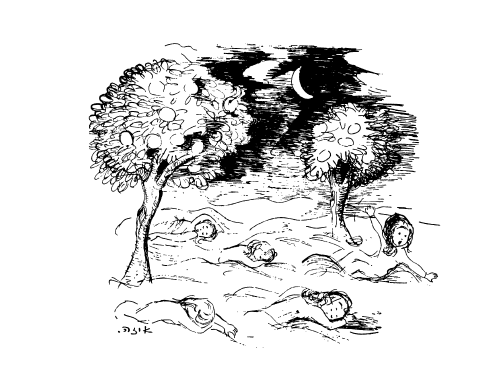
Illustration from Levin Kipnis, Untern Teytlboym (1961), illustrated by Isa.
Miriam Udel is an associate professor of Yiddish language, literature and culture at Emory University. Her most recent book, Modern Jewish Worldmaking Through Yiddish Children’s Literature, won a National Jewish Book Award.
Marge Piercy
Eliu Eser Makot | The Ten Plagues
The Quandary of Our Time
This is a poem I plan to add to my own Haggadah this Pesach. I wrote it earlier this year, after I’d begun thinking about this year’s seder. Right after the recital of the Ten Plagues, I think it’s important to talk about both the rise of antisemitism and our situation vis-à-vis Israel’s war with Hamas. The seder is a good time to discuss how we feel as Jews about the war and about resurgent antisemitism. This Pesach, I find them both impossible to ignore.
+ Read full poem here
Quandary in blood
I harvest beans, tomatoes,
zucchini while children starve
In Gaza. This new wave
of antisemitism scares me.
As a Jew, I’ve often been
the victim. I can’t process
guilt for something I cannot
change or even influence—
thousands of miles from here.
Yet it weighs on me, storm
cloud dark red with blood,
deaths that government causes.
How to do something. But
what? We are becoming
mirrors of those who killed
so many of us. How did we
transform? I can’t truly
celebrate Rosh Hashana
this year of endless violence
of invasions, families driven
from their homes. Yom Kippur
is the holy day I need, to turn
inward to examine and outward
to attempt to find the right way.
Marge Piercy is a poet, novelist and liturgist who has authored over 30 books of poetry and fiction.
David Arnow
Eliu Eser Makot | The Ten Plagues
A Call for Empathy
Unlike the biblical Exodus, the traditional Passover Haggadah devotes relatively little space to the plagues. Perhaps this is because the plagues are so morally ambiguous. For the last five plagues God hardens Pharaoh’s heart, depriving the Egyptian king of free will and preventing him from acceding to Moses’s demand to “let my people go.” The last plague, the slaying of the Egyptian first born, raises a different question. Is it justified to slay Egyptian children for the sins their parents may have committed? The God of Jonah was reluctant to destroy Nineveh because it contained 120,000 children “who cannot discern between right hand and left hand; and also much cattle” (Jonah 4:11). The God of the Exodus evinces no such empathy and slays the Egyptians firstborn children and animals to boot.
Jewish tradition is by no means blind to God’s seeming lack of empathy toward the Egyptians. The Talmud strikes an apologetic note when it imagines God chiding the angels for singing songs of praise when the Egyptians, “the works of My hands,” are drowning in the sea. The same source is often erroneously given as the rationale for the custom of spilling out a drop of wine for each plague from our cups at the seder. This tradition arose from treating these drops of wine as embodiments of the plagues and spreading them on the homes of our enemies, as was the custom in various Jewish communities.
In these times when empathy often feels in such short supply, it’s worth pondering a midrashic tradition involving the slaying of the firstborn. It first surfaced in the 3rd century and was elaborated upon many centuries later. The early version simply asks a question: What would happen if an Israelite and an Egyptian were in the same bed? Yes, goes the answer, God would pass over the Israelite and slay the Egyptian firstborn (Mekhilta of Rabbi Shimon Bar Yochai on Exodus 12:23).
A medieval midrash compiled in the Land of Israel expanded on this curious question. Before the last plague struck, the Bible says the Israelites should not leave their homes (Exodus 12:22). But…
When Moses said: ‘I [God] will smite all firstborn’ (Exodus 12:12), there were some [Egyptians] who were afraid and some who were not afraid. One who was afraid would take his firstborn to an Israelite and would say to him: ‘Take this one and let him stay the night with you.’ When midnight arrived, the Holy One killed all the firstborn. For those who were located in the houses of the Israelites, the Holy One would step between the Israelite and the Egyptian and would take the soul of the Egyptian and leave the soul of the Israelite. The Israelites would awaken and find the Egyptian dead between each and every one [of their children] (Exodus Rabbah 18:2).
This text’s call to act with empathy is breathtaking. The Israelites not only open the door to their oppressors and offer sanctuary to their firstborn children, but they are risking their lives. Are they opening the door to the mashchit, the destroyer who actually slays the firstborn (Exodus 12:23)? But the Israelites don’t just offer harbor to these Egyptian firstborn, they take them into their beds. The Israelites likely hope this will help save the Egyptians from the destroyer. Whatever drives God’s inscrutable judgment to slay Egyptian firstborn children, down here on this earth, this midrash calls us to know the heart of those in narrow straits—to be rescuers, not bystanders. It’s a tall order in any time, but if not us, who?
David Arnow is co-editor of My People’s Passover Haggadah and author of Creating Lively Passover Seders and Choosing Hope: The Heritage of Judaism.
Roya Hakakian
Dayenu | It Would Have Been Enough
A Prayer for the Promised Land
Can the telling of the Jewish story, our collective Haggadah, be complete without the story of Israel? The tale that begins with Abraham’s refusal to bow to idols, thus ushering monotheism into the world, arrives at its climax in the story of the exodus from Egypt, and reaches its resolution in 1948, with the establishment of modern Israel.
It may be difficult in our age of misinformation to see Israel in its proper 75-year perspective. Having been a witness to the 47-year struggle for freedom in my birth country, Iran, the successful execution of the Zionist liberation project appears that much more staggering. How did a group of scrappy, pogrom-surviving Europeans build a country? How did they have the foresight to build not one but two universities—Technion in 1912 and Hebrew University in 1918—decades before Israel was declared the official homeland of Jews?
The miracles that God performed in the desert through Moses, Jewish mortals performed once again at the start of the 20th century. Moses touched his cane and the rod of wood came alive. Eliezer Ben Yehuda took the inanimate Hebrew of the religious texts and breathed life into it to create a living language on the lips of millions. Moses struck the rock and water gushed forth. Jewish kibbutzniks made the desert bloom. Moses raised his arm and the waters parted. Jewish scientists built a dome that closed the Israeli sky.
So as we say a prayer over wine, matzah, bitter herbs and the rest, we must also say a prayer for the generation who summoned all of us from our disparate Egypts and restored us to the Promised Land:
“Blessed are You, Lord our God, King of the universe, who gave us the generation of Jews who finished the work that Moses began.”
Roya Hakakian is an Iranian-American writer, journalist and political commentator.
Adam Serwer
Zecher L’Mikdash K’Hillel | A Remembrance of the Temple According to Hillel
America as a Reality and as an Aspiration
If I could add one element to the Haggadah this year, it would be the poem “Let America Be America Again” by Langston Hughes.
I would read it after the Korech and before the meal. I think Hughes’s poem remains resonant in the way that it describes America both as an aspiration and as a reality, and how that dichotomy which seems so present today has existed for a long time in many forms. This may be a sobering realization, but it also contains a seed of hope in the bravery with which Hughes and others confronted this reality in their own time, when far fewer people were listening.
+ Read full poem here
Let America Be America Again
By Langston Hughes
Let America be America again.
Let it be the dream it used to be.
Let it be the pioneer on the plain
Seeking a home where he himself is free.
(America never was America to me.)
Let America be the dream the dreamers dreamed—
Let it be that great strong land of love
Where never kings connive nor tyrants scheme
That any man be crushed by one above.
(It never was America to me.)
O, let my land be a land where Liberty
Is crowned with no false patriotic wreath,
But opportunity is real, and life is free,
Equality is in the air we breathe.
(There’s never been equality for me,
Nor freedom in this “homeland of the free.”)
Say, who are you that mumbles in the dark?
And who are you that draws your veil across the stars?
I am the poor white, fooled and pushed apart,
I am the Negro bearing slavery’s scars.
I am the red man driven from the land,
I am the immigrant clutching the hope I seek—
And finding only the same old stupid plan
Of dog eat dog, of mighty crush the weak.
I am the young man, full of strength and hope,
Tangled in that ancient endless chain
Of profit, power, gain, of grab the land!
Of grab the gold! Of grab the ways of satisfying need!
Of work the men! Of take the pay!
Of owning everything for one’s own greed!
I am the farmer, bondsman to the soil.
I am the worker sold to the machine.
I am the Negro, servant to you all.
I am the people, humble, hungry, mean—
Hungry yet today despite the dream.
Beaten yet today—O, Pioneers!
I am the man who never got ahead,
The poorest worker bartered through the years.
Yet I’m the one who dreamt our basic dream
In the Old World while still a serf of kings,
Who dreamt a dream so strong, so brave, so true,
That even yet its mighty daring sings
In every brick and stone, in every furrow turned
That’s made America the land it has become.
O, I’m the man who sailed those early seas
In search of what I meant to be my home—
For I’m the one who left dark Ireland’s shore,
And Poland’s plain, and England’s grassy lea,
And torn from Black Africa’s strand I came
To build a “homeland of the free.”
The free?
Who said the free? Not me?
Surely not me? The millions on relief today?
The millions shot down when we strike?
The millions who have nothing for our pay?
For all the dreams we’ve dreamed
And all the songs we’ve sung
And all the hopes we’ve held
And all the flags we’ve hung,
The millions who have nothing for our pay—
Except the dream that’s almost dead today.
O, let America be America again—
The land that never has been yet—
And yet must be—the land where every man is free.
The land that’s mine—the poor man’s, Indian’s, Negro’s, ME—
Who made America,
Whose sweat and blood, whose faith and pain,
Whose hand at the foundry, whose plow in the rain,
Must bring back our mighty dream again.
Sure, call me any ugly name you choose—
The steel of freedom does not stain.
From those who live like leeches on the people’s lives,
We must take back our land again,
America!
O, yes,
I say it plain,
America never was America to me,
And yet I swear this oath—
America will be!
Out of the rack and ruin of our gangster death,
The rape and rot of graft, and stealth, and lies,
We, the people, must redeem
The land, the mines, the plants, the rivers.
The mountains and the endless plain—
All, all the stretch of these great green states—
And make America again!
“Let America Be America Again” by Langston Hughes from The Collected Poems of Langston Hughes Copyright © 1994. Used by Permission of the Estate of Langston Hughes and International Literary Properties LLC.
Adam Serwer is a staff writer at The Atlanticand the author of The Cruelty Is the Point.
Joy Ladin
Echad, Mi Yodeiah | Who Knows One?
New Words for a Final Song
The Haggadah annually reminds us that Jewish nationhood and peoplehood are rooted in the violent oppression we experienced during our enslavement in Egypt. The Torah repeatedly invokes these experiences to spur us to treat those who are less powerful than we are with justice and compassion. But it is all too easy to read the Haggadah as centering Jewish suffering in ways that minimize, erase and excuse suffering Jews inflict upon others. This Jewish-suffering-centered perspective has been reinforced by millennia of exile and antisemitic oppression, and it has shaped many American Jewish responses to Hamas’s October 7 atrocities and the subsequent Israeli atrocities in Gaza and the West Bank. This poem joins other recent Jewish efforts to reframe our tradition in ways that resist this perspective, replacing the words of one of the Haggadah’s concluding drinking songs, “Echad, Mi Yodeiah,” (“Who Knows One?”) with glimpses of Gaza in which everyone, Palestinian and Israeli, is described and counted as “an image of God.”
+ Read full poem here
Who Knows One?
Gaza, 2024—
One image of God
picking its way through what’s left of a street
looking for a body.
*
Two images of God. One
has the other in its sights. One is five
or seventy-five. The other twenty-three.
*
Three images of God:
one shaking, one shooting,
one screams.
*
Four images of God
praying at dawn
beside an armored jeep.
*
Five images of God
gathering
grass to eat.
*
Six images of God –
faces
birds picked clean.
*
Seven images of God
burying
the rest of the family.
*
Eight images of God
bandaging wounds
with duct-tape.
*
Nine images of God –
five hostages, two guards,
two corpses.
*
Ten images of God
only
following orders.
*
Eleven images of God
orphaned
during story-time.
*
Twelve images of God
playing soccer
who won’t turn thirteen.
*
Thirteen images of God
a moment before
the missile strikes the building.
*
One image of God
in what’s left of the street
gathering remains.
Joy Ladin is a poet and professor whose memoir Through the Door of Life: A Jewish Journey Between Genders was a finalist for the 2012 National Jewish Book Award.
Dara Horn
Chad Gadya | One Little Goat
The Courage to Leave Egypt
In my graphic novel One Little Goat: A Passover Catasrophe, a family at a seder discovers that thousands of years of previous seders are hidden underneath their seder. As the family’s oldest child travels through these previous seders, at one point he meets the Hasidic sage Nachman of Bratslav, who tells him (an actual quote from Nachman), “The Exodus from Egypt is still occurring inside every human being, in every era, in every year, in every day.”
American Jews long thought they had the luxury of understanding Passover in private terms, but now our challenges are once again from external sources, in what is a sustained attack on the idea of the Jewish people. It takes courage to recognize and resist this attempt to erase Jewish peoplehood; it is so flattering, so easy, to go along with it. It is so easy to stay in Egypt, to believe the billions of dollars’ worth of propaganda coming from some of the world’s most tyrannical regimes and flooding the phones in our pockets. But this is the Exodus from Egypt taking place within us at this hour. We once again need to have the courage to leave Egypt.
Dara Horn is an American novelist, essayist and professor of literature. She has written five novels and in 2021 published a nonfiction essay collection titled People Love Dead Jews.
Tobi Kahn
L’Shana Haba’ah B’Yerushalayim | Next Year In Jerusalem
In Turbulent Times, Art Endures
We are the people of memory, and the seder is the reenactment of our greatest collective story. The art that I create is not meant to portray what is remembered, but to evoke it. It is an invitation for the viewer to bring their own history, life and experience to what they are seeing. Viewing HYLHA is a way of experiencing the seder in its underlying beauty and significance. In turbulent times, art endures.
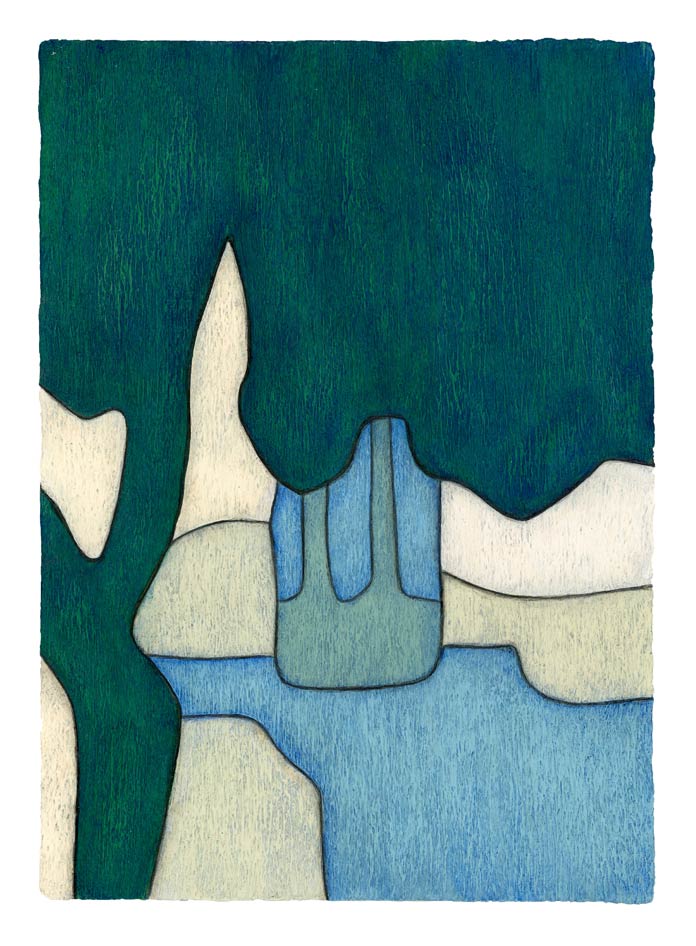
HYLHA, 2025, acrylic on handmade paper
Tobi Kahn is a painter and sculptor whose work has been featured in over 70 solo shows.