
Samia al-Ghussein spends her days in the spaces where Gazans still organize around something other than survival. With Israeli military operations having destroyed government buildings, courts, police stations and much of the institutional structure that once held daily life together, what remains is tied to civil society: human rights centers, women’s organizations, youth programs and community groups.
Al-Ghussein’s work focuses on gender-based violence—helping women to recognize its forms and respond to it. “What matters to me is that individuals enjoy their political, economic and social rights. Especially women,” she says, adding that in Gaza, that inclusion has never been granted. It has to be fought for.
In recent weeks, as foreign officials have begun speaking of “Phase 2,” a new framework for Gaza’s postwar governance, al-Ghussein has heard a familiar resignation in the voices around her: Committees are being formed. Plans are being announced. But the people most affected by those decisions remain outside them.
Al-Ghussein’s work is built on the idea that rights are not a luxury reserved for stable societies. They are the foundation that allows a society to become stable.
Phase 2 refers to the next stage of the ceasefire framework embedded in President Donald Trump’s Comprehensive Plan to End the Gaza Conflict. The first phase focused on halting major combat between Israel and Hamas, facilitating limited Israeli withdrawals, and carrying out hostage and prisoner exchanges while humanitarian aid entered Gaza.
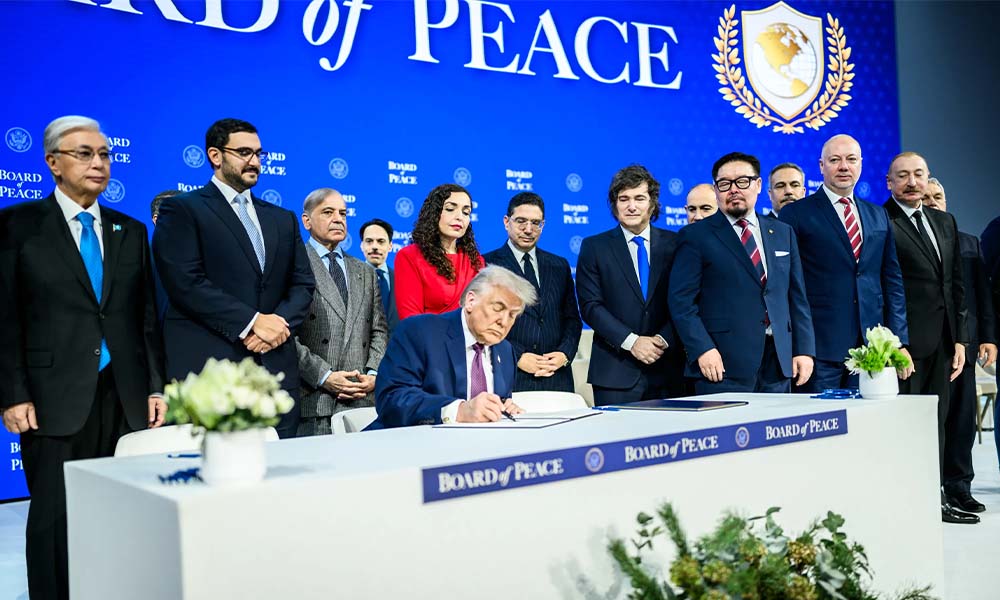
Under the plan, the Board of Peace was created to supervise the transition, while a separate body, the National Committee for the Administration of Gaza (NCAG), was formed to succeed Hamas as the Strip’s administrator and manage daily municipal services, but without formal control of the factions now operating there. According to officials familiar with the plan, the NCAG is composed of 15 Palestinian technocrats and is ultimately under the Board of Peace, which will coordinate reconstruction, oversee governance and supervise security steps tied to demilitarization, including an international stabilization force to monitor borders and train Palestinian police units.
On February 11, Israeli Prime Minister Benjamin Netanyahu signed Israel’s accession to the Board of Peace during a visit to Washington, where he met Secretary of State Marco Rubio before holding talks with Trump.
The Board held its first meeting today, February 19, at the U.S. Institute of Peace in Washington, DC, where Trump presided over a session attended by representatives from more than 40 countries. Trump said the United States would pledge $10 billion toward Gaza’s reconstruction and that other countries had committed more than $7 billion in additional contributions. Israel was represented by Foreign Minister Gideon Sa’ar. Several major European powers, including the United Kingdom, France and Germany, did not join the board as members and were either absent or represented only at an observer or lower diplomatic level. The board does not include Palestinian representatives, and key questions remained unresolved, including Hamas disarmament, the future of humanitarian aid and whether Israel would withdraw its forces from Gaza.
Indonesia has said it is preparing thousands of troops for possible deployment as part of the stabilization force, though Indonesian officials have stressed that operational details and the scope of any mission remain under negotiation.
As the planning proceeds, in Gaza, Phase 2 is being experienced as another uncertainty.
On February 12, hours after Netanyahu’s signing, senior Hamas leader Usama Hamdan responded publicly in remarks broadcast by Al Jazeera, rejecting several core elements of the Phase 2 framework.
Hamdan said Hamas has not adopted any decision to freeze its weapons, let alone surrender them, and that the group had received no disarmament proposals from mediators. “Our position is steadfast that the resistance is legitimate as long as the occupation exists,” he said.
He declared that 10,000 Hamas “police officers” operating in Gaza “aren’t going anywhere” and would continue their work under the supervision of the technocratic committee (NCAG). He called Netanyahu’s accession to the Board of Peace illegitimate, describing it as a farce. And he rejected the deployment of international forces inside Gaza, saying Hamas would accept only a border force tasked with protecting Palestinians from Israeli military operations.
Hamdan said Hamas had contacted the Indonesian government directly to convey that position, and that any international force should be limited to the border between Israel and Gaza, not deployed within the Strip.
The statements amounted to a rejection of several pillars of the Trump plan: disarmament, international enforcement inside Gaza and the legitimacy of the Board of Peace itself. At the same time, Hamdan did not reject the NCAG outright. Instead, Hamas signaled it would cooperate with the committee while maintaining its own security apparatus beneath it.
The dynamic is one that both Israeli and American analysts have warned could hollow out any transitional governance structure. The New York Times reported on a draft plan potentially allowing Hamas to retain small arms during a transition period. The detail illustrates how Phase 2 has been framed in diplomatic language that leaves the core question unresolved: what disarmament would actually mean in practice.
Notably absent from Hamdan’s remarks was any reference to elections, popular participation, or the role of Gaza’s civilian population in deciding its own future. The question of who governs was framed as a contest between armed factions and foreign powers, not as a decision belonging to the people who live there.
Even months after the ceasefire took effect, the war has not fully lifted from people’s lives. According to Gaza’s health ministry, Israeli fire has killed more than 500 Palestinians since the ceasefire began.
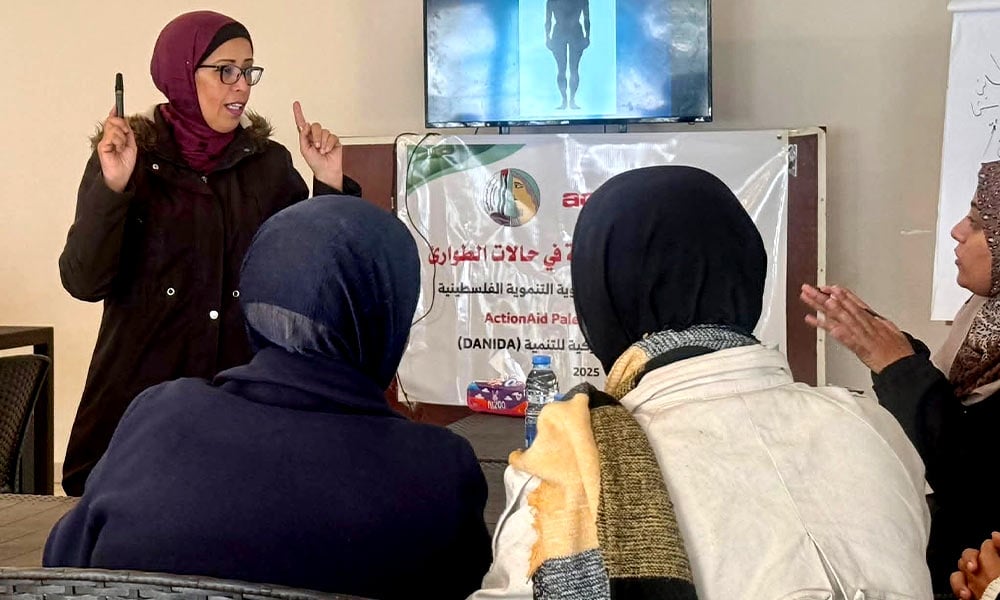
Samia al-Ghusain leads a workshop on feminist leadership in crisis situations. Organizers say this kind of practical, people-centered leadership is essential as Gaza begins the long process of rebuilding.
“I’m not optimistic about Phase 2, or about disarmament,” says Ahmed Nasr, an educator from Gaza City. “Netanyahu’s government and Hamas don’t want this war to end. He sees two potential paths ahead: either a return to war between Israel and Hamas or an internal conflict between Hamas and the technocratic NCAG.
“The people of Gaza have suffered deeply. We’ve lost loved ones because of reckless decisions. And after two years, we’re still going in circles, with no clear way forward.”
Restrictions on movement and access remain central to daily life. Aid organizations report ongoing limitations on fuel, heavy machinery and construction materials needed to clear rubble and reopen roads. The Rafah crossing has reopened but in a limited way; food, medicine and clean water remain unevenly available. Hospitals operate under strain. Schools operate where possible, often in makeshift spaces and without adequate facilities.
For families in Gaza, reconstruction is not a policy question. It is the difference between a life and a waiting period: livable housing, clean water, functioning clinics and jobs.
“On paper, there are new structures: the Board of Peace, an executive council, a technocratic committee,” says Adel al-Ghoul, a Palestinian political analyst and head of the Paris Center for Security Studies and International Relations. “But on the ground, Israel still controls the security, political and military decision-making in Gaza.”
Governance in Gaza has never been purely administrative. It has always been shaped by who controls movement, borders and policing. As long as Israel retains freedom of military movement and Hamas maintains an armed apparatus that operates outside any elected mandate, al-Ghoul argues, any civilian body operates in an environment where the final decisions are not in its hands.
From Washington’s perspective, Phase 2 is an attempt to avoid repeating the failures of earlier postwar cycles. American officials argue that reconstruction cannot be separated from security reform and that donors will not fund rebuilding unless they believe the results will last.
“Phase 2 has been announced, but in reality it has not begun because Hamas rejects several core elements, and no one is forcing compliance,” says Edmund Fitton-Brown, a senior fellow at the Foundation for Defense of Democracies and a former U.N. counterterrorism official.
Fitton-Brown describes Hamas as strategically avoiding confrontation with the plan while refusing to meet its central demands. “Hamas has consistently tried to muddy the waters. It doesn’t want to openly reject the peace plan, so it signals conditional cooperation while avoiding real compliance.”
Hamdan’s statements on February 12 appeared to illustrate this pattern: Hamas did not reject the technocratic committee. It did not walk away from the ceasefire. But it rejected disarmament, rejected an international force inside Gaza and announced that its own police would remain in place.
The U.S. plan relies on the assumption that a transitional authority, supported by an international stabilization force, could manage Gaza in a way that reduces the likelihood of renewed conflict. But any such force, Fitton-Brown emphasizes, would need teeth. “It cannot resemble UNIFIL,” he says, referring to the challenges of the United Nations Interim Force in Lebanon’s longtime mission to stabilize Lebanon and demilitarize Hezbollah. “It must be willing to put troops in harm’s way and confront Hamas directly.”
In Israel, Phase 2 is being debated through a security lens, with a core worry that Hamas could adapt to new governance structures while maintaining power on the ground.
Brig. Gen. (res.) Yossi Kuperwasser, head of the Jerusalem Institute for Strategy and Security and a former senior Israeli intelligence official, says trying to implement Phase 2 is premature when Phase 1 hasn’t been completed.
“Washington feels that if they keep waiting, the entire plan will eventually freeze, so they’re trying to revive it.”
His deeper concern is structural. “Hamas can play a game and say, ‘We’re not running civilian affairs anymore, someone else is doing it,’ while still maintaining power on the ground.”
For Israeli officials, the technocratic model is acceptable only if paired with real enforcement against armed groups. Otherwise, it risks creating a political façade that allows Hamas to preserve power while shifting the burden of administration to others.
Israeli security officials continue to emphasize disarmament and tunnel dismantlement as prerequisites. They argue that rebuilding Gaza without neutralizing armed capacity will reproduce the conditions for the next war. Others in the region argue that the conditions for recurring violence are not only military. They are also rooted in occupation, blockade and the absence of a political horizon—conditions that no stabilization force, however robust, can resolve on its own.
Inside Gaza, the gap between international planning and daily reality is visible in every blocked road, every neighborhood without sewage, every family living in a tent beside a destroyed home.
“International plans talk about smart cities, airports and industrial zones,” says political analyst al-Ghoul, “while people in Gaza need the basics: livable housing, electricity, clean water, schools, health centers and jobs.”
He describes a deep trust gap shaped by earlier reconstruction efforts. “Billions were promised before, but implementation was slow and politically conditional.”


Gaza has seen international reconstruction efforts before—after conflicts in 2009, 2014, and 2021—each tied to monitoring mechanisms and security arrangements that never resolved the underlying political conflict or the question of armed authority.
For many Palestinians, the fear is not only that Phase 2 will fail but that its frameworks will persist without ever acquiring foundations, that Gaza will be governed through committees and security arrangements without sovereignty, without elections and without the basic recognition that the people who have endured the most should have the greatest say in what comes next.
Samia al-Ghussein’s work is built on the idea that rights are not a luxury reserved for stable societies. They are the foundation that allows a society to become stable.
She speaks about women and youth participation not as a symbolic issue but as a test: whether Gaza’s future will be shaped by the people who live there or by the combination of military force, armed factions and international bodies that have, so far, left ordinary people outside the room.
“Decisions are being made about Gaza,” she says, “but the people who live here are not part of them.”
Waseem Abu Mahadi is a Palestinian journalist, writer and peace activist from Gaza, currently based in Cairo.
Top image: President Donald Trump formally ratified the Charter of the Board of Peace in Davos, Switzerland on January 22, 2026. Credit: White House.