
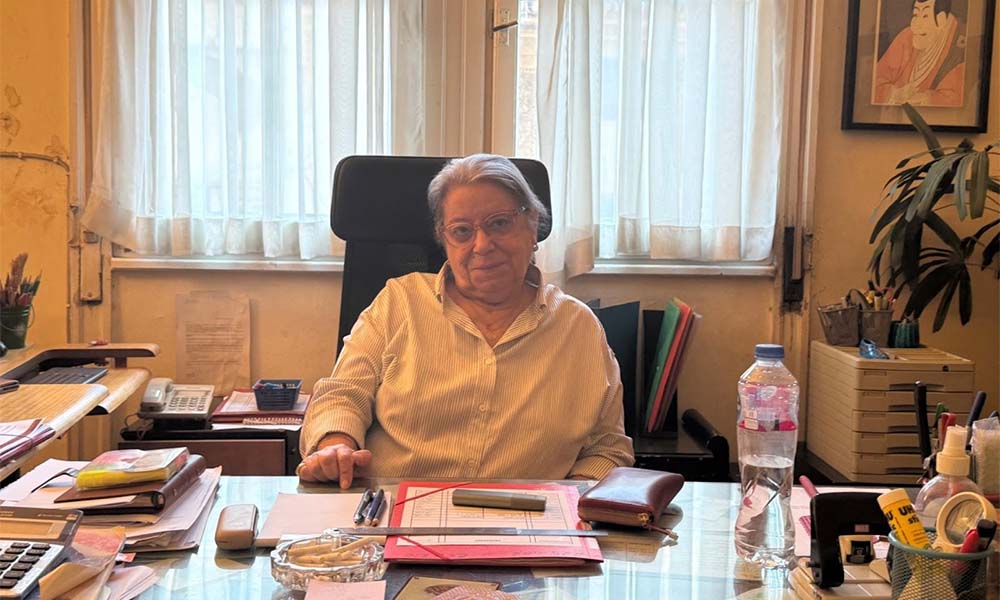
CAIRO — On a blazing July afternoon in 2019, a U.S. embassy SUV hurried me from my office in Giza to Cairo’s vast necropolis where a small group was struggling to assemble a minyan. We were burying Marcelle Haroun, mother of Magda Haroun, who now serves as custodian of Egypt’s remaining Jewish sites. A handful of elderly women stood solemnly as they watched their number dwindle by one more, while men in white galabiyyas dug into the sandy soil. Yanki Hoffman, a visiting rabbi in the kosher certification trade, recited El Malei Rachamim as Jewish diplomats from Western embassies stood quietly alongside foreign journalists, myself included, to bring the number to ten.
Bassatine, the Jewish cemetery founded in 1482 by decree of Mamluk Sultan Qaitbay, was once one of the largest Jewish burial grounds in the world. At the time of Marcelle’s burial, its paths were overgrown and many tombs lay in ruins. Yet even then Bassatine stood apart from the wider City of the Dead. While much of that necropolis was being devoured by new highways, the Jewish section endured, its walls still marking a separate, if fragile, space.
It was there that I first met Yoram Meital, the Israeli historian whose book Sacred Places Tell Tales: Jewish Life and Heritage in Modern Cairo was published last year. Magda Haroun had invited him to visit Cairo to advise on documenting synagogues, cemeteries and artifacts. He was also due to attend a conference on Moses Maimonides’s legacy. Days before it was set to open, however, security services had canceled it. Permission granted one day, withdrawn the next. Egypt.
What began as a thriving community of 80,000 dwindled to a handful by the 1970s—a loss shaped by war, expulsion and the failure of Egyptian nationalism to preserve space for its Jewish citizens.
When longtime Jewish community leader Carmen Weinstein died in 2013, Magda had stepped forward. A civil engineer by training, she was no rabbi or scholar. “I’m a problem-solver,” she tells me when I visit her office near the Sha’ar ha-Shamayim Synagogue (also called the Adly Street Synagogue) on a return trip in August of this year. She says she was drawn into leadership “because I was the last one left to take responsibility.” Her father, Shehata Haroun, who was a Marxist lawyer and outspoken nationalist, had refused to leave Egypt when so many other Jews did in the years after Israel was founded. “My father loved this country madly. I inherited that,” she says, adding, “I am Egyptian before anything else.”
Shehata Haroun pioneered intellectual property law in Egypt, opening an office in 1939 after the country’s first trademark legislation was enacted. But nationalism came with a price: When Magda’s sister fell ill and needed treatment abroad, authorities denied Shehata a round-trip permit. (Unfortunately, travel bans and movement restrictions have long been standard tools of control in the Middle East.) She died, and her grave lies under a building in Bassatine. “He still loved Egypt deeply,” Magda says.
Today Magda is the last Egyptian Jew in Cairo with both Jewish parentage and Egyptian citizenship. “I am not rebuilding a community,” she says. “I am maintaining what remains.”
***
Egypt’s Jewish presence dates back more than two millennia. The Jewish community in Alexandria famously translated the Hebrew Bible into Greek in the 3rd century BCE, producing the Septuagint. And the Cairo Genizah—a trove of more than 300,000 Jewish manuscript fragments found in the city’s Ben Ezra Synagogue—documents continuous Jewish life in Egypt from the 9th century onward, offering unparalleled insight into the rhythms of Jewish, Muslim and Christian coexistence over a thousand years.
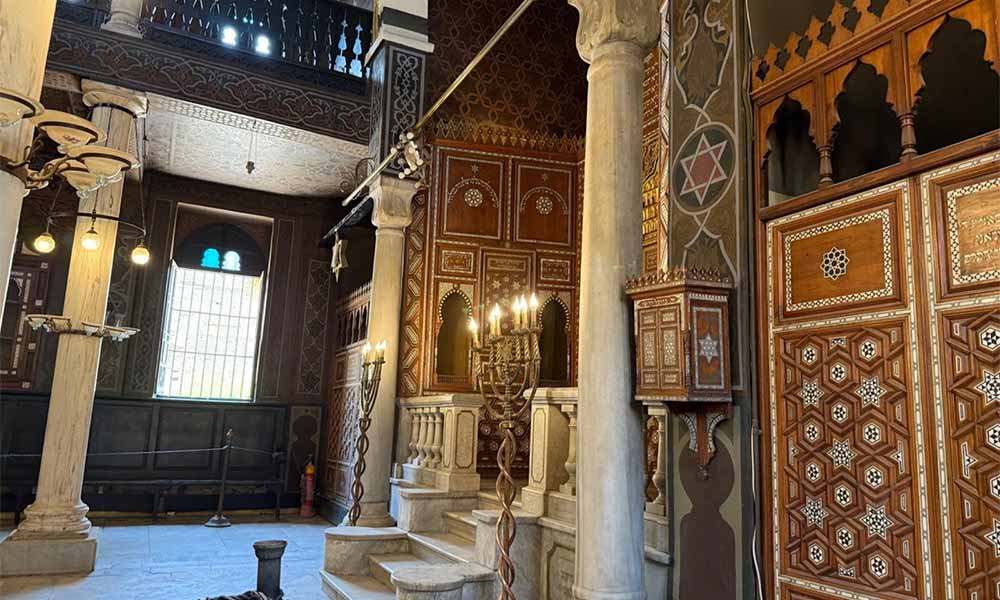
Cairo’s Ben Ezra Synagogue. Credit: Jacob Wirtschafter
In more modern times, Egypt’s Jewish population grew, and by 1948 there were some 65,000 Jews living in Cairo and another 15,000 in Alexandria. They included Sephardi and Mizrahi families with Ottoman roots, Karaite Jews with distinct practices, and Ashkenazim fleeing pogroms in Europe.
These different Jewish communities built different institutions. Karaites, rejecting rabbinic authority, built their own synagogues and a separate section in Bassatine with mausoleums for elite families. Ashkenazim, concentrated downtown, established the Adly Street Synagogue and smaller prayer halls. The larger Sephardi-Mizrahi majority funded both grand projects such as the Eliyahu Hanavi Synagogue in Alexandria and modest neighborhood synagogues woven into Cairo’s working-class districts.
“Jewish sites were never foreign enclaves,” Meital, the historian, told me. “They were integral to the Egyptian cityscape.”
The reach of Egypt’s Jewish elite was embodied in families such as the Cattauis of Cairo. Joseph Aslan Cattaui Pasha and his relative Mossa Cattaui Pasha had both served as ministers during the reign of Khedive Abbas Hilmi II, who ruled Egypt and Sudan from 1892 to 1914 under nominal Ottoman suzerainty. Although Abbas Hilmi II sought to assert Egyptian autonomy, real power had shifted to British hands after 1882. His reign ended during World War I, when Britain deposed him and declared Egypt a protectorate. The Cattauis played a prominent role in Egypt’s modernization during this period. In 1920, they were instrumental in helping industrialist Talaat Harb found Banque Misr—Egypt’s first indigenous bank and a cornerstone of the country’s economic nationalism under British occupation. A decade later, they joined a consortium of investors to finance construction of the King David Hotel in Jerusalem, which opened in 1931 as a symbol of luxury and political importance in British Mandate Palestine. A downtown Cairo street near the stock exchange still bears Moussa Cattaui’s name, and the Immobilia Building, the city’s first skyscraper, carries the Cattaui’s legacy.
Jewish artists also helped define Egypt’s cultural golden age. Leila Murad, one of the era’s most beloved film and music stars, lived for a time in the Immobilia Building. Though she later converted to Islam, Murad remained a symbol of cosmopolitan Cairo. Togo Mizrahi, a prolific director, created comedies and musicals that portrayed Jews and Muslims as neighbors and co-citizens. Henri Curiel, meanwhile, emerged as a radical political thinker, founding the Egyptian Movement for National Liberation and later playing a quiet but pivotal role in early Israeli–Palestinian peace efforts before his assassination in Paris in 1978.


The Jewish exodus occurred in waves driven by regional upheaval and mutual distrust. Violence in 1948 claimed over 200 Jewish lives and sent 20,000 fleeing. The 1954 Lavon Affair—where Israeli operatives recruited Egyptian Jews for sabotage—cast a shadow of suspicion over the entire community. The decisive rupture came in 1956 when President Nasser expelled some 25,000 Jews after the Suez Crisis, confiscating homes and businesses. In 1967, hundreds more Jewish men were detained following the Six-Day War. What began as a thriving community of 80,000 dwindled to a handful by the 1970s—a loss shaped by war, expulsion and the failure of Egyptian nationalism to preserve space for its Jewish citizens.
By 2019, fewer than 20 Jews remained in Egypt, most of them elderly women. As of 2025, the number of openly practicing Jews in the country is believed to be under five. Magda Haroun’s national ID still identifies her religion as yahudiyya—Judaism—making her the only person in Egypt whose government-issued documents bear that designation. Every other remaining Jew is either of mixed parentage, holds foreign nationality or has converted to Islam or Christianity.
***
In addition to safeguarding Jewish heritage sites, Magda Haroun is spearheading an effort to establish Egypt’s first Jewish museum inside the long-dormant Vitali Madjar Synagogue in Heliopolis. “We have an Islamic museum, we have a Coptic museum. But we don’t have the third component,” she tells me, emphasizing that the planned Jewish museum is meant for Egyptians, not tourists. “They need to know that the glory of modern Egypt was its diversity.”
She envisions exhibits featuring her great-grandfather’s engraved crystal glasses, her father’s recreated intellectual property office and reels by the Frenkel Brothers—the creators of Egypt’s first cartoons. The synagogue had also become a space for interfaith encounters: performances blending Islamic and Christian chant traditions and High Holiday services open to all. “I want people to know we’re not the enemy—we’re Egyptians who love this country,” Haroun says.
The building, unused for religious purposes for nearly 70 years, was cleaned and briefly opened in September 2023 for a secular, multicultural commemoration organized by Haroun’s Drop of Milk Association. But just three weeks after that hopeful gathering, the Hamas attacks of October 7 and the war in Gaza cast a shadow. While the vision for the museum remains intact, the public programming has gone quiet.
Cairo today is a city where restoration and erasure happen simultaneously.
While Magda Haroun is the only officially recognized Jew in Egypt, she is not totally alone. When I met Sami Ibrahim in 2019, just after Marcelle Haroun’s funeral, he offered me a ride back to downtown Cairo with the visiting rabbi. At the time, he ran an import-export business but was also Magda’s fixer of sorts—arranging access to cemeteries, handling visitors to synagogues and negotiating the buildings’ maintenance with officials.
By August of this year Ibrahim had retired from his business into the role of full-time gatekeeper. His phone buzzed with WhatsApp messages from Jewish travelers looking for family graves, from diaspora groups, and the occasional journalist like me. Walking between the restored Karaite tombs, he pointed out new signage and perimeter walls. Later, over coffee near Adly Street, he spoke about “the burden of carrying memory in a city where so few remain.”
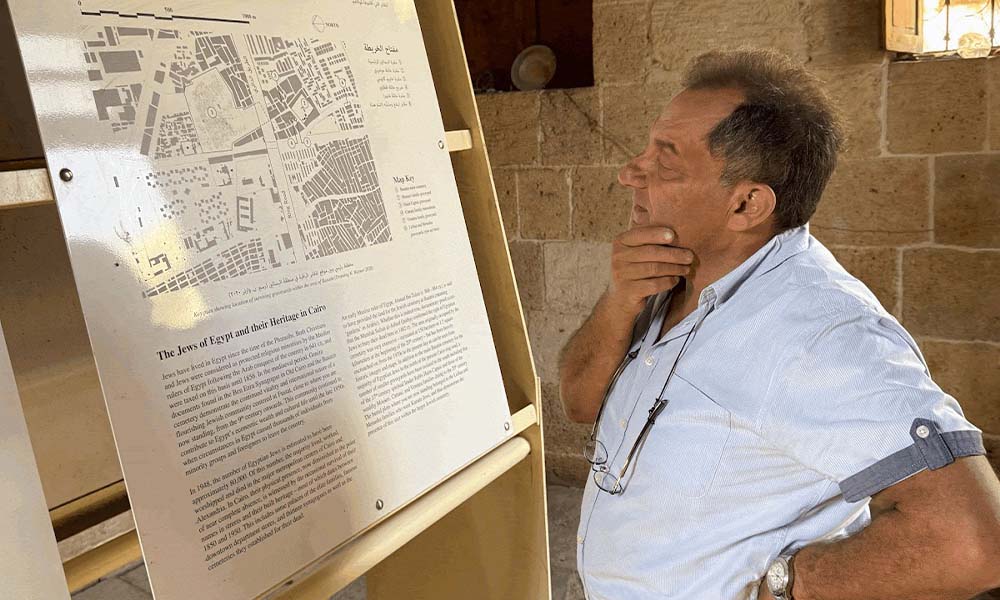
Sami Ibrahim inspects a map of restored Karaite tombs. Credit: Jacob Wirtschafter
Ibrahim also serves as vice president of the Drop of Milk Association. Originally founded in 1921 to provide milk to impoverished Jewish children, the association was revived under Haroun’s leadership as a Jewish heritage preservation group. Ibrahim, whose father was a communist with Jewish roots who converted to Islam, is married to Maroua Abudhagga, a Palestinian from Gaza. She founded Pyramids of Hope, a Cairo-based NGO for Palestinians displaced by the Gaza wars. Jewish and Palestinian stories, under one roof.
This unlikely convergence reflects a broader shift in how Egypt has viewed its Jewish past. After the Arab Spring (2010-2012), Jews were recast not as outsiders but as part of Egypt’s plural past, and Jewish heritage enjoyed an unexpected revival. Films like Amir Ramses’s Jews of Egypt (2013) and several TV dramas reintroduced Jewish Egyptians to mass audiences. “It started with Amir Ramses’s documentary,” Magda recalls. “Then came series like Haret al-Yahud” (Jewish Quarter).
The show aired during Ramadan in 2015—prime time for Egyptian television. Haret al-Yahud was a historical drama set in 1940s Cairo, built around a love story between a Jewish woman and a Muslim army officer against the backdrop of rising Arab nationalism and the founding of Israel. It opened with a stylized air-raid scene over Cairo—a reference to the actual 1948 Israeli bombing, though the target had been nowhere near the Jewish quarter—that critics still picked apart as too dramatic. But the emotional impact cut through anyway. Starring Menna Shalaby, one of Egypt’s most celebrated actresses, it was the first time in decades that Jews were shown sympathetically on Egyptian screens.
“Retelling the Jewish story opened the gate to ask, ‘What kind of Egypt do we want today?’” Meital explains.
President Sisi’s government joined in. At the 2018 World Youth Forum, he declared that Egypt would build houses of worship for Jews like for other religions, adding that “it is the right of the citizen to worship as he wishes.” A month later, Antiquities Minister Khaled al-Anani pledged 45 million Egyptian pounds (about $2.5 million) to Jewish heritage: “I would not wait for someone to give me money to service it. It is a priority for me like Pharaonic, Roman, Islamic and Coptic heritage,” he declared. In 2020, the Eliyahu Hanavi Synagogue in Alexandria was restored with state funds and reopened after years of closure.
Also in the late 2010s, the U.S. embassy hosted Passover seders and Rosh Hashanah services at Adly Street, where Ambassador Thomas Goldberger’s wife Eden read and chanted from the bimah at the synagogue, which was built in 1899 in Moorish Revival style—ritual doubling as diplomacy. And, with funding from the U.S. Agency for International Development, the American Research Center in Egypt (ARCE) partnered with the Drop of Milk Association to restore the Karaite section of Cairo’s Bassatine Jewish cemetery. Walking between the restored Karaite tombs, carved lintels and Hebrew inscriptions re-emerged. But limits showed. For example, the 2019 Maimonides conference was canceled amid the Great Return March, a Hamas-organized series of mass Palestinian protests along Gaza’s border that sparked regional tensions.
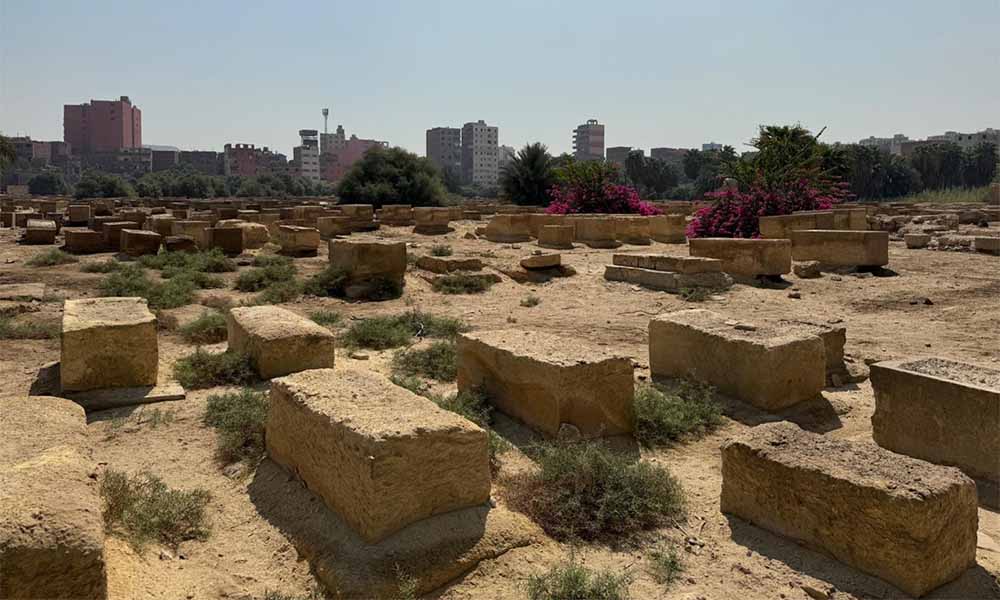
Cairo’s Bassatine Jewish Cemetery. Credit: Jacob Wirtschafter
Nicholas Warner is one of Egypt’s most respected conservation architects and led the restoration work at Bassatine for ARCE. Best known for his restoration of Howard Carter’s residence in Luxor—the house from which Carter had launched the discovery of King Tutankhamun’s tomb in 1922—Warner has shaped some of the country’s most ambitious heritage efforts. His portfolio includes the Red Monastery in Sohag, the Temple of Khonsu in Karnak, and the extensive Cairo Mapping Project, which documented more than 550 historic buildings in the city’s medieval core.
Warner is frank about the limitations facing even well-supported preservation projects. “Our influence on how the sites are accessed is minimal,” he notes. “Those decisions are always in the hands of the sites’ owners, and with Jewish sites, security will always dominate.” Bassatine, he explains, was an exception—operating without direct oversight from the Ministry of Antiquities, which gave the team an unusual degree of independence.
Still, Warner underscores that the future of Jewish heritage in Egypt will depend on more than expert care or international funding: “In the long term, the role of the Egyptian State in preserving Jewish heritage will be decisive.”
Cairo today is a city where restoration and erasure happen simultaneously. Its population has soared past 20 million, expressways carve through old quarters, and in the desert to the east, what’s known as the New Administrative Capital rises with ministries and monumental places of worship.
In Giza, the Grand Egyptian Museum looms beside the pyramids, its atrium dominated by a colossal statue of Ramesses II—thought by many to be the pharaoh of the Exodus story.
Against this pharaonic scale, Bassatine’s significance lies in endurance. When I returned in 2025, the Karaite section gleamed: inscriptions legible, paths cleared, walls secure. Across the road, centuries-old Muslim mausoleums were being bulldozed for highways.
“Jewish heritage sites may seem modest beside Egypt’s soaring mosques, highways, and new capital city. But their importance outweighs their footprint,” says Meital. “Synagogues and cemeteries do more than recall the past. They test the present—whether Egypt can still recognize itself as plural.”
That day in Bassatine, I thought back to Marcelle Haroun’s burial six years earlier. Then, the cemetery felt like it was held together only by memory. Now its tombs were stabilized, the grounds cleared, the gates locked and unlocked by a man who understood both the weight of history and the fickleness of the present.
The restoration, however, is fragile. Without Magda Haroun and Sami Ibrahim, access to Egypt’s Jewish story could once again vanish behind closed doors. As we walked among the restored granite slabs, Sami paused by a freshly stabilized Karaite tomb. “This is what we have left,” he said, gesturing toward the Hebrew inscriptions now clearly visible again. “The question is what Egypt will remember.”
Top image: Magda Haroun. Credit: Jacob Wirtschafter
3 thoughts on “Egypt’s Last Jewish Chapter”
Thank you very much for a very interesting article.
Thank you for a very informative article
In 1966, we were forced to leave Cairo leaving everything behind. That was a very good timing since the Egyptian government arrested all male Jews in prison and concentration camps for 3 years.
Thank you for a very informative article, which I thoroughly enjoyed.
I was born in Cairo and have many fond memories of those years. Sadly, my family and I had to leave when I was 14. My parents left with nothing but the shirts on their backs—everything else was confiscated. What remains are the treasured memories of my childhood.