
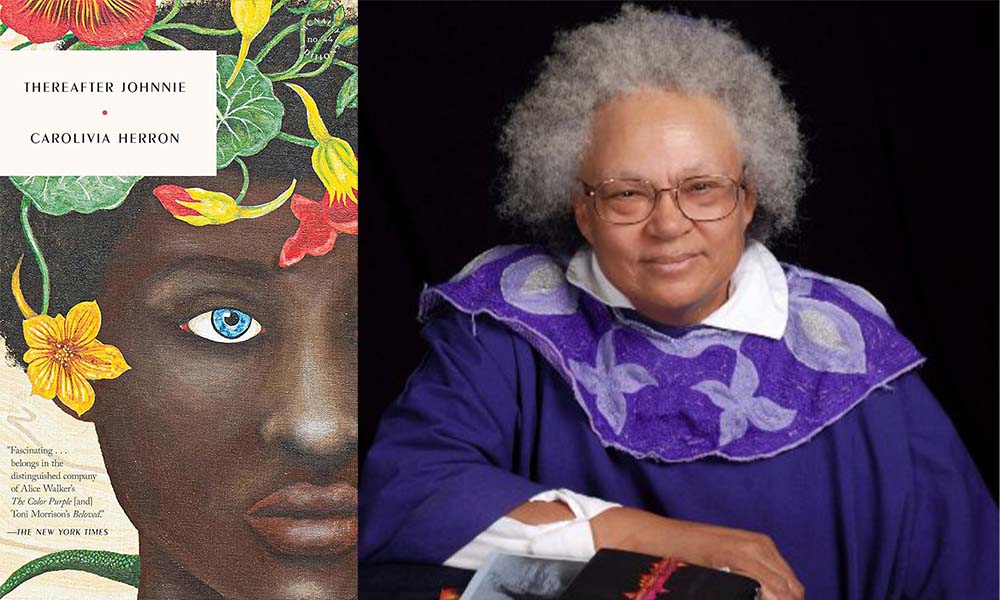
Carolivia Herron has to reschedule our interview. “I just remembered,” she emails me, “I’m supposed to do a re-enactment as my enslaved great-grandmother for a bunch of 5th graders that day.” Fair.
When we do meet at Busboys & Poets in her hometown of Takoma, DC, she arrives wearing her signature purple cape and green kippah to discuss Thereafter Johnnie, her 1991 fiction debut, recently reissued by McNally Jackson Editions. A Howard professor, host of a weekly DC radio show and author of the children’s book Nappy Hair, she’s now something of a local celebrity, and during our time a former student of hers comes by to say hello (“I can’t go anywhere in Takoma…”). Johnnie is a complicated, dense novel that doesn’t play favorites or concede ground to any preconceived notions of religion, villainry, victimhood or abuse. Herron, who “prayed every night” to become a writer when she was young, digs deep into the minds of perpetrators and sufferers—of slavery, of incest, of trauma.
In Herron’s world, being evil and being victimized aren’t mutually exclusive. Patricia, a character who gets raped by her own father, John Christopher, then shunned by her family into a separate apartment and forced to carry his child, is, according to Herron, “evil, like Satan. Jump-out-of-the-womb evil.”
But aren’t Patricia’s irrational moods and erratic behavior tied to the abuse she suffered? It doesn’t really matter, Herron says. When she first imagined the character of Patricia, with a hand up to the sky, waiting on a street, “She was condemning Washington, DC, putting a curse on the city, putting a curse on the country. She says, ‘If you build it up, I’ll tear it down. Whatever you create, I will destroy. If you try to turn my evil into good, I’ll take it and turn it back into evil.’”
Johnnie is often quite uncomfortable to read (Patricia’s sexual abuse is given ample pages early on), but it’s worth its weight. And in 2026—when complex books are passed over and feel-good hockey smut is selling out—its willingness to get into the mud with any topic is downright risky.
“My goal is different today than it was in ’91,” she says. “In ’91, I was trying to say, ‘This is what you are, you, United States of America.’ Today, I’m saying, ‘This is not what you have to be.’”
She wrote the book in Portugal and knew it was “complex and not an easy read,” though she felt proud of its accomplishment. “I said, ‘I’m bringing this book back to America, and nobody’s gonna want it.’” It’s narrated by Diotima, a Japanese poet who has fled to Mexico from the declining empire of America to tell the story of the Snowdons, an affluent Black family whose house overlooked Rock Creek Park. With all its references to Washingtonian suburbs and neighborhoods, roads and monuments, I was surprised that the narrator was so far removed from the city (there was also a previous version set in Japan). “If I had good sense and went to a writing class, I probably would have known really quickly that it belonged in DC,” she says. “But I had to teach myself.”
“In the process of creating a vision, you get a little stupid. All you can do is tell what’s there, step back and say, ‘Oh, is that what I said?’”
The seemingly simple plot belies the book’s zigzagging structure, fairytale-like sequences, moments of unabashed desperation and shameful secrets. She was inspired both by fairytales (“My iPhone never has a chance to upgrade because I listen to them all night long”) and Paradise Lost. Herron uses the Snowdons’ story to examine the horrors of slavery wherein the hands of history come back to bite. Alongside his abuse of Patricia, John Christopher is at a remove from his daughters, who seem familiar to him but are disruptively different. They’re students of the word, while he reigns over the body as a heart surgeon. “I don’t want them to love poetry more than they love me,” he thinks once while watching them play.
His character was informed by Herron’s stint of working as a medical researcher for a couple of years, where she was amazed to learn such medical oddities as how heart surgery patients improve drastically after an operation compared, say, to lung surgery patients, who get better more slowly. “The heart is such an amazing thing,” Herron says. “It didn’t turn my poetry upside down, but I felt a fundamental challenge through the concept of life, restricted by our physical bodies and our nonphysical spirit.”
John Christopher, however, doesn’t have this insight. He instills fear in the family, and in typical abuser behavior, sends his victims away. Banished to her little house in the Northwest DC neighborhood of Kalorama, Patricia writes him letters filled with both longing and hatred. “Cursed be she who has been loved of the Lord,” she ends one note. “Who can please him long?”
When I ask Herron why she wanted to link incest with religion, making a (fictional) assertion that God raped one of his own children, she shrugs like it was the most obvious thing in the world. “You’re asking me to define a source for something that seems natural to me,” she says.
She notes, though, that her transitional religion might have been a part of it. She wasn’t Christian, like her mother, at the time of writing, but had not yet embraced her Judaism (Herron had gravitated to the latter religion all her life, then later realized she had Sephardic ancestry). “The things I was arguing with in Christianity were things like, ‘Get over it.’ Or, ‘That happened a long time ago, think about tomorrow.’ I’ve found, in Judaism, nobody was telling my people to forget.”
Part of Thereafter Johnnie was inspired by her own past, but inadvertently. When she was three years old, her infant brother died at the hands of an aunt motivated by “jealousy and envy,” and Herron herself was sexually abused by an uncle. Publishing the book tore her family apart. “I gave [my uncle] a chance to privately apologize, and he didn’t, so I took it public,” she says. “He died. All my enemies are dead.”
When I ask if writing the book was a way to process these events, Herron says that the opposite happened. As a girl, she had unconsciously repressed the abuse, and later swam through the Snowdons’ story without knowing where her inspirations lay. “I had no idea where it came from,” she says, and after finishing it underwent psychoanalysis for several years, where she remembered what happened. “I wanted to write a work of art,” she says. “I wasn’t trying to process.”


“In the process of creating a vision,” she continues, “you get a little stupid. All you can do is tell what’s there, step back and say, ‘Oh, is that what I said?’”
In fact, Herron has distanced herself from the story so much that she’s surprised when I ask about the people she’s written about—why, for example, is John Christopher so confused by his daughters? Why did Patricia relinquish herself to her father’s control, even years later? “You’re asking me to be the psychiatrist!” she laughs. “The questions you’re asking me aren’t from my perspective, but from the perspective of my characters.”
The distance she’s careful to create is purposeful. Our way of understanding fiction has collapsed so much so that it’s difficult to separate the author from the story, and characters’ beliefs are often taken as the writer’s own. This limits the power of fiction—and the empathy we reserve for new characters with fresh ideas. I ask her why there’s been a recent trend of readers taking fiction as fact.
“It used to be obvious!” she says. “That a work of fiction is open-ended and you can take it the way you need it to go, and the artist takes a chance letting it be open. If you don’t let it be open, it’s very clear, ‘I want you to believe so-and-so.’ You don’t want those kinds of books. For a work of art, engage it if you want, and if you don’t want it, leave it alone! You decide if you have to have any reaction to it at all.”
This fictional freedom is what allows her to create knotty, unsettling ideas that the mind recoils at having understood. Johnnie, Patricia’s daughter and John Christopher’s granddaughter/daughter, bears the brunt of her family’s broken, disruptive history. “The beauty of torture,” she mind-wanders during one arresting passage, “the delight of slavery, the joy of being tied up bound down whipped beaten drawn quartered stretched broken into the ground is this—the mind is free…it discovers infinite stillness—there are no decisions to make. It’s just like love.”
Herron shakes her head, as if stupefied at her own words (she hasn’t reread the book in about ten years). “It’s an awful state for a human being to be in,” she says of those lines, then recounts where she was when she wrote them: “I rented a little villa and it was wintertime, it was chilly. I remember finishing a sentence like that, probably in that section, it’s really clear in my mind, and breaking out of the door and racing down to the ocean. ‘I didn’t realize the sun was out!’” In Portugal, she would wake up before dawn and then write until the afternoon, where the bright sun would always shock her.
“In ’91, I was trying to say, ‘This is what you are, you, United States of America.’ Today, I’m saying, ‘This is not what you have to be.’”
The story’s heaviness certainly weighed on her, but she kept it that way, quitting jobs when she got promoted just so she’d have more time to write. She’d gotten a master’s degree, then a job at the Bureau of Land Management that she traded for a low-wage position at Sears. “I wanted a place where I could make just enough money to eat and live and I could spend the rest of my time writing,” she says, and ended up spending ten months in Portugal.
Today she’s teaching at Howard, writing her next novel. Focusing on Joseph’s wife Asenath, Herron plans to mix divine and erotic love more than ever, with nods to the Hebrews, Jews and Israel. It’s more of a multimedia project made up of conversations between her and her students; if Thereafter Johnnie was written in solitude, the next work depends on the people in Herron’s circle. It will definitely be set in Washington; she was creatively stuck in white gentile environments. “I have to have African-American people give me the characters,” she says. “It’s only since I came to Howard that I realized I had the community now.”
She knows that old folks don’t immediately die when they turn 80, but still, that’s her benchmark for when she’d like to retire. “Then I can write whatever,” she says. In the meantime there is still work to be done, including more children’s books, and figuring out how to put her next novel on a platform like Substack (she’s “working with some guys at MIT”). She’s said previously she always had a feeling Thereafter Johnnie would come out, but only after she’d passed. “I can’t believe how nonchalant I was,” she says of her book’s first publication. “Seventy-eight years old, it’s something to come towards the end of your life and see that people still like your work. It’s a gift.”
Moment Magazine participates in the Amazon Associates program and earns money from qualifying purchases.
One thought on “Carolivia Herron’s Forbidden Story”
Thank you for this review and interview. I met Ms. Herron a long time ago and have given “Nappy Hair” to so many – a dear book. When I saw this had been released – she posted on Facebook – I ordered immediately. Tho’ I’ve not read, it’s in the pile of sooner than later to be read books. Ms. Herron is a treasure in the world, known by some of us, needed to be known by many more. You are helping that happen. Thank you.