
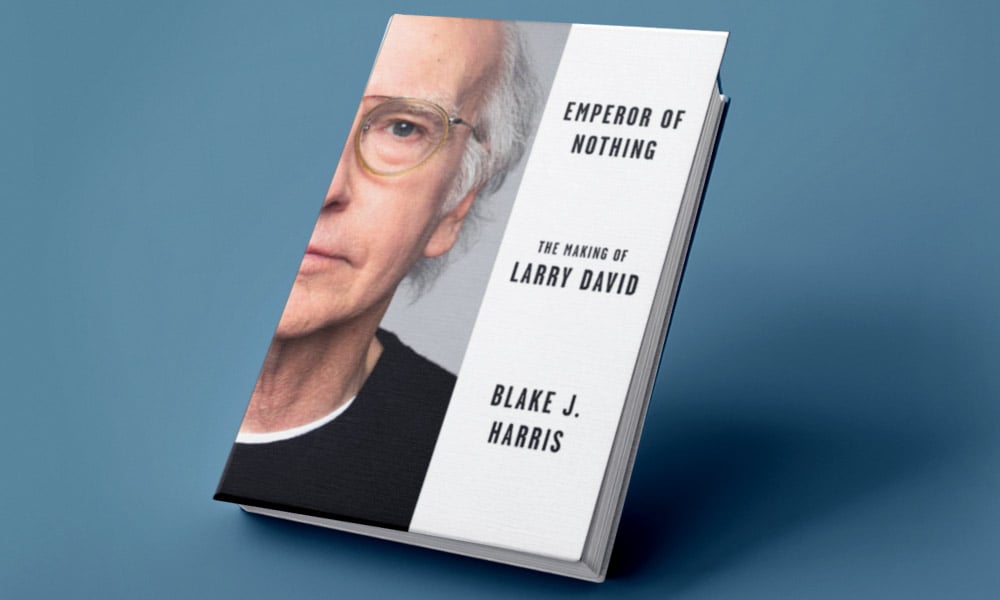
Emperor of Nothing: The Making of Larry David
By Blake J. Harris
Dey Street, 576 pp.
In one episode of the landmark HBO comedy series Curb Your Enthusiasm, Larry David-as-Larry David whistles Wagner to pass the time outside of a theater. But in the Davidian universe, no deed—good or not—goes unpunished, and a random passerby calls him a self-hating Jew. “I do hate myself,” Larry indignantly responds, “but it has nothing to do with being Jewish.”
This self-hatred, brought out by a terminal inability to shut up, plagues the Larry David character throughout Curb, my entry point to his catalog of iconic television and lesser-known screenplays and stand-up. He can’t help dining at a Palestinian chicken restaurant despite his Jewish friends deeming him a traitor, or noting the penis length of a business partner’s son. In every episode, he’s right and wrong, ridiculous and reasonable, a well-intentioned pervert and an endearing asshole.
In Emperor of Nothing: The Making of Larry David, journalist and author Blake J. Harris narrates the story of the smart-alecky schmuck, with particular focus on the question a project like Curb Your Enthusiasm asks—is this guy for real? The hefty book is concerned with the divide between Real Larry and Screen Larry, if there is one, with a seemingly endless well of sources: his co-stars, network execs, his writers. Cheryl Hines, who played his wife on Curb, shows up often (David actually introduced her to her now husband, RFK Jr.), as well as his daughter Cazzie, now a writer in her own right—but less time is focused on his family and friendships than his career. The book was written over the course of five years, drawing from those of David’s circle who have since died, like Richard Lewis, Gilbert Gottfried and Rob Reiner, at times imbuing the book with an unnerving mortality. All attest to the secret niceness of Seinfeld’s enfant terrible while noting his infuriating stubbornness.
“One of Larry’s gifts is that he can take a morsel and make a seder out of it.”
Growing up as a Brooklyn-born Jewish boy who later worked as a taxicab driver and a bra salesman, David really wasn’t particularly humor-inclined (his brother agrees). One night he walked into The Improvisation, a comedy spot in Hell’s Kitchen, and a desire to perform emerged after watching the headliner, thinking, “I’m as funny as that guy!” In the middle of the show, he went up to Budd Friedman, the club’s owner, and with no comedy experience, asked to go on. “It’s the single most insane thing I’ve ever done in my life,” David tells Harris.
Thankfully, he didn’t perform that night, but his first official set wasn’t much better. He walked on during Hootenanny Night at Gerde’s Folk City, an open-mic event where most people played music. David, however, did impressions of Rod Steiger and Howard Cosell. (He bombed.) Surprisingly undeterred, he continued to write material and perform at the Improv and Catch a Rising Star, another club, where he was met with lukewarm responses. His set was more performance art and less punchline-focused, involving sketches like a lawyer defending his preteen client in “Masturbation Trial,” a male kangaroo suffering from “pouch envy,” an eager dairy lobbyist talking a senator’s ear off about sour cream, or a soliloquy to a depressed penis. “Most of the time, my stuff didn’t work,” he says. “I thought it was funny.” (He was known to walk off stage or antagonize the patrons if he felt disrespected, even heckling one for checking his watch.)
After keeping at it, his name was printed in Variety for the first time in 1979—“Further development is needed, but the laughs are coming”—and the following year, was named Most Promising Comic by the Association of Comedy Artists. He was scooped to write for ABC’s new sketch comedy show that would rival Saturday Night Live; the ripoff result, Fridays, completely embarrassed David, though he did get a recurring hit in his Rabbi Feinberg sketches. (He purchased a convertible Fiat with his earnings, and one day when he was driving around with the top down, a heckler yelled that his show stunk.) Then he moved up to the actual Saturday Night Live as a writer, where he butted heads with Dick Ebersol, a producer who always cut David’s sketches. In the middle of one taping, David screamed at Ebersol, disparaging the show and quitting, only to return the next Monday morning (which would show up in a later Seinfeld plot). Next came a dispute over a skit involving a trapeze artist; David wanted to cast a writer, a larger man, instead of an actor, to accentuate the comedy. Ebersol said no, so David quit for good.
He eventually crossed paths with Jerry Seinfeld, who was performing on the late night comedy circuit. David wrote jokes for a mutual friend’s birthday dinner, but she was too drunk to perform them, and so passed it to Seinfeld, who noticed that his voice worked well with the material. Seinfeld’s mainstream cred tempered David; David’s off-beat humor made Seinfeld stick out.
Despite its current legacy, Seinfeld never sought out to be a show about nothing. In its earliest iterations, Jerry Seinfeld’s character would notice life’s daily oddities and detritus, later creating a stand-up act out of them. But both comedians felt like television at the time was missing realistic dialogue and grit. How else to mine true New York stories but to pull from the minds of real New Yorkers? David was an expert at taking lightly comedic situations—a stakeout on a date, being stuck in a Chinese restaurant, the gift of an unwanted pen—and exaggerating them to dramatic proportions. (Even the brainstorming process for the show was turned into an episode.) Some were stumbled upon; David passed on all of writer Spike Ferensten’s pitches until he offhandedly mentioned a dictator-like soup seller and the idea for the “Soup Nazi” episode was born. “One of Larry’s gifts is that he can take a morsel and make a seder out of it,” Alan Zweibel, who worked with David on Curb Your Enthusiasm, notes.
Seinfeld wasn’t the instant hit one might assume, and in fact performed so poorly at the test run that NBC slotted the “destined-for-doom” pilot on a random summer night. NBC was hesitant in continuing the show—they ordered four more episodes, then thirteen, then finally picked it up. This was torture to David, who had to mentally calculate four character arcs per episode, times the season order. “Now I need to come up with eighty-eight great ideas,” he recalls thinking. “And that always seemed like a daunting prospect to me. Especially because all the good ideas were used up the year before!”


David left the show after Seinfeld’s seventh season to spend time with his kids and because he felt he’d been there too long. (Due to his tantrums, a lot of writers assumed he’d be back.) After directing and writing Sour Grapes, a movie met with awful reviews, he turned his gaze to himself to craft Curb, originally envisioned as a special about stand-up, trying to avoid the rigor of television again. Hollywood mega-agent Ari Emmanuel was less than thrilled when his client pitched a “low-budget quasi-documentary about returning to a craft that he’d never been incredibly successful with in the first place.” But just like Seinfeld, it evolved into a finely tuned masterpiece that showed the mouthy know-it-all behind the cutting writing, with a hard line of his requirements as a showrunner: We start when I have the scripts ready, I’m only writing outlines and I have complete control of everything. (Dream job.)
Emperor of Nothing is full of tiny gems—David runs into O.J. Simpson the night he (Simpson) is accused of killing his ex-wife and her friend; the original Kramer, David’s old neighbor, threatens to sue; after a lawyer friend loses a bet, David enshrines him in scripts to humiliate him—but the book would have greatly benefited from a stern edit. Harris’s bounty of interviewees provide compelling anecdotes, but at times, Emperor of Nothing reads like an oral history that blocks a more elegant narrative. One such example, from Seinfeld recalling a writing session with David:
“This would have been in like 1978. He and I used to have lots of funny conversations together in the bar at Catch a Rising Star. And one day, we decided to get together and work on each others’s stand-up. You know, just run ideas. Comedians will do that a lot. It’s called a ‘bounce session.’ You bounce your ideas off of them, they bounce their ideas off of you and you just kind of react to it. And I remember he and I going to this little coffee shop on Columbus Avenue and getting coffee and muffins and just working on material.”
At 576 pages, this tale, and many others, could use a good paraphrase. And while Harris praises David’s motto for avoiding sentimentality in Seinfeld, “no hugging, no learning,” Harris does a lot of both. (Would it really be a “grave mistake,” as he calls it, to assume writing the largely improvised Curb Your Enthusiasm was easier than Seinfeld?) His sources are often used to tidy the story of a famously complicated man to get at the so-called divide between the Larrys, but their inseparability is obvious. Harris is no Walter Isaacson, but I’ll allow that a funnyman’s life doesn’t need an overly rigid retelling.
Still, Emperor of Nothing is a delight. David was reluctant when Harris initially contacted him about the book, but later relinquished—“Oh Jesus,” he emails. “If we must.” At 79, David is still going—as whomever watched this summer’s Life, Larry and the Pursuit of Unhappiness knows—but Harris’s authorized biography (the first) might have been one of the last chances to get his story on the record.
The perceived divide in David isn’t a question to figure out, but a character trait that has propelled him through his career—he indulges the ode to scrap our surface-level personas with who we want to be and what we want to say. All of Harris’s sources loop around this patchy framework of identity. It’s fitting that the best diagnosis of the Larry David condition comes from one such source, Ted Danson, who starred as himself on Curb Your Enthusiasm: “Larry is such a bundle of wonderful contradictions,” he says. The fact that “he takes every situation to the most disturbing, awkward, cringe-making level—sometimes out-and-out offensive—and still walks away beloved by the audience is, I think, a testimony to who he truly is.”