
“B’Ivrit: A Hebrew Language Media Roundup” is a monthly look at the news through the eyes of Israeli media consumers.
1. Trying to read Trump
One of the favorite pastimes for Israeli reporters, experts, pundits and, quite frankly, everyone else in Israel is to try and figure out what is going through the mind of the president of the United States. There’s nothing special about that, of course. It’s exactly what every American is struggling with on a daily basis.
For Israelis at a time of war, this question is not just a matter of curiosity. It can be a matter of survival. How many times will they have to run to the bomb shelter in the middle of the night? Will their kids’ schools ever reopen? Is it safe to leave home without checking in advance where the nearest shelter is located? The answers to all these questions depend on one soon-to-be octogenarian leader who resides in the White House and who has made it his trademark to issue conflicting messages about the war every day, many times several times a day. As for Israel’s 76-year-old leader, it’s generally accepted that Benjamin Netanyahu is following Donald Trump’s lead on the future of this war.
And so, the Israeli press is doing its best to figure out what Trump means and what he is planning. The TV studios, broadcasting on a 24/7 news schedule since the war broke out, are packed with reporters and experts, each offering their take on Trump’s latest comments: Does he really mean it when he says that the war is almost over, or is it just an attempt to deceive the Ayatollahs? Why is he threatening to take Iran back to the Stone Age after saying a minute earlier that the regime is reasonable and that negotiations are going well?
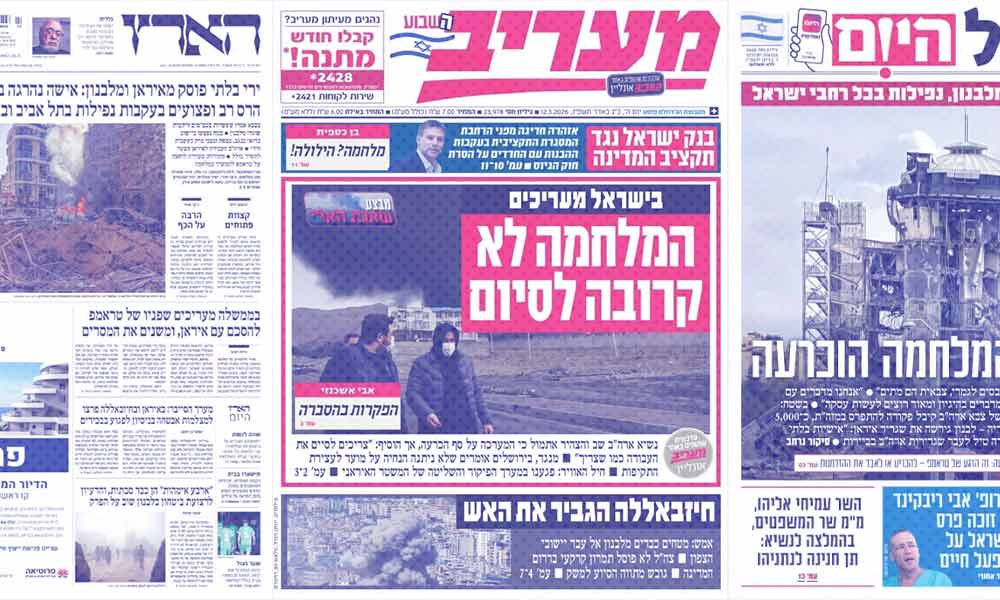
A mid-March headline in the centrist daily Ma’ariv seemed to reflect this uncertainty. “Israeli sources believe the war is not close to ending,” it read, but right underneath the headline came a mention that “Trump said the war is almost done.” A week later, Israel Hayom, known for its right-of-center lean, led with a dramatic quote on its front page: “Trump: The war has been won.” But here too, the caveat came a few sentences below: The United States is sending more ground troops to the region for a possible ground operation.


That same day, the liberal-oriented Haaretz explained that the Israeli government is sensing that Trump is headed to a deal with Iran and is pressing for further military action before he does so.

Reporting on Trump’s April 1 special address to the nation, Ynet, the popular website owned by the centrist Yediot Ahronot media group, ran with the headline: “What does Trump want?” The article did not offer an answer, but pointed out that the president sounded “confused” and “did not offer any coherent reason for launching the war, for its goals, or for an exit strategy.” (Incidentally, the Israeli media overwhelmingly supports the idea that Iran is an existential threat, that it needs to be taken out in any way possible, and that the longer the war goes on the more Iran’s capabilities are degraded.)
This confusion over Trump’s thinking plays out now every day in the Israeli news cycle. Each and every comment, speech or social media post by Trump is instantly reported as breaking news and immediately warrants push notifications from all major outlets. Then begins the frantic effort to try to understand what exactly Trump meant and how it will impact Israel. And by then it’s already time for the president’s next comment or post, and for another cycle of guesses and speculation.
2. Israel’s wartime media diet
More than a month into the war, Israelis are still on a news-heavy media diet. Many are working from home due to never-ending missile and drone attacks; schools are closed and so are most culture, sports and entertainment events; even family gatherings are limited, because who wants to get stuck on the road on the way to your grandmother’s Passover seder when a missile alert might force you to stop on the side of the road, lie face down on the ground and pray it doesn’t hit?
TV networks have long given up on their regular programing in favor of providing endless news coverage. The anchors are accompanied in studio by a uniformed Homefront Command officer who walks the audience through the steps they need to take during attacks. Alerts of incoming missiles have become a regular feature on the right-hand side of the TV screen, like a weather ticker on a local news channel.
News shows turn to reporting from the scenes of missile hits and interviewing residents hobbled in their bomb shelters. (“The neighbors are really great and we got to meet wonderful people here, but we really want the war to end,” is the standard response to reporters asking for the thousandth time how they feel.) All this alongside dramatic footage of what used to be quiet residential streets, now marked by large craters, broken windows and cars on fire.
As Israelis have learned over the past three years, at times of war their favorite TV channels, radio stations and news websites take on a different role: They’re not about investigative journalism, groundbreaking stories or hard-hitting reporting. The media is there to serve the most basic needs of its audience: Where and when will the next missile hit? How do I protect my family? And when is it all going to end? (Well, that one is up to Trump.)
3. Still no space for dissent
Taking on the role of a public service announcement board means that the Israeli press, usually known for its critical views about everything and anything, has given up on asking tough questions. At a time of war, the media feels a need to sound supportive and patriotic, which means that despite the endless hours of news broadcasts, one would be hard pressed to find even a single voice questioning the reasoning behind this war, the need for continuing it or its end goals.
It’s not as if the Israeli press has become Bibi Netanyahu’s lapdog overnight. It still asks tough questions about the lack of proper shelters in many areas or about the feelings of residents along the northern border that they’ve been abandoned by their government. The Israeli media’s ability to criticize the government was on full display last week, when the Knesset passed a law that mandates the death penalty for Palestinian terrorists convicted of murder, if they did so “with intent to deny the existence of the State of Israel.” Reporters pointed out the inherent bias of the law, which penalizes Palestinians but not Jewish terrorists who commit murder, and also, as in this story posted on Ynet, noted that it is practically impossible to prove the intent of those convicted.
[Read: “The Crime of Israel’s New Death Penalty Law”]
The press is also still discussing the government’s questionable budgetary decisions, its refusal to draft yeshiva students to the military despite a shortage of fighting troops, and corruption scandals involving high-level officials. Many pounced on an unnecessary trip taken by the minister for social equality to New York in the midst of the war, but no one asked if waging war on Iran at this time is a good idea and if the price Israelis are paying is worth it. The consensus in Israel is that Netanyahu and Trump were right to hit Iran, and the media has shown no appetite for challenging this consensus.
4. Helping the observant (and all those with bad cell reception)
Ever ask yourself how observant Jews get missile alerts during Shabbat, when the use of electric devices is forbidden? This is a real issue for many Israelis who rely on their cell phones and on TV and radio stations to provide them with the needed alert in time to head to the bomb shelter. There is a solution and it’s called “the silent wave.” On Friday evening, some radio networks now switch to this special wartime mode in which they broadcast only alerts, but nothing else. Observant Israelis are asked to turn the radio to these stations before Shabbat and leave it on all the time. The broadcast remains silent, and only breaks in the case of a missile alert.
And what about those in the fortified bomb shelters who find it hard to get decent reception on their phones? TV networks are now offering an audio-only mode on their apps—which allows residents to hear the news while in the shelter, even if they don’t have enough bandwidth on their phone to watch the full broadcast.


5. No exodus this Passover
It wasn’t much of a Passover vacation in Israel, a holiday during which hundreds of thousands of Israelis usually go overseas. But with Ben-Gurion Airport operating on a very limited schedule and with all international carriers cutting their flights to and from Israel, most are stuck at home.
The Israeli press reported extensively on efforts to enable the return of Israelis stranded abroad in the early weeks of the war (describing these flights as “rescue missions” which ironically were meant to “rescue” Israelis from safe destinations overseas to their war-torn homeland.)
Now attention has shifted to Israelis stuck at home but still dreaming of a spring vacation, or those in need of traveling for business or family matters. “This is how you can go on a Passover vacation right now,” read an article on Mako, offering its readers useful advice on how to bypass Ben-Gurion and travel through nearby airports in Taba, Egypt or Aqaba, Jordan. Other outlets aggregated tips on avoiding the long lines at the border crossings. Haaretz sent a reporter to follow the process from start to finish, with useful insights on the journey (pay extra for VIP service at the border crossing, bring food because the Taba airport cafeteria has very little to offer and, while you’re at it, make sure to pack a roll of toilet paper, which apparently this small airport lacks.) The aptly chosen headline given for this travelogue was: “Exodus to Egypt: The long and grueling journey from Israel through Taba.”