
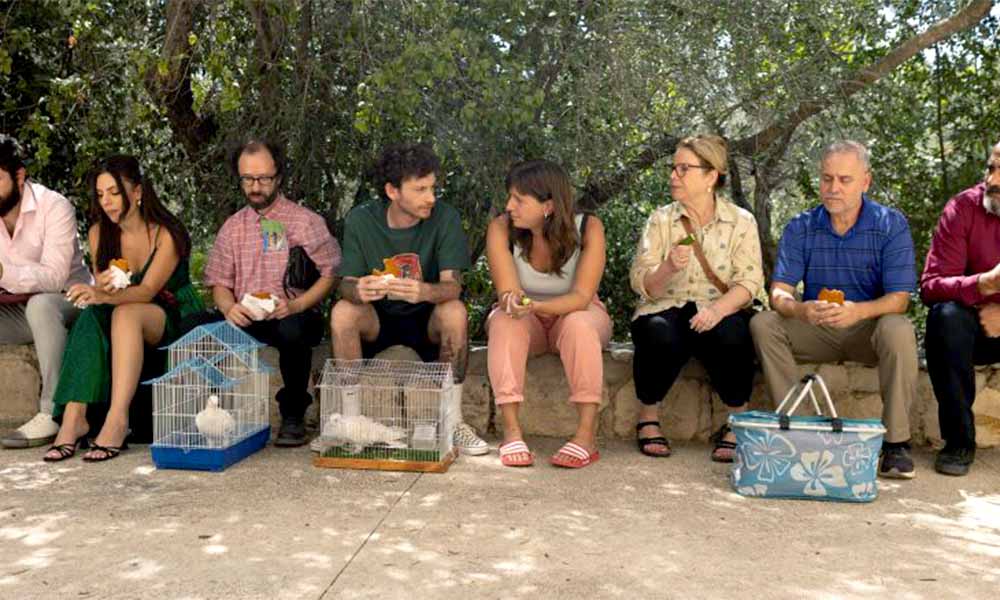
At her office in Jerusalem, Hedva Goldschmidt, the veteran distributor behind Go2Films, sat with Israeli filmmakers Jamal Khalaile, a Palestinian, and Zohar Shahar, a Jew. The two co-directed the dark comedy Bella, which follows an Israeli man and a Palestinian couple chasing a valuable dove through checkpoints and borders, their friendship tested by the same barriers that divide their peoples. The film had been finished before the October ceasefire agreement and hostage release—in a time of war, its collaboration held together by willpower alone.
“It was really amazing to sit near the two filmmakers and to hear how hard it was for them to collaborate from time to time,” Goldschmidt tells me. The trauma of October 7 and Israel’s devastating response in Gaza was impossible to ignore. “Sometimes they said they were driving in a car and not speaking for two hours—but they kept the dialogue open. They kept working together.”
That quiet determination—to keep creating across one of the world’s most painful divides—has become increasingly rare. Across the global film community, partnerships like that of Bella’s creators are collapsing under pressure from both sides. In September 2025, more than four thousand film professionals—including Olivia Colman, Mark Ruffalo and Emma Stone—signed a pledge to boycott Israeli film institutions, accusing them of complicity in “genocide and apartheid.” Within weeks, several festivals quietly adjusted their programs. Israeli films were left off lineups or postponed as organizers sought to avoid controversy—decisions that reflected a growing unease about where art ends and politics begin.
Does refusing to engage bring justice closer—or does it silence the very people who might help build it?
Among those supporting the boycott is Israeli filmmaker Avigail Sperber, who describes her stance as both painful and necessary. “My support for cultural pressure comes from a place of deep frustration and powerlessness,” she says. “As an Israeli filmmaker and a Zionist, I do not oppose the existence of my country, and I pray for this terrible war to end. But for months we—the critical voices—have been protesting and creating and demonstrating, and we are not succeeding in changing our government’s path.”
Sperber knows the cost. “Those who say boycotts silence dissenting voices are somewhat right,” she admits. “I am one of those voices. But as long as these atrocities are being committed in our name, we are not doing enough. If our internal dissent isn’t stopping the war, perhaps strong international pressure—on art, sports, academia, the economy—is the only thing that can force change. I am willing to pay this professional price for the chance to end the bloodshed.”
Her words reached me with an ache of recognition. (Our conversation occurred before the ceasefire agreement, yet the situation on the ground continues to involve daily casualties.) I am a Palestinian journalist from Gaza, and I have seen how easily stories vanish behind walls. The collaboration that built Bella—two filmmakers refusing to stop working together—embodies a kind of fragile hope that feels almost extinct. I care about these filmmakers not because I ignore the pain of war but because I understand how silence hardens it. Dialogue, even strained and imperfect, is still resistance against the machinery of hate.
The debate isn’t just moral—it’s reshaping film culture itself. At the Toronto International Film Festival (TIFF) in September, a Canadian documentary about Noam Tibon—an Israeli father who rescued his son during the Hamas attack on October 7—was quietly dropped from the lineup after internal debate. TIFF cited rights issues, but several programmers privately described staff conflict and fear of protests.
New York-based film journalist and critic Amir Bogen, who spoke with those familiar with the situation, says the controversy showed how political divisions now shape curatorial decisions. “What used to be quiet boycotts have become open refusals,” he tells me. “A film is ‘not selected,’ with no reason given, or you hear, ‘We love it, but not this year.’ You can feel it when it’s about the passport, not the picture.”
He added that while Russia and South Africa once faced official sanctions, Israel’s case is different: There’s no government ban, only growing pressure from activist networks and cultural institutions. For Bogen, the real loss is nuance. “In the eyes of certain activists, any Israeli film is propaganda,” he says. “If it echoes government talking points, it’s crude propaganda; if it’s self-critical, it’s ‘sophisticated’ propaganda that whitewashes Israel as liberal and tolerant.”
Inside Israel, the government has begun tightening its grip on cultural institutions. In September, Culture Minister Miki Zohar announced that state funding for the country’s top film awards, the Ophir Awards, would be withdrawn starting with the 2026 budget. The move followed the success of The Sea—a drama about a 12-year-old Palestinian boy from a West Bank village who is denied permission to join his school trip to the Mediterranean and decides to make the journey on his own. The film won Best Picture and became Israel’s Oscar submission. Zohar accused the filmmakers of “defaming” Israeli soldiers and said taxpayers should not support what he called “a disgraceful ceremony.”
Months earlier, No Other Land, a documentary about Palestinian evictions in Masafer Yatta co-directed by Palestinian activist Basel Adra and Israeli journalist Yuval Abraham, won the 2025 Academy Award for Best Documentary and was denounced by several right-wing Israeli politicians as “anti-Israel propaganda.”

Hedva Goldschmidt
“I don’t believe in boycotts and I believe even less in protests,” Goldschmidt says. “Boycotting opinions is the opposite of dialogue. If you don’t want to hear other perspectives, how can we ever build a bridge?” She has watched distribution deals collapse mid-process and festivals postpone screenings until “after the war.”
“I once believed boycotts were just noise around us,” she says. “Now I see how they stop dialogue—the one thing we truly need.”
Not everyone agrees that dialogue is the solution. “Our artistic self-criticism is no longer sufficient,” says Sperber. “We are creating critical art, we are protesting in the streets, but it isn’t stopping the war. The call for a boycott isn’t a rejection of our art—it’s a desperate call for an external lever to force the political change that our art alone, in this moment, cannot achieve.”
Even as these arguments rage, some Israeli filmmakers continue to win recognition abroad. On October 25, director Yuval Hadadi received the top prize at the Austin Film Festival for A Man Walks Down the Street, while filmmaker Meyer Levinson-Blount earned the Silver Medal at the Student Academy Awards for Butcher’s Stain. Their successes highlight the contradiction at the heart of the moment—films celebrated for artistry abroad may be suspect at home or elsewhere for political reasons.
For Eran Polishuk, founder and CEO of Chapter Two Films, a distributor, the challenge is not only political but structural. He says the post-pandemic collapse of major U.S. theater chains like AMC and Regal has devastated art-house cinemas, leaving fewer screens for independent films, which most Israeli films are. Yet, he remains optimistic. “Jewish audiences are very loyal—to Jewish-themed films and to Israeli films,” he says. “The real question is whether North American distributors will take a chance, which mainly means investing in promotion and marketing.”
His company works to persuade theater bookers that Israeli cinema is still worth showing. Many productions now focus on the Jewish Film Festival circuit, which he calls “a blessing, because they always show Israeli movies.” The filmmakers who stay active and keep submitting, he believes, are the ones who will eventually land distribution deals. “Jewish film festivals are our best allies—and we should be grateful for that.”
For Goldschmidt, optimism is less a strategy than a duty. She keeps returning to the image of those two Bella filmmakers driving through silence yet staying the course. “After October 7, so many collaborations and WhatsApp groups just fell apart,” she says. “But the ones that survived—those are the stories that give me hope.”

The cultural standoff reminds Bogen, the film critic, of another era. In the 1980s, American musician Paul Simon broke the cultural boycott of apartheid South Africa to record Graceland with Black South African artists. Critics accused him of legitimizing apartheid, but the collaboration also introduced global audiences to musicians who had been largely silenced by isolation. A later documentary, Under African Skies, argued that cultural engagement, not separation, ultimately gave those voices strength. Israeli filmmakers, Bogen says, now face a similar paradox: “Does refusing to engage bring justice closer, or does it silence the very people who might help build it?”
Sperber sees her own call for boycott as temporary. “I don’t believe in a complete break,” she says. “My call is a painful, temporary tool to force the conditions under which true dialogue can exist. I pray that when a real political process of peace and forgiveness begins, we can all create again, without boycotts. My deepest hope is to return to collaborating with Palestinian artists and the world—but in a new reality of peace, not one of occupation and war.”
Goldschmidt hopes that day comes soon. “Films are the new literature of the world,” she tells me. “They teach us empathy, patience and how to see the other. When you sit and watch a film for an hour or more, it changes how you understand people and places. That’s why we keep doing it—because even when everything around us falls apart, storytelling keeps us human.”
Bella takes place in Jerusalem, where borders are not always visible but are always felt. Goldschmidt says the movie made her laugh and ache at the same time—it finds humanity in the small absurdities of life between Palestinians and Jews. Maybe that’s the quiet miracle cinema still offers: not peace, not agreement, but a moment when the audience breathes the same air.
Waseem Abu Mahadi is a Palestinian journalist, writer and peace activist from Gaza, currently based in Cairo.
Top image: promotional still from Bella. Credit: Colin Levêque.