
Living in Trump’s America as a historian gives me a better understanding of the subject I have been researching for most of my lifetime: Weimar Germany and its decaying democracy in the early 1930s. I had all the theoretical knowledge, had read memoirs and diaries and had gone through archival records, but I often wondered what the people who lived through that period of transition actually felt and how they responded. As we see the oldest democracy crumble piece by piece, day by day, I begin to realize how easy it is to close our eyes and retreat into our private spheres before the daily horrors occurring on our streets, and how much harder it is to make sense of the world we live in than to describe the world that is a distant past to us.
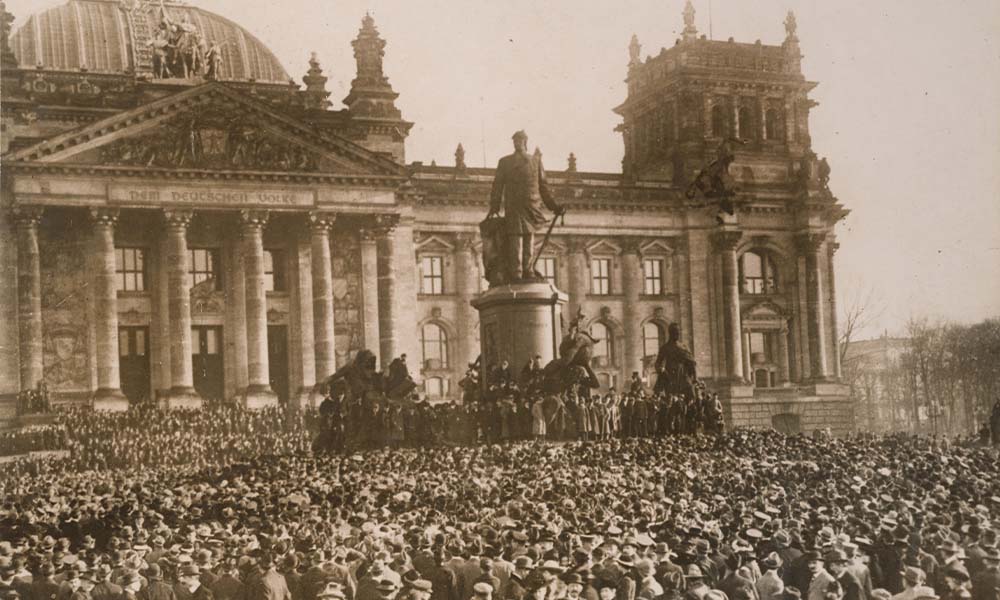
Weimar stands today for a fading and failing democracy. The small city that in 1800 had been the center of classical German literature lent its name to the first German Republic, whose constitution was ratified there in 1919. The Weimar Republic was unstable and largely unpopular, and it lasted less than 15 years. Its death blow was the appointment of Adolf Hitler as chancellor by the aged president of the republic, Field Marshal von Hindenburg, in January 1933 and the destruction, without much resistance, of the republic’s democratic structure. All of it followed a constitutionally legitimate process and happened within a few weeks.
Many people in the United States ask themselves today: Is our democracy failing? Is it on the path to full-blown dictatorship? Are we living in a Weimar America? (Future generations would probably call it a Mar-a-Lago America.) The answers to these questions are complex. There are obvious historical differences and there are undeniable political parallels. Let us start with the latter.
1) The power of the enablers. The political structures in Weimar Germany and in today’s America are very different, but Germany then, like America today, had a strong democratic constitution. If a constitutional transformation from a democratic to an authoritarian regime occurs, the strongman depends on the support of those who enable his power. The Nazi party was Germany’s largest party, but still far from reaching an absolute majority. Hitler needed the help of more moderate conservatives—such as former Chancellor Franz von Papen from the Catholic Center Party—who looked down on the upstart politician and believed that they would easily be able to control and dominate him. Despite their personal misgivings, they would support anyone who fought against the much-hated left and helped to feed their own personal ambitions. In the end, the ruthless upstart easily controlled all of these political dinosaurs. We might think that we know today how shortsighted this political opportunism and arrogance of the enablers was. But it seems that history is quickly forgotten when it interferes with personal interests.
2) The unholy alliance between political leaders and the private business elites. Hitler succeeded in winning over a large part of the German business elite with his promises to make Germany great again by reviving its military power and ignoring international treaties that had been concluded after World War I. Only a few weeks after he was appointed, many of the largest German business leaders accepted Hitler’s invitation to contribute a significant amount to support him in the last somewhat free elections Germany would see for the next 12 years. The powerful steel and coal industries quickly fell for Hitler’s promises, and they were rewarded in the short run with huge gains before and during World War II.
The German economy did well under Hitler, but it did so while preparing a war and exploiting millions of people, my parents among them, as slave workers. In the end, the big industrial magnates, like the Thyssens and Krupps and Flicks, either became disillusioned with Hitler or were implicated in the crimes of the regime and later had to pay the price for it. Today, the new business elite need to ask themselves if they are willing to pay an as-yet-unknown price for the possible short-term success Trump offers (aside from the obvious cost of weakening our democratic traditions, closing our eyes to environmental dangers, disregarding scientific findings, destroying our health system and endangering the world for future generations).
The real problem for any democracy, then and now, is not the single authoritarian leader and the cronies around him, but the support by those who know better.
3) The fatal attraction of a strongman. Crises invite radical measures and leaders who offer a miraculous cure. This was true in 1930s Germany, when the masses called for a strongman to deliver Germany out of a political mess, and the same is true in today’s America. The megalomaniac rhetoric of the current U.S. president as the virtually messianic savior of the nation, the insulting language against both his friends and foes, the childish begging for awards and honors and the naming of public buildings and institutions after himself—all these stand in the tradition of a Hitler or a Stalin and not of a Roosevelt or a Kennedy. Everyone who has seen the plans of Hitler’s architect Albert Speer to transform Berlin into a gigantomanic Germania must shudder when imagining Trump’s ideas to expand the White House, to build an oversized Triumphal Arch and to distort the Kennedy Center.
In contrast to real fascists, Trump has no ideology to adhere to. He believes mainly in himself, and the way he expresses this often reminds us more of Charlie Chaplin’s imitation of a dictator than of a real dictator. Many of his plans sound so comical and absurd that we are tempted to laugh. But the laughter dies when we realize how seriously his most bizarre claims are taken by his supporters. The real problem for any democracy, then and now, is not the single authoritarian leader and the cronies around him, but the support by those who know better.
4) The populist game. One of Hitler’s most successful political moves was to show his voters that he was one of the people. Even after coming to power, he continued to speak a language the masses would understand and to rant against the Berlin elites. This is the language coming out of the White House today as well. Even though he occupies the most important political position in the world and is an intricate part of the business elite of this country, Donald Trump knows all too well how to sell himself as one of the people and to speak a language considered politically incorrect. No matter that he is the establishment, he is able to present himself as anti-establishment. Populism always needs easy slogans. Deutschland, Deutschland über alles translates quite well into Make America Great Again, with all its accompanying arrogance and disrespect toward the rest of the world.
5) The conspiracy myths. The violence of World War I and the humiliation of Germany’s loss invited easy explanations. Conspiracy myths provided by political extremists led to a divided perception of reality. The extreme right marked Jews and socialists as scapegoats who had allegedly stabbed Germany in the back and thus caused its defeat in World War I. In the minds of their supporters, Germany simply could not have lost a war, just as a century later Trump could not possibly have lost an election. After Hitler failed to come to power by violent means in his Beer Hall putsch of 1923, he returned ten years later and used the democratic structures to destroy the very foundations of democracy. Once back in power, Hitler celebrated the insurrectionists of his failed Beer Hall putsch, some of whom had served prison sentences, as heroes and true patriots. In the face of Trump’s rewriting of the history of the January 6 attack on the nation’s Capitol, and of the pardoning of 1,600 violent rioters, this sounds all too familiar.
6) And what about the Jews? Trump may not be an antisemite, but his playing with antisemitism and with stereotypes is dangerous. No other American president in recent history has been so casual about having antisemites to dinner (Nick Fuentes), belittling their obviously antisemitic comments (Tucker Carlson) or even embracing them (Charlottesville’s “very fine people”). To the dismay of Jewish communities in Europe, the U.S. government has expressed its support for the most right-wing parties on the continent, including the German Alternative für Deutschland (AfD), whose leaders have repeatedly denied the significance of the Holocaust in German history. At home, Trump used (the very real) antisemitism on college campuses as a pretext to bring universities in line with his policies. One long-term danger of this strategy is that many will see the cuts of billions of dollars of essential medical and other research as the Jews’ fault.
Most important, Trump uses the same derogatory language that antidemocratic demagogues have always used against minorities, especially immigrant communities. When he calls Somalis “garbage,” makes Haitians into people who eat their pets and calls other nations “shithole countries,” he should not be surprised that some of his supporters denounce Jews as well. As Jews we often think that we are especially sensitive to these attacks. But some in our community seem never to have heard of Pastor Niemöller’s famous words (“First they came for the socialists…”) or don’t think they might apply. But be assured, while “they” may come for others first, they will come for us if we keep silent.
Every historian who studies authoritarian personalities will recognize, in Trump’s rhetoric and actions during the first year of his second presidency, familiar steps in the playbook to destroy the democratic structures of a society. But the authoritarian mindset of a president does not automatically mean that we live in an authoritarian state. There is still hope that the America of today is more capable of defending its democratic values than the Germany of 1933.
Despite all the alarm lights flashing, we need to be clear: America in 2026 is not Germany in 1933. To say it is would disregard that Weimar Germany was a very young and inexperienced democracy going through the aftermath of a lost war, a wave of hyperinflation that wiped out most people’s savings and an unemployment rate of 33 percent. The challenges our current economy faces are not comparable with a crisis of such existential dimensions. Further, one should hope that the world’s oldest democracy will prove more viable when under attack than a country with barely 15 years of democratic experience. The grassroots and neighborhood mobilizations against the brutality of ICE and federal law enforcement, as well as the support for targeted immigrant families, are all signs of this hope, especially as they have been growing in numbers and becoming more effective in their outcomes.

At least for now, we do not live in a fascist authoritarian state. To say so would belittle the reality of a dictatorship, in which there is no freedom of expression, no ability to form protest movements and no political opposition. This article could not have been published in Germany in 1933 or, for that matter, Italy or the Soviet Union of that time. If you raised your voice there to fight the regime in public, you would be arrested and put in a prison, a labor camp or a concentration camp. These societies did not allow for political parties besides the ruling one. There would be no mayors, no governors, no senators speaking out against the leader. There would be no independent courts ruling against government decrees. The number of victims of grassroots street protests would be in the thousands (just look at today’s Iran).
Germany’s parliament passed the Enabling Act, which sacrificed its system of checks and balances for the authoritarian rule of the new strongman. It did this on March 24, 1933, less than two months after Hitler came to power. Two days earlier, the Dachau concentration camps had opened, and many political opponents were arrested and tortured there. While the democratic constitution remained nominally in effect, courts were streamlined, oppositional parties outlawed, local and state politicians replaced, freedom of expression abolished, Jews removed from civil service positions and SA and SS brutality sanctioned. That is not where we are.
There is still time to save our democracy, but no one knows for how long. It may not be 1933 this year, but we have to work hard so that America in 2027 or 2028 will not resemble it. History does not happen the same way twice; it rhymes, as the saying goes. The new detention camps won’t be called Dachau. The new legislation against minorities won’t be called Nuremberg Laws. The new pogroms won’t be called Kristallnacht. The new victims—some of whom we’ve already seen shot, dragged from cars or deported without due process—might not be the Jews. And while ICE is not the Gestapo, no one should be surprised about this comparison, when their agents mask their faces and jump out of black cars without identifying themselves, when their leaders dress and speak 1930s-German-style, and when the victims end up in detention facilities unworthy of any democratic society.
There is still hope that the America of today is more capable of defending its democratic values than the Germany of 1933.
No, we are not there—yet. But the Weimar example teaches us that once we are there, there is no way back. Given the unprecedented extent of the systematic assault on many institutions that are the lifeblood of democracy after only a quarter of Trump’s four-year term, we should be better prepared for further attempts to distort fair elections, limit checks and balances and extend inhumane prison and detention facilities, as well as for increased racial inequalities, ruthless street violence by state militias, demonization and marginalization of minorities, international confrontations and declarations of war. (After all, there is presumably a reason for renaming the Department of Defense the Department of War).
America, like every other place, has its weak spots for populist strongmen, its share of believers in conspiracy myths and its supply of egotistic political and business leaders who serve only their own cause. In the end, it is the people themselves who need to defend our democratic values. It is not the actions of the power holders and the enablers that bring down a democracy, but the inaction of the bystanders. As Pastor Niemöller said, there comes a point when it will no longer be possible to speak out and to act, and no one can predict when this point will be reached. We might realize then that today democracies no longer die in darkness, but in full daylight.
Michael Brenner is distinguished professor of history and director of the Center for Israel Studies at American University in Washington, DC. He is also the chair of Jewish History and Culture at Ludwig Maximilian University Munich and the international president of the Leo Baeck Institute for German-Jewish History. His latest book is In Hitler’s Munich: Jews, the Revolution and the Rise of Nazism (2022).
(Top image credit: National Archives and Records Administration)
2 thoughts on “Are We in Weimar America? Similarities and Differences”
This is very clear and I largely agree. But it does not mention the important factor of the growing street violence that led bourgeois liberals to believe that democratic governance could not assure law and order. As in pre-fascist Italy, frequent clashes between Nazis and “Red” paramilitary groups increased from 1930 to 1932. Even if S.A. provocations were largely “responsible,” once heads became cracked, patience with democracy failed. Street clashes undermined democracy in interwar Italy, France, Germany and Spain. This is not to recommend that democrats should not demonstrate, only to caution that once politics is played out in the street, results are unpredictable, whether in U.S. or even Israel.
This is an important article.
Indeed, it is superficial to invoke the Weimar Republic analogy to the present situation.
While Trump’s social agenda, designed by Stephen Miller and Steve Bannon, Project 2025, and other people intent to undo New Deal and Great Society social policies, the power of the U.S. billionaire class have unbelievable wealth and impact, as they seek to end our Constitutional Republic. Their influence and power are magnitudes greater than that of the German industrialists, who thought they could control Hitler, imagined.
Hitler’s rise to power was not inevitable. It was made possible by so many German families without fathers who died in WWI, making people susceptible to Nazi cults, like the Hitler Youth Corp. Fortunately, we do not have a comparable situation.
The information situation here makes totalitarianism not possible with the Internet, cellphones, and the independent media present on Substacks and YouTube, which had no equivalent in Germany.
Hitler was also made possible be a political vacuum created by the desth of a giant.
See below
===================
Stresemann, who died on October 3, 1929 — just weeks before the Wall Street Crash. His death is indeed considered one of the pivotal “what ifs” of Weimar history.
Why Stresemann’s death mattered so much:
Stresemann was the consummate Weimar statesman — a man who had begun as a nationalist and monarchist but evolved into the Republic’s most skillful defender. As Foreign Minister from 1923 until his death, he was essentially irreplaceable. He had negotiated the Dawes Plan, the Locarno Treaties, and Germany’s entry into the League of Nations, giving Weimar a period of relative stability and international respectability (the “Golden Twenties”). He shared the Nobel Peace Prize in 1926 with Aristide Briand.
His death left a vacuum at precisely the worst moment. Within weeks, the Depression hit, unemployment skyrocketed toward six million, and the centrist coalition politics that Stresemann had painstakingly maintained began to collapse. The parties of the moderate middle fragmented. Presidential government by emergency decree under Hindenburg began to substitute for parliamentary democracy.
The specific dynamics his absence enabled:
Without Stresemann, the German People’s Party (DVP), his own party, drifted sharply rightward, accelerating the collapse of the grand coalition under Chancellor Müller in March 1930. That collapse was the true beginning of the end — it inaugurated rule by emergency decree and made the Reichstag increasingly irrelevant, normalizing extra-parliamentary governance before Hitler ever arrived.
Stresemann had also been the key figure capable of bridging business interests, moderate nationalism, and republican loyalty. His death meant no one could hold that coalition together when the Depression made the stakes existential.
The counterfactual:
Historians like Eric Weitz and others have speculated that had Stresemann lived — he was only 51 and died of a stroke, arguably brought on by overwork and the stress of fending off attacks from both left and right — he might have managed the Depression’s political fallout more skillfully. He almost certainly would have resisted the turn to Brüning’s deflationary austerity policies, which deepened the crisis. Whether he could have prevented Hitler’s rise entirely is unknowable, but he represented the one figure with the stature, skill, and credibility to defend the Republic from the center.
His death is one of those moments where individual contingency intersects fatally with structural crisis — the wrong death at the worst possible time.