
For Abbie Bingham Endicott, the events in 1940 France are naturally distant; while her parents and some of her ten siblings lived through them, she wasn’t born until 1946. However, those events would become, many decades later, so much a part of her and her family’s lives that she has memorized the details.
The most important: Her father, Hiram Bingham IV, directly helped more than two thousand Jews flee Vichy, France, the southern part of the country whose government was collaborating with the Nazis.
Bingham was the U.S. vice consul in Marseille in 1940 when the Germans invaded France. Jews and other refugees crammed the roads leading from Paris south to Marseille. They were desperate to escape, cross the Atlantic and reach the safety of the United States.
“Today is not a walk down memory lane. The level of refugee admissions in 2025 was the lowest since 1980. There are places in the world where people are suffering. Our work is not done.”
For those refugees, a U.S. visa would be a lifesaver, so they formed a long line outside the U.S. consulate in Marseille.
Bingham (the son of the famous explorer Hiram Bingham III, who, as they say, rediscovered the Inca ruins of Machu Picchu) was responsible for issuing those visas.
In those days of Allied defeats and other catastrophes, Harry Bingham (as he was called) was defying orders from the State Department not to issue visas to Jews and refugees. His boss in the consulate was certain the Germans would win the war and that the U.S. should appease them.
Nevertheless, Bingham issued some 2,500 U.S. visas to Jews and others seeking to escape Europe as the Germans advanced south through France. Some of those recipients were famous: the artists Marc Chagall and Max Ernst, philosopher Hannah Arendt andGerman Jewish author Lion Feuchtwanger, who was on the Nazis’ most wanted list. He was among those Bingham hid at his villa outside Marseille until he could help them escape over the Pyrenees on foot.
But most of the people he saved, like my mother, Helene Sylvia Ginsburg, and my grandmother, Anna Ginsburg, were nobodies. They were just Jewish refugees desperate to flee France.
On the run, my mother had wired her sister in New York from a small town in southern France called Ax-les-Thermes. “QUELLES NOUVELLES LES VISAS” she wrote, as if she was screaming. “What news about the visas?”
The visas were waiting in Marseille. With U.S. visas signed by Bingham, the famous and the not-at-all famous could escape France into Spain and Portugal and then book passage to New York. Which is what my mother and her parents did, arriving in New York harbor in October 1940.
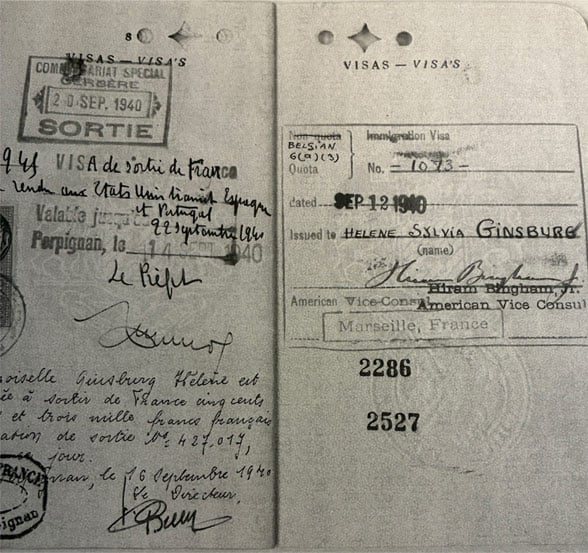
U.S. immigration visa the author’s mother received from Hiram Bingham in September 1940. Courtesy of Jane M. Friedman
In the opinion of the American rescue worker Varian Fry, who had been dispatched to Marseille by Eleanor Roosevelt to save anti-Nazi intellectuals, Bingham was the only man at the consulate who knew his job was to save lives. Fry would later call him his “partner in the crime of saving human lives.”
But it wasn’t an easy partnership. On the contrary. Breckinridge Long, an avowed antisemite, headed the visa division at the U.S. State Department then, and he had instructed U.S. consulates to postpone visa applications and keep refugee numbers low.
Because Bingham was breaking the rules, he was pulled from Marseille and reposted to Lisbon. He was then posted to Buenos Aires where, at the end of the War, he warned the State Department that Nazis were escaping Europe to Argentina. The U.S. government didn’t want to know.
Bingham resigned from the foreign service in 1946, returning to his family’s estate in Connecticut. He never spoke about his past; he hid papers that described his actions behind a chimney at home. Growing up, his children knew nothing about his World War II courage. He died in 1988 at age 84 and was buried without fanfare in Connecticut. His story was buried as well.
A 1994 U.S. Holocaust Memorial Museum exhibit about Varian Fry and his rescue of artists and intellectuals in France did mention Bingham’s work alongside Fry. But Bingham still hadn’t had his due.
Then, in 2002, Bill Bingham, one of Hiram’s 11 children, discovered the pile of documents behind the chimney and another stash in the attic of the family’s home in Salem, CT. The documents included letters from people Bingham had saved. The family donated some of the letters to the U.S. Holocaust Memorial Museum.
That same year, Secretary of State Colin Powell honored Bingham with a posthumous “constructive dissent” award from the American Foreign Service Association. Four years later, Bingham became one of six former U.S. diplomats to appear on a special postage stamp. Powell said that Bingham had “risked his life and career” to help more than 2,500 Jews who were targeted by the Nazis to escape France to America in 1940 and 1941. He stressed that Bingham had sacrificed for what he knew was right.
Indeed, Bingham’s heroic actions had ruined his career. He had been passed over, several times, for promotions. Sadly, he never learned about the honors that were eventually bestowed. This past May, the Connecticut legislature established July 17, Bingham’s birthday, as Hiram Bingham IV Day, to be marked every year.
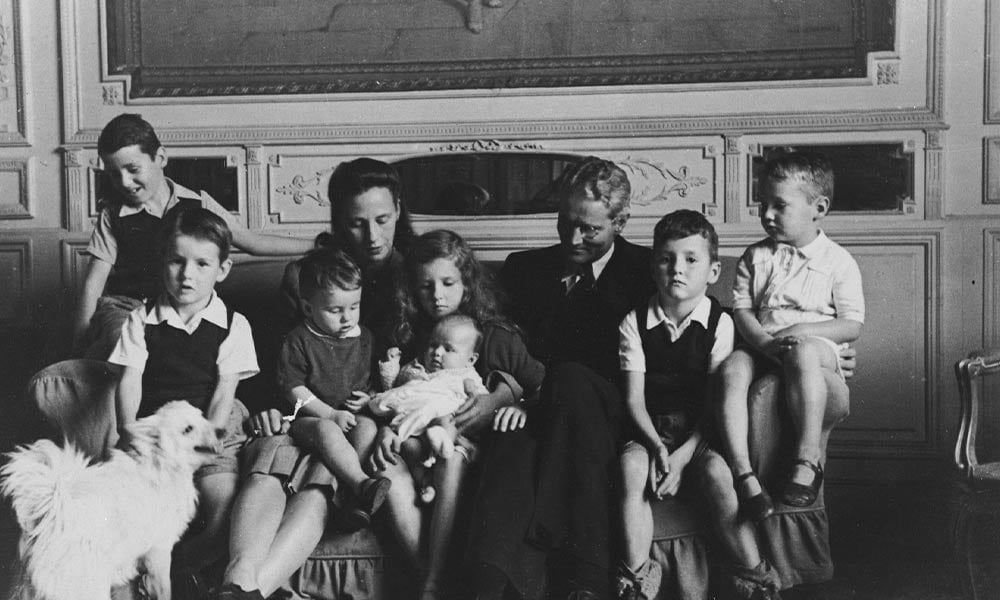
Vice Consul Hiram Bingham poses with his family at his residence in Buenos Aires, Argentina, 1944. Credit: United States Holocaust Memorial Museum, courtesy of Eric Saul
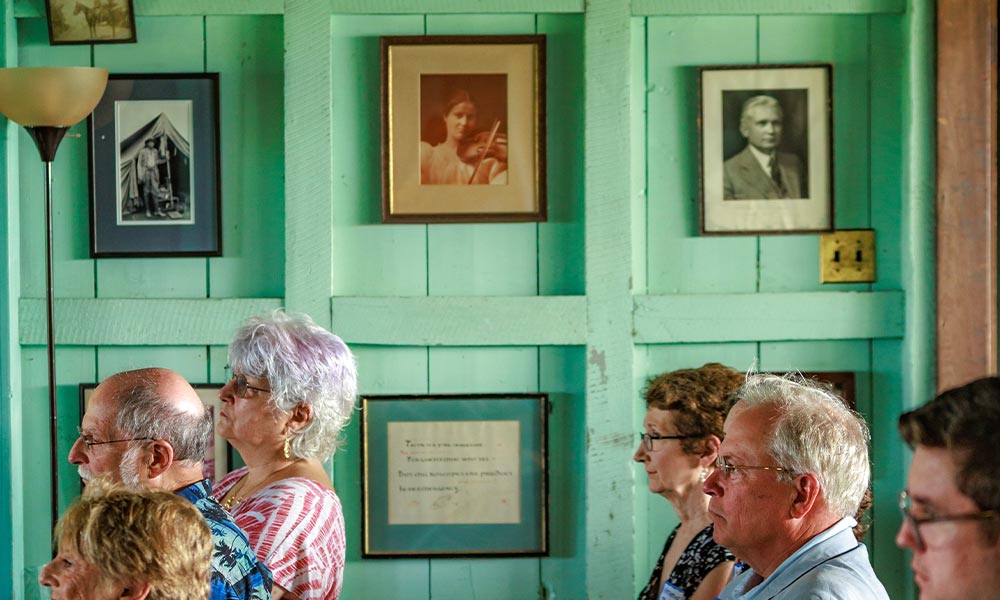
The Bingham family invited friends and supporters to join them at their home in Salem that day, to celebrate the man and his good works. As the descendant of someone who had been saved by Bingham, I was asked to speak about how my mother and grandmother escaped certain death at the hands of the Nazis. I said that had it not been for Hiram Bingham, I likely would not have been born.
State officials, including U.S. Congressman Joe Courtney and Senator Richard Blumenthal, also praised Bingham.
“The State Department told Hiram Bingham to close his eyes and look away. He refused and he stood up,” Blumenthal said in his speech. “Everyone of us must make a stand today,” he added, referring to the fight against antisemitism.
Courtney lamented the recent drop in the number of refugees entering the United States. “Today is not a walk down memory lane,” he said. “The level of refugee admissions in 2025 was the lowest since 1980. There are places in the world where people are suffering. Our work is not done.”
Israel’s Holocaust Authority Yad Vashem has not awarded Bingham its highest honor, that of a “Righteous Among The Nations.” In a letter to Abbie Bingham, the institution said only that it “wishes to express its thanks for the humanitarian disposition of your father at a time of persecution of Jews by the Vichy regime in France.” But his actions, for them, didn’t rise to heroic. A spokesman for Yad Vashem told me a few years ago that Bingham hadn’t suffered for what he did. He was able to return to his home in Connecticut. Varian Fry, who was named a Righteous, was arrested in France for his efforts in saving refugees and given a few hours to pack his bags and get out of France. And he fled.
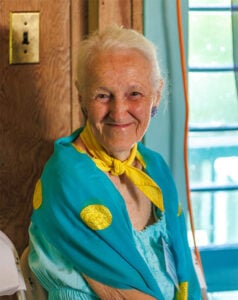
Abbie Bingham Endicott. Credit: Yakov Binyamin Turmelle
Abbie Bingham is neither bitter nor angry. She knows her dad felt good about what he did during the war. “It was what the Lord wished him to do,” she told me, adding that she believes “the most important thing for him was whether he could help people.”
“I hope,” she said, “he is happy that we honored him today for being a human who is kind and good.”
Eloise Bingham, age 57, a granddaughter who came for the event, said it well. “He was trying to shape us. He made me realize that we need to uplift others.”

Jane M. Friedman was a long-time foreign correspondent in Paris, Jerusalem and Cairo. She now resides and reports in New York City.
Top image: Attendees at the inaugural observance of Hiram Bingham IV Day at the Bingham family estate in Salem, CT, on July 17, 2026. Credit: Yakov Binyamin Turmelle