
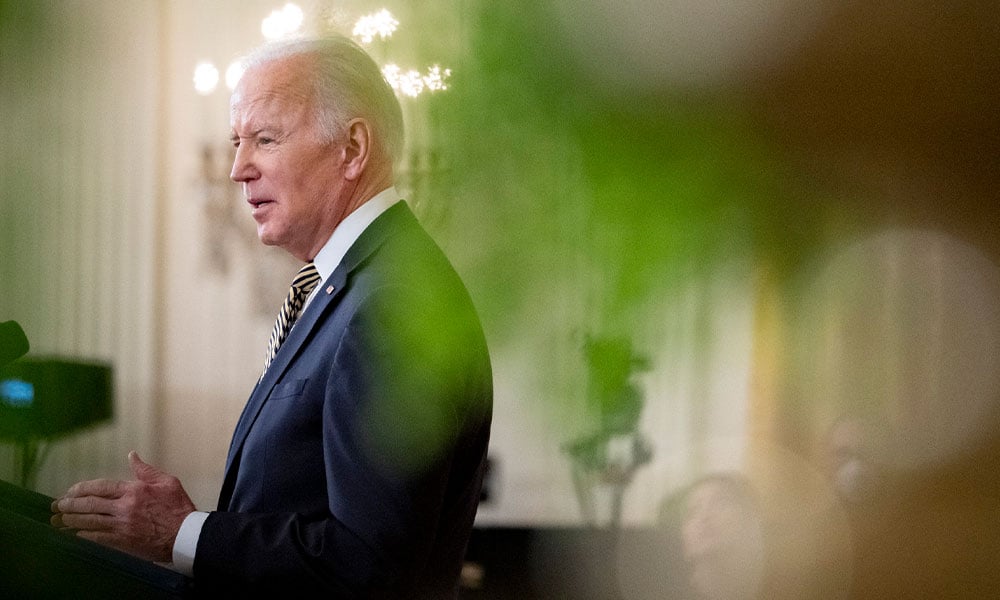
At the end of every presidency since 2008, Julian E. Zelizer, a professor of history and public affairs at Princeton, has gathered scholars to write essays for an early historical postmortem. As Zelizer writes in the introduction to The Biden Presidency: A First Historical Assessment, he was a few minutes into watching the disastrous Biden-Trump debate when he realized “we’d be compiling the next book now, not four years from now.” The scholars sprang into action. The resulting volume, just out, reads like a faint, depressing echo from a vanished age, but it’s still possible to discern some useful lessons, about miscues generally and the fallout from October 7 in particular. Did Biden mishandle October 7? Was he doomed by internal or external forces? Zelizer spoke with Moment opinion editor Amy E. Schwartz.
You’ve written these for several presidents, right?
I started doing it with George W. Bush when his presidency ended. The last one, on Trump, had its own unusual moment: After The New York Times ran a story about what we were doing, including that we’d already had a meeting to present drafts to each other, the president’s people approached me and wanted to do an interview, which we eventually did, on Zoom.
All of what you write seems so long ago. What remains today of the Biden legacy, going forward?
He can’t detach from the negative part: the return of President Trump and the entrenchment of MAGA Republicanism in American politics. As for the more positive aspects, we’ll see. I think about Jimmy Carter, also a one-term president but one who actually started to tackle ideas and policies that later came to be central, such as environmental conservation. Biden, even though the programs he backed are being rapidly dismantled, showed a way to think about how government could help with green energy, semiconductor manufacturing, affordability, and just because those initiatives are now being destroyed doesn’t mean they can’t be consequential in the future.
We treat each election as a dramatic sign that everything’s changed, but I think his victory in 2020, and the fact that 2024 was still relatively close despite everything that had happened, showed there is some appetite in the country for a more traditional and boring approach to governing, and that was part of his promise—normality and calm. And even though we tend to say 2024 was a rejection of all that, I think a lot of people still have an appetite for it. He was a reminder of what that looks like, and the desire for that hasn’t disappeared. In 2026, some Democrats might want to look back to what Biden was doing.
Things seem to be changing very fast. I know this is a “first historical assessment,” but is it too soon to tell how far the pendulum will swing?
These books are not predictive, nor declaring what the legacy is or isn’t, just getting smart historians to look at issues that were important in a presidency. Rather than the day-to-day accounts from journalists, they try to add some long-term context. So instead of starting the Biden immigration story in 2021, in this essay we think back to the 1960s. Or to discuss the changes in the Department of Justice (DOJ), where Biden tried to reestablish a wall between DOJ and the presidency, we look at how those walls were built after Watergate. So that’s the flavor I’m going for. It’s a first take, intended to open the conversation rather than give a definitive ending.
I look back at the other books, certainly the one about George W. Bush, and some things hold up. One was a chapter I wrote of a history of how conservatives had come to embrace robust presidential power rather than remaining a “conservative” party in that regard. In retrospect, that trend continued and became part of what the GOP is about today. In all three books, people wrote about struggles the Democrats have had with the new media world, with communication and messaging, which has changed as the books were written. A lot of different essays in the books have talked about how the Democrats can figure out how to restore the messages of the New Deal, and that came back again in the Biden book. And in all the books since Bush, there have been essays about the deep changes in views of immigration, Republicans shedding parts of the party that are more sympathetic to open borders or open immigration, and how that has played out.
In your introduction, you use the term “hyperpartisanship.” We’re used to thinking of this as a frame for the current administration; was it also the leitmotif of the Biden administration?
To some extent. Bear in mind, he was dealing with a Republican party that’s hyperpartisan. Democrats still tend to be coalitional, believing in restraints and guardrails. They ultimately need a government that’s functional , since it’s the center of what Democrats promise their voters. Republicans are more comfortable tying things up in knots, because they’re an anti-government party. With Biden, we looked more at what he was dealing with, his difficulties in seeing how far many Republicans would go to defeat him and stop him, in ways he couldn’t imagine or didn’t understand.
Former U.S. ambassador to Israel Daniel Kurtzer suggests in his essay that Biden will be judged harshly on his handling of the Israel-Palestine war, despite his seemingly unwavering support for Israel. Why the contradiction?
You have to separate the diplomatic part from the political part. As Kurtzer writes, the politics became a fault line Biden couldn’t handle, given the deep fissures in the party. Diplomatically, Kurtzer takes a more balanced view. In some ways Israel ended up stronger than before, despite what was going on in the United States politically. Kurtzer also wrote an essay in our volume on the Trump presidency about how Trump didn’t really have a vision for the Middle East, just a transactional approach. Despite achievements such as the Abraham accords, he pushed off the Israel-Palestine issue and didn’t want to deal with it. So it was on the table and likely to explode.
Although the Gaza war dominated the end of Biden’s term, Kurtzer suggests in his essay that the limits on what he could accomplish were really set by Afghanistan and Iran. Is that your view too, and does it carry through today? I think it’s an interesting and relevant point. Everything moves so fast in politics that we forget how damaging the withdrawal from Afghanistan was. The terms were set by the Trump administration, but it wasn’t handled well. The logistical problems played out on TV and social media, the way the collapse of Vietnam did, and created the perception of Biden as someone who could not just govern well or handle significant foreign policy. He never really recovered from that, and it set the conditions for dealing with October 7. In a similar way, the unfolding Iran war is a political problem for Trump that affects all other areas of foreign policy. It’s not his Afghanistan, but it’s his foreign policy dilemma, and it’s producing the same kind of ripples.


Was there anything Biden could have done differently after October 7?
It’s hard to analyze a counterfactual—it’s much easier to analyze what he did do. But you could imagine a more effective politician, someone with a stronger ability to communicate and stronger physical and mental capacity to deal with the coalitions in his party and hold them together, even as these debates unfolded. It’s not as if he was the first president to face deep divisions in his party over the Middle East or other foreign policy issues. And in some cases presidents still hold that coalition together. So maybe he could have done the politics better. He was hampered by the weaknesses the book looks at elsewhere—messaging, personal interaction, mental capacity.
Just to go back to partisanship for a second: You write that “Like Obama, he learned that the forces that divide the nation are much more deeply entrenched in political institutions and the electorate than he understood.” Do you come away from this with recommendations for structural change in the American system?
Not in this book. I wrote another book in defense of partisanship, and there I offered lots of detailed procedural reforms, like getting rid of the debt limit from 1917, or new leadership that embraced norms and guardrails, but this book isn’t intended to make recommendations.
I think there’s more interest among Democrats in making changes. You hear more Democrats talking about the problems of the Supreme Court or presidential power in ways reminiscent of the 1970s or Vietnam, when you had bursts of interest in procedural reform. I don’t know if it will happen before 2028, because they are laser-focused on trying to win back power. Anything that moves the conversation away from affordability is not a winning issue. But in the “short long run,” four to eight years, you’ll see more attention to those questions. It’s not unlike the post-Nixon years, when there was great interest in how politics work. There’s a window when it could happen—maybe in response to the redistricting wars. I could easily see that coming back into the conversation—campaign finance, congressional powers, executive powers, limits on the Supreme Court.
Historian Michael Kazin in his essay quotes Rep. Marie Gluesenkamp Perez: “There is no one weird trick that is going to fix the Democratic Party.” Do you see the future Democratic Party as becoming greatly different?
I’m not so convinced there’s a massive change taking place. Putting aside specific issues like the Middle East, I think on most economic, regulatory, environmental questions, the debates you’re seeing between different factions of Democrats are not that different from what played out under Obama. I’m not sure the party is jettisoning some of the core values and ideas they’ve been talking about—student loans, home purchases, care for veterans—I think they’re very rooted in the New Deal/Great Society era. They’ll evolve and change, but not fundamentally.
Will the Democratic Party still be the party of most American Jews? I’ve been asked this question every election literally since I got out of graduate school in1996. There’ve been incremental gains by the GOP, but we’re still an overwhelmingly Democratic group, and I say “we” as the son and grandson of rabbis. I’m not persuaded that there’s been any wholesale shift. Jews tend to be more liberal, and to attach great importance to the Great Society issues that still define the Democrats, but also, even in this age of the electorate, whole groups don’t really move. The question is do you have a chunk of Jews shift that could make a difference in certain states? That could happen, as opposed to a change in the 70 or 80 percent of Jews still voting Democratic.
Could Jews be made so uncomfortable by Democratic politicians that they get pushed out. of the party, as opposed to leaving?I don’t really think so. The same could be asked about the GOP. It’s not as if some of those similar issues don’t exist in the GOP, and some would say even more intensely. It’s not clear to me it’s easy to make such a major shift, and I don’t see the evidence for it.