LGBTQ+ ORTHODOX
No to Conversion Therapy “When Leviticus Is Not the Last Word: Making Space for LGBTQ+ Jews in the Orthodox World” by Nadine Epstein (Winter 2026) offers a profound look at the evolving landscape of inclusion, courage and the halachic shifts happening within our community.
One of the most vital milestones mentioned is the recent psak (halachic ruling) signed by 75 liberal Orthodox rabbis and rabbanits—including my father, Rabbi Prof. Daniel Sperber—formally forbidding the recommendation of conversion therapy. This ruling is a crucial step in ensuring that “Torah information” is never again used to justify harm but rather is used to build a world of compassion, dignity and true belonging for all. I highly recommend taking the time to read this deep dive into where we’ve been and, more importantly, where we are headed.
Avigail Sperber
Tel Aviv, Israel
DON’T LET BIGOTRY RULE
It’s a delight made even more meaningful by its rarity when queer lives are written about with dignity and humanity, well researched and thoroughly considered. I’m grateful to Moment for having taken such care to do so in this article. It is crucial for the soul of our communities that religious leadership open their hearts and welcome us into Jewish life as our true and authentic selves; to do otherwise is to forsake our commitment as Jews to human thriving and the Law as a living, rather than static, document.


Lo ba-shamayim hi; it is not written in the heavens that we should let bigotry rule our lives, and even if it were, it is our birthright and the legacy of our greatest sages that we should reject that and live lives of love anyway. In Nadine Epstein’s article, I saw that as a possible future, and I saw how far we’ve come and that there is so far to go.
Aaron Sofaer (she/her)
Sunnyvale, CA
MORE INNOVATORS
We hear you! Having received numerous suggestions of individuals missing from our innovators list and following discussions and debate on social media, we are compiling an an additional list of more people who have helped shape Jewish life over the past 50 years. Some are described below. Check momentmag.com/50-jewish-innovators to see all the names we missed. —The Editors
JOYFUL JUDAISM
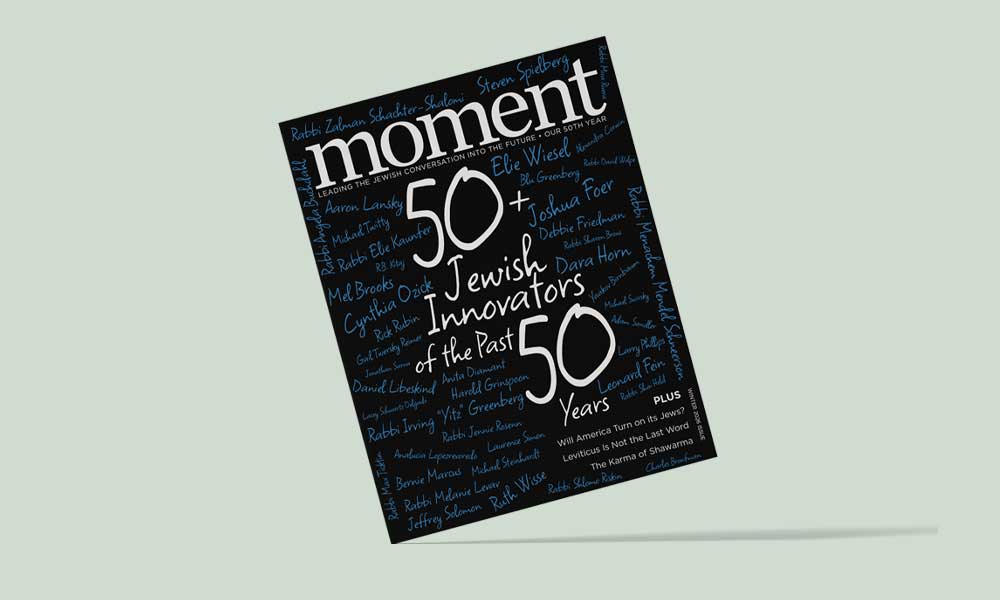
Your list of “50+ Jewish Innovators of the Past 50 Years” (Winter 2026) is a worthy and welcome project. Lists like this bring honor to changemakers and model for our community who and what matters. That’s precisely why we’d like to offer a notable omission: Lynn Schusterman.
Schusterman has brought extraordinary energy, joy and an unshakeable belief in the Jewish people to everything she’s touched. She has dedicated her life to inspiring young Jews to embrace what she calls joyful Judaism—to live, give, learn and love being Jewish. Her rallying cry, “Be that Jew,” captures something essential: that Jewish identity isn’t just preserved, it’s lived with passion and purpose. That philosophy has animated her extraordinary investments in organizations like Repair the World and the Birthright Israel Foundation, both of which she helped envision and create, and which have transformed how hundreds of thousands of young people connect to Jewish life and to Israel.
Schusterman has been the heart and soul of a movement to energize and strengthen Jewish life in America. Her impact will reverberate for generations.
Cindy Greenberg and Elias Saratovsky
New York, NY
SINGING PRAISES
I strongly recommend that Cantor Deborah Katchko-Gray be included on your Jewish Innovators list. She is one of the most significant innovators in modern American synagogue life, particularly in the field of the cantorate. Her influence extends far beyond music; she has helped reshape the very structure and culture of Jewish spiritual leadership in the U.S.
Through her founding role in the Women Cantors’ Network, she played a transformative role in advancing egalitarianism within Conservative and Reform Judaism. Her work helped normalize and legitimize women in the cantorate, expand opportunities for Jewish clergy of diverse identities and foster greater inclusion of LGBTQ+ individuals within synagogue life. The synagogue soundscape, leadership model and communal culture we experience today are deeply shaped by her vision and courage.
Cantor Erica Lauren Rubin Lipp
Oyster Bay, NY
WOMEN (AND MEN) OF VALOR
As a founder of Lilith magazine in 1976, and its editor-in-chief for half a century, Susan Weidman Schneider was a major influencer of Jewish feminist thought and action. Jews, particularly young Jews, experienced the satisfaction and joy of helping far-flung communities around the world through Ruth Messinger’s long-term leadership of American Jewish World Service. Richard Siegel, Michael Strassfeld and Sharon Strassfeld, editors of The Jewish Catalog, sparked the DIY trend in Judaism. Recognized as the “Mother of the Disability Rights Movement,” Judy Heumann engaged in tireless advocacy that resulted in significant legislation and policies benefiting disabled members of the Jewish, American and worldwide populations. Gifted musician Flory Jagoda introduced Sephardic music from her native Sarajevo to the Ashkenazi American community, bringing into the mainstream songs like “Ocho Kandelikas,” which have become staples of Jewish celebrations.
Avis Miller
Chevy Chase, MD
RABBIS, WRITERS, MUSICIANS
Your Winter 2026 issue highlights 50+ Jewish innovators of the past 50 years. Undoubtedly, you’ll receive many letters citing what you missed. Here’s mine: Rabbi Jonathan Sacks, perhaps the most prolific and widely read Orthodox scholar in contemporary Judaism. Rabbi Adin Steinsaltz, translator of the Talmud and prolific writer on Jewish mysticism. Rabbi Avi Weiss for his tireless work on behalf of Soviet Jewry and then for his founding of a yeshiva that imagines a more egalitarian Orthodoxy, including ordaining Orthodox women as rabbis. Also missing are the Israeli psychologists and Nobel Prize winners Amos Tversky and Daniel Kahneman. And what about the justly famous triumvirate of Israeli novelists, A.B Yehoshua, Amos Oz and David Grossman? And the great refusenik, Anatoly Sharansky? So many more Israeli cultural icons come to mind. As noted in the intro, you decided to limit your list to American Jews. But even on the American scene, how does the list not include Rabbi Abraham Joshua Heschel? (Okay, he died just over fifty years ago.) Or a representative of the Yiddish and klezmer revival movement? Zalmen Mlotek or Alicia Svigals would have been fine representatives. And two greats who muddied themselves but nonetheless were so influential: Woody Allen and Shlomo Carlebach.
Mitchell M. Frank
Queens, NY
TALK OF THE TABLE
AS THE DÖNER TURNS
I greatly enjoyed Dan Freedman’s recent “Talk of the Table” (“The Karma of Shawarma,” Winter 2026). He did mention that shawarma evolved from what is known as döner kebab in Turkey. I would also add that the same food item, more or less, is generally known across the Aegean as “gyro” (pronounced “yee-row”)—which in Greek means “turning.”
And while we are in the Aegean, we might note that from the same Turkish verb that yields döner kebab—dönmek, “to turn”—comes the term “dönme” for the followers of Sabbatai Zevi, who turned from Judaism to Islam in the 17th century.
Zevi began his messianic preaching in his native Smyrna (today’s Izmir), which had a sizable Sephardic population. But he enjoyed his greatest success in Salonika, today’s Thessaloniki, which was in many ways the cultural capital of the Sephardic world for centuries. He was eventually given the choice between conversion to Islam or death, and chose the former, as did most of his followers, who were then described as dönme well into the 20th century. They maintained their own identity and built a new mosque for themselves in 1902. The dönme have sometimes been described as crypto-Judaic, although they vigorously professed their allegiance to Islam, and as a result were included in the population exchange between Greece and Turkey in 1923.
Tom Yohannan
Barcelona, Spain
WILL AMERICA TURN ON ITS JEWS?
In December, “Moment Debate” went live to ask if America will turn on its Jews. Menachem Rosensaft, general counsel emeritus of the World Jewish Congress, and Adam Scott Bellos, founder and CEO of The Israel Innovation Fund, engaged in a lively and sometimes contentious debate moderated by Moment Opinion & Books Editor Amy E. Schwartz.
The hour-long program garnered nearly 400 comments on YouTube. Some commenters supported Bellos’s “yes” take, reaffirmed by his move to Israel. “Totally agree with Adam,” one wrote, elaborating that “what’s needed is a broad educational push to build a Hebrew-fluent, ‘aliyah-ready’ diaspora: Jews of all ages with the basic skills needed to function in Israeli society. Even if most never make aliyah, that shared readiness would strengthen resilience, restore agency and could help reduce our internal divisions at home and around the world.” Others noted Bellos’s brash approach: “Adam has to learn how to build crisp arguments based on specific facts and reference rather than preach broad generalities,” one wrote. “He’s a better preacher than logical builder of ideas.”
Rosensaft’s cautious but skeptical mindset gained him support. One commenter even compared him to Theodor Herzl sounding the alarm, 40 years before the Wannsee Conference: “Like Herzl we must think in larger chunks of time and plan accordingly instead of getting distracted by irrelevant details moment to moment.” But others thought that his connecting rising antisemitism to Israel lacked “historical backdrop and fundamental understanding of Jew hatred,” as one commenter put it. “The notion that American anti-Jewish reality is promoted by Israel is very shallow at its core.”
Despite the wide range of opinions, most agreed the conversation was worthwhile and pertinent. “Please keep going with this conversation with future panelists,” one person wrote. “Jews are in trouble and we need to figure out what to do.”
MOMENT DEBATE
HE BELLOWED
In the last “Moment Debate” between Adam Scott Bellos and Menachem Rosensaft (“Will America Turn on its Jews?” Winter 2026), Bellos says that antisemitism makes less headway against strong Jewish communities rooted in being Jewish and then says that strength never existed in the diaspora. Well, where did it exist? Is he referring to biblical Israel? To the State of Israel?
In the MomentLive! debate between the two, from which the print version was adapted, Bellos ridicules Rosensaft for apportioning much blame for the antisemitism in the United States to Israel’s policies. He says we shouldn’t be looking outward but at our own country’s issues. He also blames President Obama for splitting American Jews while making a nuclear deal with Iran. (When Bellos said that he left the United States in 2006 because he didn’t want to live under Obama, my jaw dropped.)
You could see inconsistency and error due to emotionalism in much of what Bellos said. I do not like where this country is headed, and with the loss of democratic norms, the Jewish people are at great risk locally and federally. The only thing Bellos contributes is to drive more sober, less fanatical minds to start thinking about this growing crisis and fighting it politically, socially and sanely. (And yes, I live in the USA. I’m not a weak bunny rabbit who turns tail and flees the country because he’s uncomfortable with a president.)
Michael Rudnick
Berkeley Heights, NJ
UNITY IS KEY
I enjoyed this interesting “Moment Debate,” but it missed several points:
• The idea that the Jewish community can/should protect itself by itself is silly. Once a government ceases to take real responsibility for its citizens’ safety, antisemitic and hate ideologies have triumphed, and anything Jews do by themselves will be inadequate.
• Current leadership of Jewish organizations is profoundly out of touch with antisemitic realities. These organizations were built for another time, when there were fair-weather alliances, legislative opportunities and achievable goals (e.g., freeing Soviet Jews), and antisemitism was still tamped down because of Holocaust history. If Jewish organizations don’t fully unite around fighting Jew hatred as Job One, they won’t be around much longer.
• There may still be time to leverage legal tools to pinpoint and challenge specific anti-Jewish organizations and bankrupt them with ongoing, complex and expensive litigation. The Jewish community should have a robust legal arm.
• If America does indeed turn on its Jews, where will all the anti-Israel Jews go? Netanyahu notwithstanding, Israel is there precisely for when the world expels its Jews.
History, they say, doesn’t repeat itself, it merely rhymes. Except when it comes to Jews.
Avrom Jacobs
Chestnut Hill, MA
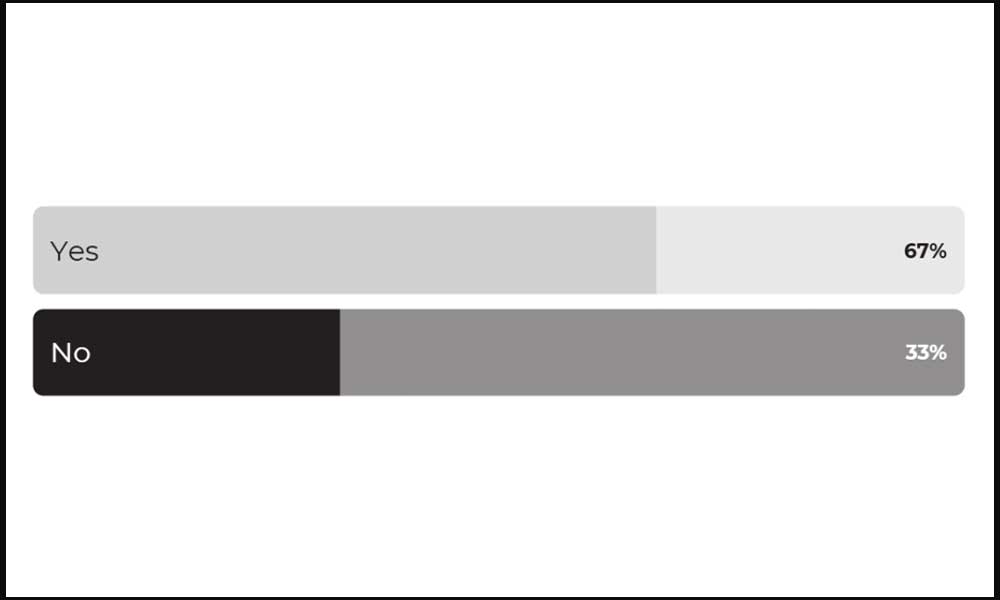
MOMENT DEBATE POLL
Moment readers weighed in on last issue’s “Moment Debate” question, “Will America Turn On Its Jews?” The majority answered “Yes.”