


Dear Reader,
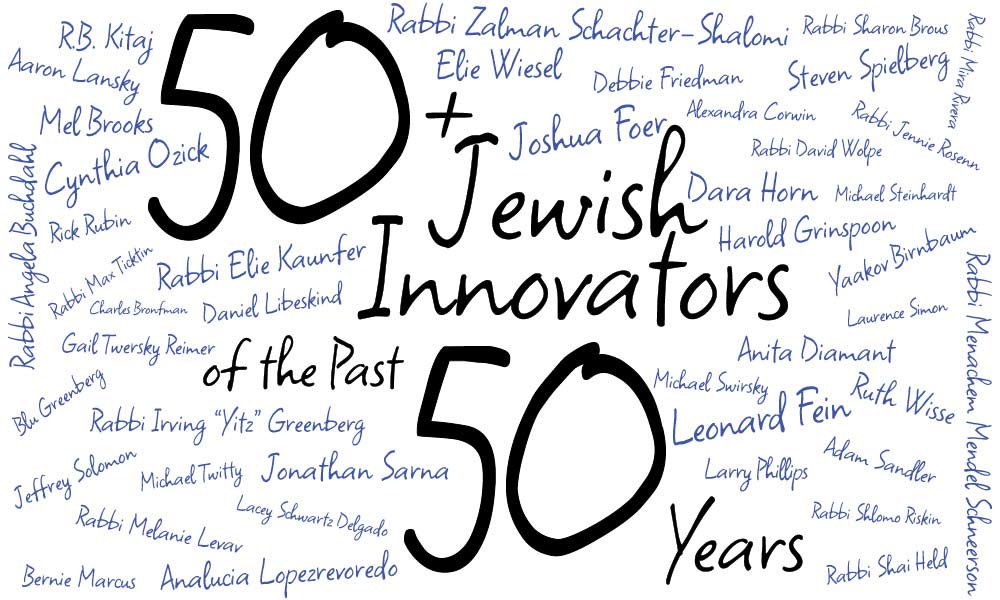
It seemed like a simple task when we first started thinking about assembling a list of the most innovative Jews of the past 50 years. Magazines publish lists all the time; how hard can it be? But the more we dove into the project, the more difficult it became. After all, is there such a thing as a lone innovator, or is innovation a collaborative effort? Were we talking about Jewish innovators such as Jonas Salk, Sergey Brin, Larry Page and Ruth Bader Ginsburg, who changed the world for everyone, or were we more interested in innovators who shaped Jewish American life? Did we want to expand our universe beyond America to the rest of the world, including Israel? And what exactly does it mean to be an innovator? If to innovate is to change the way something’s done or to introduce something novel, should the focus be on the innovation itself? Who should decide, and if we were going to name names, how to keep it from becoming a popularity contest? How to make a list that is representative of a 50-year period? These and other questions led to countless animated editorial debates, and a few times we threw up our hands and came close to ditching the whole idea. Finally, we narrowed the scope and turned the endeavor into a “Big Question,” because it truly is one. We tracked down scholars, thinkers and innovators themselves and asked them to weigh in. No surprise, all of them think about innovation in their own way and are excited by different people and ideas. More than a year later, here’s our exploration: rich, multilayered and sprawling. What have we learned? A lot of things, but above all we learned that American Judaism and Jewish life over the past 50 years has been incredibly dynamic!
The Editors
P.S. No doubt you will read this and say, “By Jove, they’ve left out the most important innovators!” By nature such an exploration is incomplete and excludes many deserving people. Please tell us who you think should be included, and we will consider adding them online. Email editor@momentmag.com
+ Jewish Innovators
Rabbi Adina Allen Rabbi Morris Allen Robert Arnow Rabbi Albert Axelrad Jackie Baldwin Yaakov Birnbaum Charles Bronfman Mel Brooks Rabbi Sharon Brous Rabbi Angela Buchdahl Alexandra Corwin Paul and Rachel Cowan David Cygielman Anita Diamant Lacey Schwartz Delgado Barbara Dobkin Nathan Fielder Leonard Fein Joshua Foer Debbie Friedman Blu Greenberg Rabbi Irving “Yitz” Greenberg Harold Grinspoon Rabbi David Hartman Yoram Hazony Shai Held Dara Horn Rabbi Elie Kaunfer Adam Kirsch R.B. Kitaj Aaron Lansky Rabbi Melanie Levav Daniel Libeskind Rachel and Jon Goldberg-Polin Analucia Lopezrevoredo Bernie Marcus David Mintz Cynthia Ozick Larry Phillips Julie Platt Gail Twersky Reimer Rabbi Shlomo Riskin Rabbi Mira Rivera Rabbi Jennie Rosenn Sage Cassell-Rosenberg Rick Rubin Aaron Samuels Adam Sandler Jonathan Sarna Rabbi Zalman Schachter-Shalomi Rabbi Menachem Mendel Schneerson Hershel Shanks Barry Shrage Steven Spielberg Laurence Simon Jeffrey Solomon Rabbi Joseph B. Soloveitchik Michael Steinhardt Rabbi Michael Swirsky Izabella Tabarovsky Rabbi Ethan Tucker Michael Twitty Eric K. Ward Elie Wiesel Bari Weiss Ruth Wisse Rabbi David Wolpe Meir Zlotowitz
+ Contributors
Diane Bolz Sarah Breger Raven Schwam-Curtis Neshama Carlebach Nadine Epstein Josh Foer Yossi Klein Halevi Dara Horn Ilana Kaufman Adam Louis-Klein Aliza Mazor Avram Mlotek Jonah Platt Amy E. Schwartz Francie Weinman Schwartz Andrés Spokoiny Abraham Socher
A general comment about innovation—it’s not about creating something ex nihilo, but mostly about integration and adaptation, upgrading existing ideas and developing “the adjacent possible.” The people I list here all share that talent. Their ideas are not necessarily original, but they found a new twist or a new application for an existing approach. It’s hard to focus on only five, but here they are, in no specific order.
Solomon has been involved in a long list of innovations. Not all were the product of his imagination, but he gave a generation of younger leaders the possibility of dreaming up new ideas and developing them—from Birthright to Reboot to Gift of New York to 21/64. For me, however, Solomon’s most important innovation was to conceptualize the shift in Jewish philanthropy toward strategy, transparency and, yes, innovation.
Foer is a serial entrepreneur, but Sefaria, the project he created with Brett Lockspeiser to put the entire Jewish textual canon online, stands alone as one of the most transformative Jewish projects of the 21st century.

Joshua Foer, Rabbi Elie Kaunfer and Harold Grinspoon
Rabbis David Hartman, Michael Swirsky, Shai Held, Ethan Tucker and Elie Kaunfer
Hartman founded the Shalom Hartman Institute. Swirsky founded Pardes. And Held, Tucker and Kaunfer founded Hadar. In doing so, they transformed Jewish studies, mixing rigor with openness and thus enabling new populations to access Jewish learning. While two of these institutions are based in Israel, they were created by North Americans and have an impact on this side of the ocean.
Shrage was a visionary in the redesign of Jewish Federations. He was the first to open Federated giving to donor designation, and he was the first to establish Jewish education and learning as a core mission of a Federation. The fact that many of his ideas are now considered banal is a testament to their enduring relevance.
Harold Grinspoon, David Cygielman, Charles Bronfman and Michael Steinhardt
Three great innovative projects of the early 21st century—PJ Library, spearheaded by Grinspoon; Moishe House, designed by Cygielman; and Birthright, dreamed up by Bronfman and Steinhardt—rest on something simple but brilliant: “Judaizing,” a behavior that already existed. For example, parents read to their children; Grinspoon provided them with high-quality Jewish books. Young people live with roommates; Moishe House helped them live with other Jews. And young people travel; Birthright encourages them to travel to Israel.
Andrés Spokoiny is the president and CEO of the Jewish Funders Network and the author of Tradition and Transition.
Rabbi Irving ”Yitz“ Greenberg
Our most important theologian on post-Holocaust Jewish identity, Greenberg taught us the meaning of the “Third Era” of Jewish history, as he puts it, and redefined the core of Judaism as a survivor people’s commitment to enhancing life and human dignity.
The forgotten founder of the Soviet Jewry protest movement, Birnbaum taught American Jews how to effectively wield political power, setting in motion the forces that would retrieve a quarter of the Jewish people caught behind the Iron Curtain and raising a generation of Jewish leaders and activists.
Rabbi Zalman Schachter-Shalomi
Reb Zalman was the shadchan (matchmaker) between Hasidism and 1960s counterculture, 1970s New Age and the religions of the East, offering a vision of a universally minded Judaism steeped in Jewish mysticism.
Paul, one of the leading journalists of the last generation, and his wife Rachel, a convert who became a prominent rabbi, jointly wrote a seminal book, Mixed Blessings, that helped interfaith couples encounter Judaism. Together they were a model of a joyful American-rooted Judaism for thousands of seekers.
Yossi Klein Halevi is an Israeli journalist and author whose book Like Dreamers won the 2013 National Jewish Book Award’s Book of the Year.
What this moment demands from us is creative leadership. One thing we’ve learned over the past few years is that we need community to sustain us in good times and in bad; we need communities that have meaning and purpose. These five women are creating access to Jewish communal life for those who might otherwise be unengaged or under-engaged.
As the founder and executive director of Jewtina y Co., Lopezrevoredo has created a space for the 750,000-person-strong Latinx Jewish community to come together, celebrate Latin and Jewish heritage, conduct systematic research to document the community and its needs, and advance the leadership of Latinx Jews.
Allen has transformed the role of creativity in Jewish life through the Jewish Studio Project. Together with her book The Place of All Possibility and the trainings she does throughout the country on Jewish creativity, she has revolutionized text study and spiritual practice.
Levav is enabling the Jewish community to confront mortality by helping to normalize conversations about the end of life and by empowering Jews to access Jewish wisdom as they engage in end-of-life planning. Through Shomer Collective, she is transforming the communal conversation around death and dying.
As executive director of Ammud: The Jews of Color Torah Academy, Corwin is transforming Jewish life by creating a platform for Jews of color to engage in deep Torah learning and leadership development. This organization was created by and for Jews of color to amplify Jewish wisdom and increase JOC leaders’ visibility in roles of communal leadership.
Rosenn founded Dayenu: A Jewish Call to Climate Action in 2020 to mobilize the American Jewish community to confront the climate crisis with spiritual audacity and bold political action. The organization has since grown exponentially and now mobilizes thousands of Jewish climate activists. Dayenu is active in interfaith climate action and engages Jews around the country through Dayenu circles.
Aliza Mazor is the chief field-building officer for UpStart, which supports an alumni network of over 200 organizations.
Rabbi Menachem Mendel Schneerson died 30 years ago and is still, inarguably, the greatest innovator of Jewish life in the last 50 years. I’m not sure which of the many entrepreneurial ideas—from far-flung Chabad houses to Friendship Circle—were his and which were his lieutenants’, but the same could be said of Thomas Edison.
Rabbi Joseph B. Soloveitchik was above all else a teacher, who insisted that his students (and their students) could and should combine an unyielding commitment to halacha and Jewish tradition with the best in modern scholarship and culture. Although he died more than 30 years ago, his influence is still felt at Yeshiva University and throughout the Modern Orthodox world.
If anyone can revitalize liberal Judaism, whose market share Chabad and Modern Orthodoxy have challenged over the last half-century, it’s the leaders of the nondenominational Hadar Institute, in particular its inspiring co-founder, the theologian Shai Held, whose recent book Judaism Is About Love takes on all comers, from Christian supersessionists to Orthodox hyper-legalists.

Rabbi Menachem Mendel Schneerson, Cynthia Ozick and Dara Horn
A little over 50 years ago, Cynthia Ozick burst upon the Jewish literary scene, pricking the overblown egos of one male Jewish intellectual after another (Norman Mailer, George Steiner, Harold Bloom, to name a few), while writing the most deeply theological fiction American Jewish letters had ever seen. Remarkably, blessedly, she’s still doing so. Among her literary heirs, Dara Horn has paired Ozick’s stringent moral criticismwith a surprising Jewish activism, responding unflinchingly to the current crisis of antisemitism on university campuses, in books, essays, podcasts and even curricula. Adam Kirsch, too, is an heir to the tradition of American Jewish letters, which he has absorbed and made new in his impossibly omnivorous criticism, his delicate neo-formalist poetry and, most recently, in his devastating and deeply Jewish critiques of post-this and post-that ideologies, humanism and colonialism in particular.
Abraham Socher is the editor of the Jewish Review of Books and professor emeritus of Jewish Studies and Religion at Oberlin College.
Meir Zlotowitz
R.B. Kitaj
Rick Rubin
Menachem Schneerson
Nathan Fielder
Joshua Foer is co-founder of Sefaria, Sukkah City, and Lehrhaus. He is the author of Moonwalking with Einstein.
As you might expect from someone who edits a lot of rabbis, when I think of innovators, the first two who come to mind are both rabbis whose influence on Jewish life went far beyond the pulpit. One is a major figure in Modern Orthodoxy, the other in the progressive Chavurah movement.
Rabbi Shlomo Riskin, now 85, had a dramatic impact on American Jewish life before making aliyah in 1983 to found the West Bank settlement Efrat. At age 23 he founded the groundbreaking Modern Orthodox community Lincoln Square Synagogue, widely credited with the resurgence of an observant Judaism that attracted highly educated, affluent New Yorker Jews and popularized the phenomenon of baalei teshuva, those who become Orthodox as adults. (A 1986 New York magazine cover story on “The New Orthodox” certified the arrival of Jewish observance as “cool.”) Lincoln Square was an early Orthodox venue for experimental women’s minyans, and Riskin, though he never joined his more liberal colleagues in support for ordaining female rabbis, was a driver of advanced Talmud education for women, later founding Ohr Torah Stone to offer women graduate degrees in Talmud and training them as legal advocates in rabbinic divorce courts.

Rabbi Shlomo Riskin, David Mintz and Nathan Fielder
Rabbi Max Ticktin, who died in 2016 at age 94, was ordained a Conservative rabbi, but his innovative worship approaches went beyond any one denomination and shaped Jewish prayer and study in ways that still resonate. He helped found two influential congregations that shaped the Chavurah movement, with its style of independent, participatory, egalitarian and lay-led prayer and study. Spreading nationally and did much to make Jewish worship and study less formal and more approachable: first the Upstairs Minyan in Chicago, where he was serving as the director of the University of Chicago Hillel, and then Fabrangen, a chavurah in Washington, DC. Ticktin left his mark on many other parts of the community, serving as a national Hillel leader for a decade and as a professor of Judaic Studies at George Washington University for 30 years. A film was made about his work with an underground network of abortion providers in the years before abortion was legalized.
Rabbi Morris Allen, creator of the “Hechsher Tzedek” project (later called the Magen Tzedek certification), sought to broaden the idea of kosher certification beyond traditional halacha to encompass such justice issues as humane treatment of animals and a living wage and healthy conditions for workers. Allen launched the Hechsher Tzedek in 2007 and, although it was never universally adopted—and, indeed, was fiercely opposed by most of the existing kashrut certification authorities—it left its mark on the discussion of kashrut as a system of ethics rather than simply of legal details.
David Mintz, a New York caterer, revolutionized the possibilities of Friday night dinner in 1981 by inventing Tofutti, the first commercial tofu ice cream, which allowed his strictly kosher customers to serve ice cream-like desserts with a meat meal. Called “the P.T. Barnum of tofu” in a New York Times obituary, Mintz spent years trying to perfect a buttercream feel for the otherwise unexciting tofu and ended up with a product that expanded the dessert possibilities not only for the kosher-observant but for the lactose intolerant, vegans and those with allergies. The formula, according to the Times, remains proprietary, but the expanded range of non-dairy dessert products continues to enrich Jewish culinary life.
Amy E. Schwartz is Moment’s opinion & books editor and oversees “Moment Debate” and “Ask the Rabbis.”
Over the past 50 years, few have embodied innovative moral leadership and spiritual resilience like Rachel and Jon Goldberg-Polin. When their son Hersh, of blessed memory, was abducted from the Nova music festival on October 7, 2023, they did not retreat into silence or despair. Instead, they sparked a movement, becoming the faces and voices of the “Bring Hersh Home” and “Bring Them Home NOW” campaigns, transforming personal anguish into a global outcry for justice and compassion. Rachel’s quiet, searing act of wearing a numbered strip of tape across her chest to mark each day of her son’s captivity became a symbol recognized around the world, adopted by thousands who stood in solidarity, aching for peace, truth and the return of all hostages. Even after Hersh was tragically murdered in captivity, they continued their activism. Their grace, even in grief, has offered the Jewish—and broader—world a new language of resistance rooted in compassion, a model of activism rooted in empathy. Their story is not only one of loss but of moral imagination: a vision of what it means to be human in the face of inhumanity, and what it means to be Jewish in an age that demands both courage and heart.
Neshama Carlebach is a singer who has released ten albums, some in Hebrew. She is in the process of becoming a rabbi.
Rabbi Irving ”Yitz“ Greenberg
No other rabbi or scholar in the past 50 years has contributed more to the mosaic of American Jewish life than Yitz Greenberg. His Torah of a mission-driven Judaism that is more pluralistic and inclusive, connected to Israel, and focused on continuing and experiential education can be found across the denominations.
Steven Spielberg
His Shoah Foundation’s preservation of Holocaust survivor voices alone is an innovative feat for perpetuity; that the name Spielberg is synonymous with filmmaking is testament to his everlasting cultural impact.
Debbie Friedman
Friedman transformed Jewish liturgical music—which was choir-focused, formal and rooted in European classical traditions—into easy-to-sing, folk-inspired melodies. She, like Rabbi Shlomo Carlebach in traditional communities, revolutionized Jewish worship, and their imprint on Jewish music today is undeniable.
Mel Brooks
If Jews are known for comedic quality and insight about America, we have Brooks to thank for paving the way—a way that Larry David, Jerry Seinfeld, Ben Stiller, Adam Sandler, Jon Stewart, Sarah Silverman and countless others now walk.
Avram Mlotek is a rabbi, artist and writer and founder of Base Hillel, a pluralistic center for young Jews worldwide.
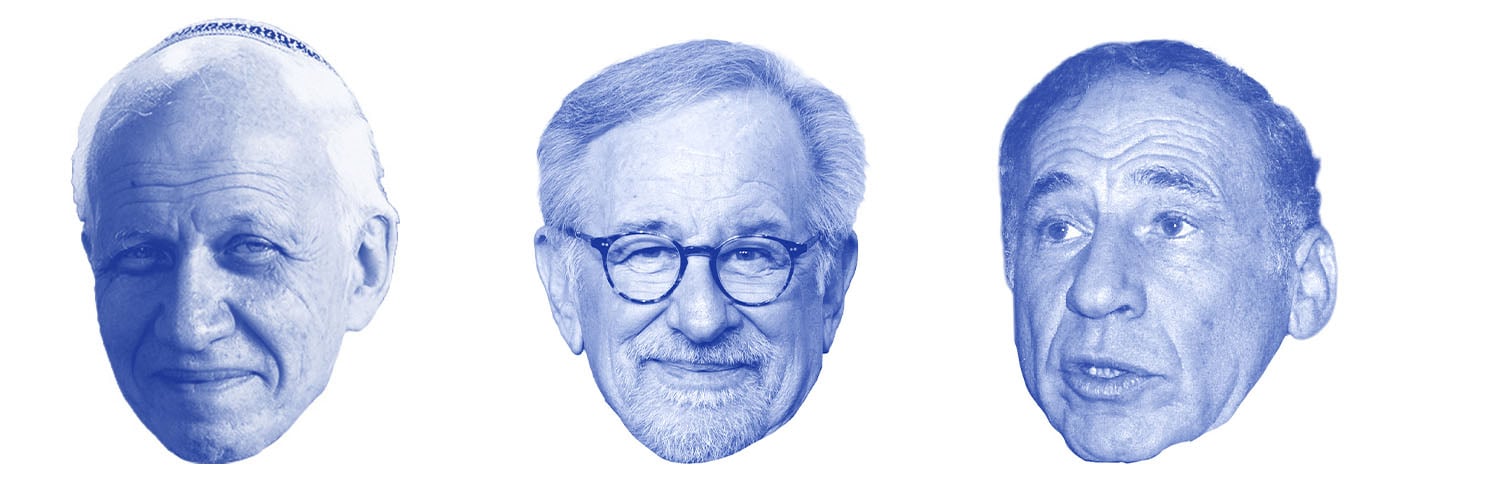
Rabbi Irving “Yitz” Greenberg, Steven Spielberg and Mel Brooks
 Francie Weinman Schwartz’s Picks
Rabbi Sharon Brous
Founding rabbi of the non-denominational congregation IKAR in 2004, Brous’s goal was to bring together young Los Angeles Jews on the margins of their faith, to create a community seeking joy and justice. Twenty years later, her best-selling book The Amen Effect: Ancient Wisdom to Mend Our Broken Hearts and World, confirmed this theme: by showing up and feeling the pain of the other, a single soul joins other single souls, together building a world of compassion and understanding.
Francie Weinmann Schwartz is a writer and educator specializing in Jewish subjects and a senior editor at Moment.
Rabbi Angela Buchdahl
The first Asian American to be ordained as rabbi and cantor in North America, Buchdahl is also the first woman to lead Manhattan’s Central Synagogue in its 180-year history. Rabbi Buchdahl is an innovator in leading worship, drawing large crowds to Jewish ritual and attracting audiences from around the globe. She is an inspiring advocate for Jewish life and the beauty of maintaining and merging cultural traditions.
Analucia Lopezrevoredo
Lopezrevoredo is an innovator in expanding the thought leadership, understanding and celebration of Latin Jews. She is the founder and executive director of Jewtina y Co., and she serves in pivotal roles at organizations such as Bend the Arc, JIMENA and OneTable.
Rabbi Mira Rivera
The first Filipina American rabbi to be ordained at The Jewish Theological Seminary and a trailblazer as a Conservative rabbi, Rivera is a board certified chaplain. She has served both as a spiritual and community leader, co-founding Harlem Hevruta and educating and mentoring for the next generation of clergy through her leadership at Ammud: The JOC Torah Academy.
Michael Twitty
The renowned culinary historian frames food as a mode of social justice, examining the connections between Black and Jewish culinary histories and themes such as resilience, faith and cultural preservation in the kitchen. Twitty has created profound conversations about heritage, memory and belonging in American Jewish life, and is a recipient of the prestigious James Beard Award.
Ilana Kaufman is the founder and CEO of the Jews of Color Initiative (JoCI).

Rabbi Angela Buchdahl, Michael Twitty and Adam Sandler
Jonah Platt’s Picks
Adam Sandler
Bernie Marcus
Dara Horn
Rabbi David Wolpe
Julie Platt
Jonah Platt is a singer, actor and host of the podcast Being Jewish with Jonah Platt.
Jonathan Sarna
It might seem odd for a historian to appear on a list of innovators, but no one has shaped how American Jewish history is understood more than Sarna. The longtime Brandeis historian—now emeritus—argues that the Jewish religious story in America is not one of assimilation and dilution, as many previous scholars had claimed, but one of creativity and reinvention. For Sarna, it was the unique freedoms Jews found in the United States that allowed a distinctly American form of Judaism to emerge. His 2004 American Judaism: A History remains the standard text in the field, but he has published on everything from synagogue architecture to why matzah in America is square. Sarna’s popularity lies partly in his accessibility—he is a Jewish journalist’s best source!—but also in the fact that his work remains eminently readable, demonstrating that serious scholarship need not be obscure to be authoritative.
Rabbi Elie Kaunfer
Kaunfer helped found and popularize the independent minyan movement, which emerged in the early 2000s among young, highly educated Jews seeking serious prayer and community outside of denominational Judaism. In 2006, Kaunfer co-founded what would become the Hadar Institute, an egalitarian yeshiva and center of learning. Kaunfer and his cohort have helped us see how serious Jewish text study and spiritual practice can function outside traditional institutional models.
Blu Greenberg
Considered to be the matriarch of Orthodox feminism, Greenberg paved the way for the robust leadership and study opportunities that exist for Orthodox women today. Her 1981 book On Women and Judaism: A View from Tradition, with its oft-quoted line “where there’s a rabbinic will, there’s a halachic way,” offered a path for those trying to reconcile their feminist ideals and their love of traditional Judaism. In 1997, Greenberg helped found The Jewish Orthodox Feminist Alliance, and she remains an outspoken advocate for agunot.
Sarah Breger is the editor of Moment and director of the Daniel Pearl Investigative Journalism Initiative.
Izabella Tabarovsky
Tabarovsky’s work still awaits its full appreciation. In a powerful body of essays for Tablet, she traced anti-Zionist slogans like “Zionism is racism” and “Zionism is Nazism” back to their origins in Soviet propaganda, exposing how these libels were seeded into Western leftist movements and institutionalized through the UN. Tabarovsky has not only recovered this buried history—she has laid the foundation for a new, genealogical approach to anti-Zionism, one that understands it not as a spontaneous moral response to Israeli policy, but as a coherent ideological formation rooted in anti-Judaic and classical antisemitic traditions. As awareness grows about anti-Zionism as a distinct and holistic ideology of anti-Jewish hate, and as the scholarly study of anti-Zionism begins to take shape, I believe Tabarovsky’s work will remain one of its most important precedents.
Bari Weiss
Weiss has reshaped the landscape of journalism by resisting the collapse of public discourse, the ideological narrowing of mainstream media and the spiraling extremes of the culture war. As founder and editor of The Free Press, Weiss did more than advocate for a principled center; she reimagined journalism as a kind of intellectual curation—an editorial space where diverse voices and lived experiences converge in a shared search for meaning. What distinguishes her work there is not only its moral clarity, but its creative openness: journalism not just as reportage, but as a pluralistic and innovative practice of thinking in public.
Yoram Hazony
Hazony occupies a singular place in today’s intellectual and political landscape. Often associated with the right and an explicit defense of conservatism, Hazony’s work complicates the usual spectrum. In books such as The Virtue of Nationalism and Conservatism: A Rediscovery, Hazony argues not for reaction or stasis, but for a recovery of nationalism as a progressive force in the face of empire—something the contemporary left has now forgotten. In his hands, both European and Jewish nationalisms reappear as liberatory projects—emancipatory movements that challenged imperial domination—rather than being dismissed as “colonial.” In an era where the left increasingly embraces anti-Western expansionist regimes—Islamist, Russian, Chinese, etc.—Hazony’s project is less about defending the right than about articulating the need for a renewed politics of freedom.
Adam Louis-Klein is a writer, anthropologist, musician and founder of the Movement Against Antizionism (MAAZ).
Daniel Libeskind is a Polish–American architect, artist, set designer and professor. He is the principal design architect of Studio Daniel Libeskind, which he founded in 1989 with his wife, Nina. He is particularly known for his innovative and
unconventional design of the Jewish Museum in Berlin, Germany, which opened in 2001. His use of symbolic architectural forms, empty spaces and the interplay of light and shadow to convey trauma and absence creates an emotional, non-traditional experience for museum visitors. Libeskind is also the architect of the Danish Jewish Museum in Copenhagen and the Contemporary Jewish Museum in San Francisco. In addition to numerous other projects, he has designed Holocaust memorials in Ottawa, Amsterdam and Columbus, OH. In 2019, he created and installed a special temporary exhibition, “Through the Lens of Faith,” outside the entrance to the Auschwitz Memorial and Museum in Oświęcim, Poland, that featured portraits of Auschwitz-Birkenau survivors by photographer Caryl Englander.
Diane Bolz is Moment’s arts & articles editor and the creator and editor of the magazine’s “Visual Moment” column.
The Lubavitcher Rebbe is without a doubt the most important American Jewish leader of the past 50 years. He created the most successful American Jewish organization of the past half century.
Ruth Wisse is shaping a generation of Yiddish scholarship in America and is also an unequivocal voice for free thought.
Cynthia Ozick influenced a generation of Jewish writers and illustrated what was possible with unapologetic deep knowledge and artistry that brings Jewish civilization into American literature.
Dara Horn is a novelist, essayist and professor of literature. Her 2021 essay collection, People Love Dead Jews, was a finalist for the 2021 Kirkus Prize in nonfiction.
Lacey Schwartz Delgado
A filmmaker known for her PBS documentary Little White Lie, Schwartz Delgado offers one of the most nuanced explorations of race, Jewish identity and belonging in contemporary Jewish American life. Her work powerfully interrogates Ashkenaziness, Blackness and the social construction of race, creating space for more honest conversations about identity within Jewish communities and beyond.
Aaron Samuels
Co-founder of Blavity, Samuels has helped build one of the most influential Black digital media ecosystems in the country. As a Black and Jewish entrepreneur, his work expands how Jewish identity can exist within broader cultural and political storytelling, shaping media, business and community connection at scale.
Sage Cassell-Rosenberg
An organizer, writer and educator affiliated with Keshet, Rosenberg’s work sits at the intersection of Blackness, Jewishness, queerness and disability justice. Their contributions have helped reshape how Jewish institutions think about inclusion, embodiment and belonging, particularly for Jews of color and LGBTQ+ Jews.
Jackie Baldwin
A Chicago-based organizer and educator with the Jewish Council on Urban Affairs, Baldwin has been a leading force in anti-racism education and coalition-building. Her work with the Kol Or Jews of Color Caucus and broader social justice movements models how Jewish values can be lived through accountability, solidarity and structural change.
Eric K. Ward
A longtime civil rights strategist and educator, Ward is widely recognized for his work confronting white nationalism and antisemitism while building durable multiracial coalitions. Although he isn’t Jewish, his leadership has been instrumental in shaping contemporary understandings of how antisemitism functions as a core pillar of extremist ideology, and his work bridges Jewish communal safety with broader struggles for racial justice and democracy.
Raven Schwam-Curtis is a content creator who posts information on Black and Jewish issues on her social media platforms.

Daniel Libeskind, Jackie Baldwin and Anita Diamant
The selection of an innovator is very much subjective, reflecting someone’s passions and paths through life. One of my paths has been Moment. The magazine’s co-founders Leonard Fein (launching Moment and Jewish projects to alleviate hunger and increase literacy) and Elie Wiesel (encouraging survivors to tell their stories, helping to imagine the United States Holocaust Memorial Museum) were both great writers and serial creators, shaping American Jewish life until their deaths, and Moment editor/publisher (1989-2003) Hershel Shanks made biblical archeology accessible to non-scholars. Looking back, other innovators who have helped expand and enlighten Jewish spaces are author Anita Diamant (dreaming up and founding Mayim Hayyim in 2001 and jumpstarting a network that opened up the mikvah experience to more people who use it for more kinds of transitions); Gail Twersky Reimer (starting, with the support of philanthropist Barbara Dobkin, the Jewish Women’s Archive in 1995, a digital endeavor that has begun to fill in gaping holes in history with the stories of North American Jewish women); Larry Phillips and Laurence Simon (establishing the Jewish international relief organization, American Jewish World Service in 1985, so that American Jews could directly confront poverty and oppression in non-Jewish corners of the globe); Aaron Lansky (turning his passion for Yiddish books, language and culture into the Yiddish Book Center in 1980 and helping to spark a revitalization of the language); Harold Grinspoon for creating PJ Library and filling Jewish homes with children’s books; Robert Arnow, whose work educating Israel’s Bedouin women inspired new generations of Americans to pay more attention to Israel’s minorities; and Rabbi Albert Axelrad, the Brandeis University chaplain who in the 1970s initiated the now popular tradition of adult bar and bat mitzvahs. Last but not least are the many innovators who helped make it possible for women, the LGBTQ+ community and all “others” to more fully participate in Judaism and Jewish life.
Nadine Epstein is a writer, artist, social entrepreneur and editor-in-chief and CEO of Moment.
(Photo credit: Courtesy Angela Buchdahl / Avrohomb (CC BY-SA 4.0) / Meri Bond / Joan Halifax (CC BY 2.0) / CleftClips/Kyle Mizono (CC BY 2.0) / Montclair Film (CC BY 2.0) / Bryan Berlin (CC BY-SA 4.0) / LVA Events (CC BY-SA 2.0) / Martin Kraft (CC BY-SA 4.0) / German Armed Forces (CC by 2.0) / Mordecai Baron (CC BY 3.0) / Towpilot (CC BY-SA 3.0) / Geni Alando from Noun project)